
Leaderboard
-

sdlTBfanUK
Moderators4Points2346Posts -

beanbag
Members3Points300Posts -

Spongy
Members2Points35Posts -

jayc
Moderators1Points6248Posts
Popular Content
Showing content with the highest reputation on 01/16/20 in all areas
-
I just did a google search for yearly variation in barometric pressure, and it brought me to this page: https://www.securevideo.com/blog/2016/03/18/global-barometric-variation-annual-maps-and-monthly-raw-data It looks like I live in the blue region with low variations and you live in the yellow region with larger variations.2 points
-
2 pointsI have been super interested in letting my babies do what they want, my other half came home with what can only be a shrimp breeding tank. Hobby is going mental. Who to put in???? I have a blue jelly . Amazing, wanna keep the blue though. x2 points
-
Thanks for that, I will read that with interest later! Time to do the weekly shrimp tank water change and maintenance............ Simon1 point
-
1 pointI hope you manage to get your money back without any hassle. We all suffer from impulse buying, especially with this hobby. I don't think we ever stop learning either with this hobby. Maybe the challenge is part of the appeal? Ask as many questions as you want! Simon1 point
-
 1 pointThanks Simon. I've decided to just return them to the store as they were sold to me as diseased fish (fin rot has progressed too far for it to have been my fault) and as you said the cost for the medicine is more than that of the fish. The fish really aren't doing well, so I think it'll save a fair bit of work. Hopefully the store can do a better job at keeping them alive now that I can make them aware of the problem. Even though I am sort of giving up on the fish I have certainly learned some lessons through this experience. The whole thing shocked me a bit, as this is a problem I would have expected when I first started out, but not now, just as I'm getting comfortable with the hobby. In hindsight it may have been my being comfortable that caused this mistake. Anyway, thanks for the advice Simon. Hopefully I won't have to ask a question like this again, and I can learn from this unfortunate situation.1 point
 -
1 pointI started with a 15L and it went really (too) well and did make a great breeding tank, went from less than 10 adult shrimps to over 100 babies in just a few months. Good luck with it and keep us updated? Simon1 point
-
1 pointSorry to hear about your problem with the new fish. I don't know what meds you have in Australia but we have a few which are supposed to be for 'fin rot' but any aquarium place probably stocks at least 1 fin rot medication I expect. Usually though the medication can be fairly expensive (especially in relation to the cost of the fish) so whether you consider it worth doing for just a couple of fish when it may not work anyway is a decision only you can make! I don't wish to be too harsh but I would just quarantine the few that are ok,/left or carry on as you are, and they will either die or survive at this stage. It is quite common in my experience that you will lose a few in the first few days when you get new fish from a shop, it has happened EVERY time with me anyway, though not to your severity! It is stressful for them to be moved and transported and they are simple/fragile creatures anyway! You should probably only get fish from a shop when you plan to then take them straight home and into the (quarantine) tank ASAP, within an hour if possible. The loss of colour is normal when you buy new fish and that is a result of stress as well but usually they colour back up in a day or so if all is well and they are happy! If it is mild and you keep them in a well maintained tank once they settle down and feel calmer it can just clear with a bit of time - it has happened several times to me with betta, including my current one, to the point I just ignore it as a norm now with a newly acquired fish that is stressed and getting used to its new environment! If you have a magnifying glass it is worth taking that when you buy fish so when they are in the bag (before paying for them) you can see better what condition they are in at that point - also saves a lot of time/hassle! Fish sent through the post are a different subject and one I have never done but very tempted to try, but obviously that can take a lot longer so the packaging is completely different. All my shrimp have been through the post successfully. If you do go for meds, don't forget to remove any carbon from the filter system (if you have any) whilst doing the treatment! I have heard a lot of good things about this products IF it is available in Australia? I've never tried it myself though as mentioned above. https://www.pro-shrimp.co.uk/health-support-treatment/3562-waterlife-myxazin-100ml-5018438009309.html?search_query=fin+rot&results=932 Hopefully someone from Australia may be able to give you better info about meds in Australia? Simon1 point
-
Two of my Taiwan Bees got berried as soon as they hit maturity in December / January. This is with a tank temperature of 67-70F.1 point
-
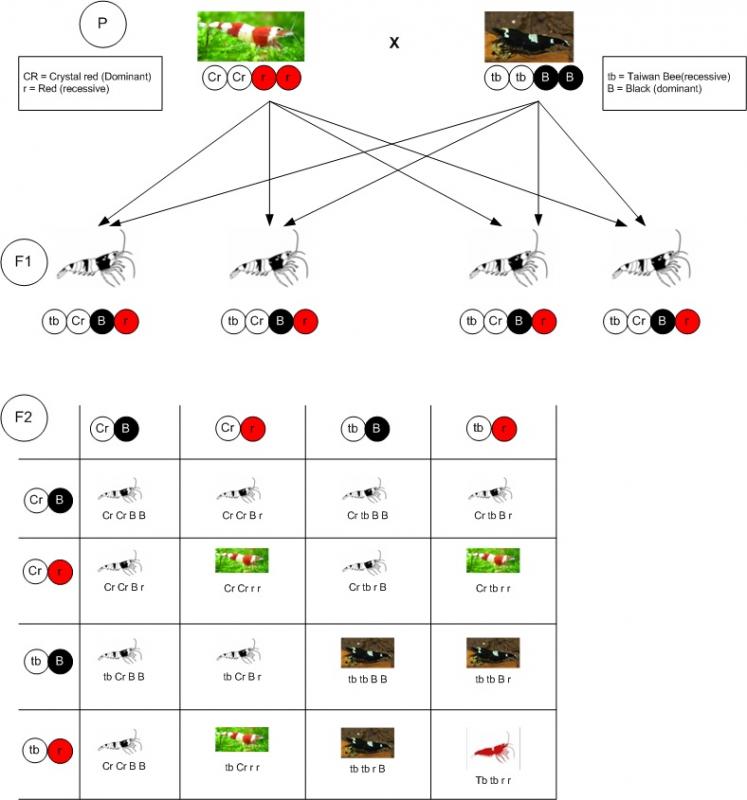
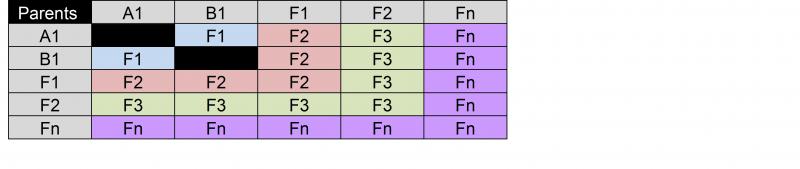
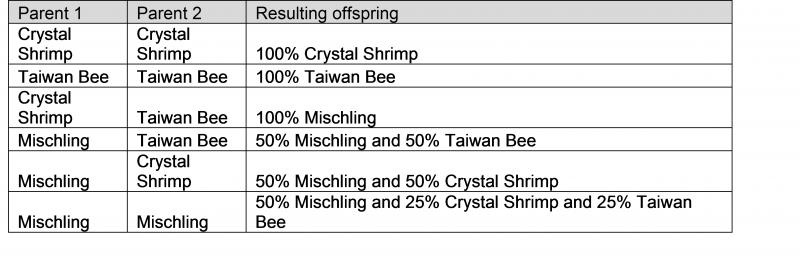
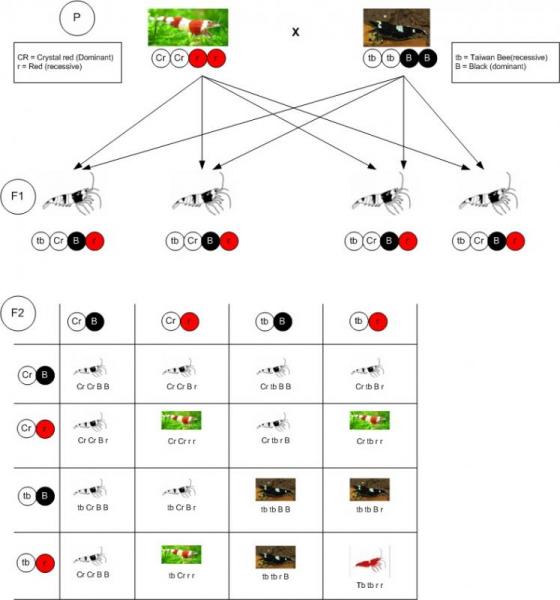
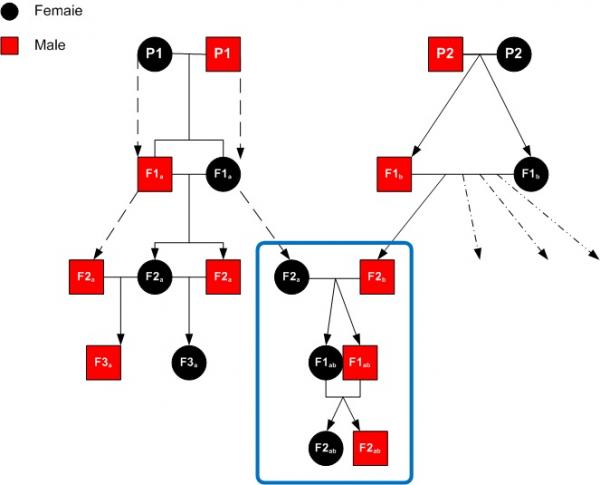
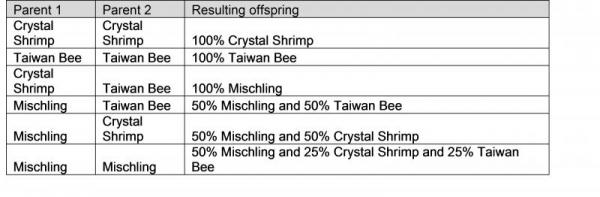
Genetic Linkage from Mendel's Laws To begin defining the F1, F2, F3, etc terminology, we need to cover some basics in genetics and inheritance. Using Gregor Mendel's Law of inheritance, let's observe how genetic traits are handed down from parents to offspring. We will concentrate on the simplified traits of shrimp variants and colour traits (or phenotype) only, which will be easier for everyone to understand. A simplified view of what you would get crossing a Taiwan Bee and Crystal Shrimp. Over simplified Mendel's Law applied to Bee shrimps (click to expand). Of course it is never that simple and it doesn't mean you are guaranteed a % of either offspring. A more detailed result of Mendelian inheritance including the Law of Dominance applied to a Taiwan Bee and Crystal Shrimp is as per this picture I drew up below. (Click to expand) Notice in the F1 generation, the Black trait is dominant, all the resulting offspring look black, but they still carry the recessive red gene. Let's see what happens in the F2 generation. When the F1 generation mate with each other, we see the results in the F2 table above. Notice we get many more Black Crystal shrimp, than Red Crystals. We also have a smaller possibility of getting Black Taiwan Bees. And an even smaller chance of getting a Red Taiwan Bee. So in this example, we have 1 in 16 chance per egg of getting a Red Taiwan Bee. 3 in 16 chance per egg of getting a Black Taiwan Bee. 3 in 16 chance per egg of getting a Crystal Red. 9 in 16 chance per egg of getting a Crystal Black. The F3 generation will dilute the possibilities again of getting a recessive trait. Let's assume you are aiming for that Red Taiwan Bee in the example above. The chances are 1 in 16 or a 6.25% that the right allele (or colour trait) is passed on. Notice I said "per egg". If the shrimp is carrying 16 eggs, it doesn't mean you will get at least 1 Red TB !! This is where the practice of culling is used to keep the variation in dominant and recessive traits to a minimum to achieve a certain result. There are no guarantees with nature. Even when you think you have the Blue genes breeding true in your colony of shrimps, a Red gene could pop up by chance even after 4 generations of Blues. The Blue gene might be dominant, but when two shrimps with the red recessive gene get together by chance ... nature has spun you a curve ball. What is Filial F1, F2, F3, etc ? F1 stands for Filial 1 (or first filial). Filial is a word used to describe sons and daughters, and it means the first generation from a genetic cross between parents. For example, it can be used to describe fish that are first generation from wild parents (ie. the fry have come from wild caught fish), so it's seen as an indication of genetic quality. Definition: the offspring of a genetically specified mating: first filial generation (symbol F1), the offspring of parents of contrasting genotypes; second filial generation (F2), the offspring of two F1 individuals; third filial generation (F3), fourth filial generation (F4), etc., the offspring in succeeding generations of continued inbreeding of F1 descendents. So an F2 would be the 2nd generation from the original parents you are counting from. This could be from the F1 mating with the Original parents or between two F1 siblings. As long as it involves the F1 generation. An F3 would be the 3rd generation. This could be from the F2 mating with the Original parents or between two F2 siblings. As long as it involves the F2 generation. And so forth for F4, F5, etc (Click to expand) A1 Original Male B1 Original Female Fn Offspring Filial number The moment you introduce an individual from a different Parent (and thus genealogy), you can't continue counting the Filial number. So while an F4 Tibee with Parents (A) X another F4 Tibee of a different Parents (B) still produces a Tibee, it is no longer an F4 Tibee. The offspring of two different F4 individuals has different genetics (A & B) now and has to be an F1 again. IF you get two related brother and sister F4 Tibees who share the same P (initial parents), then yes ... it's offspring will be an F5 Tibee. (Click to expand) From a practical point of view, another thing Filial numbers are used for is to determine how stable the genes are in a certain specimen. For example, if you are looking for CRS, then an F8 CRS is going to be more desirable than an F1 CRS. The F8 CRS has more stable genes, than an F1 CRS which might have been an offspring from a mischling or taiwan bee shrimp. And would be closer to being a candidate for a Pure Red Line programme. Thus the F1 CRS is not as "pure" bred as an F8. But on the other hand, it could also be an indication of how far it is from the desirable genetics. Like in the case of fish, an F1 Apistogramma or Discus might be more desirable than an F9 fish. Since the F1 offspring are direct descendants of wild caught fish. And if the breeding stock is small, and offsprings keep breeding with each other, then the F5 generation will have a very small gene pool diversity from it's original parents. <-- not good. Since it will be an increased risk of genetic defects/disorders.

 1 point