

Leaderboard
-

Forevermango
Members1Points79Posts -

NatefromSa
Members1Points24Posts -


RealSlimSquiddy
Members1Points6Posts -

BlueBolts
Members1Points5650Posts
Popular Content
Showing content with the highest reputation on 08/31/17 in all areas
-
1 pointHello all, I'm Nate all the way from Cape Town SA! I really could not wait to post hear after all I have read and experienced since starting with shrimp a couple of years ago. First had some cherries 50, CBS - 40 & CRS - 50 until my niece opened up my co2 and gassed all my shrimp. Was that a nightmare [emoji22] I knew I was playing with danger having co2 and shrimp but it was working for a while. So about two years after that which was the beginning of August 2017 I finally started a 60lt dedicated for CRS. So here we go with some specs, Size - 60lt Substrate - ADA Filtration - sponge filters Readings; PH 6.6, kh 1, GH 4 Temperature - 23 degrees Plants Susswasertang Fissidens Bucephelandra melawi Frogbit Natural additions Catappa leaves, bark Alder cones Some pictures of setup, Please let me know if I need to change anything! Thanks Nate Sent from my VKY-L29 using Tapatalk1 point
-
With so many dedicated new members, and the mountain of information, I thought I'd summarised my 6 most critical water parameters I frequently test, to ensure my shrimps have the best possible water quality. GH (General Hardness) GH is the measure of Magnesium (Mg+) and Calcium (Ca+) ions in water. Water described as “soft†or “hard†is in reference to GH. GH is measured in dH, and 1 dH is approx.. 17.5mg/L (ppm) 0-4 dH (Very Soft) 4-8 dH (Soft) 8-12dH (Medium hard) 12-18 dH (Fairly Hard) 18-30 dH (Hard) KH (Carbonate Hardness) KH is the measure of carbonates and bicarbonates in water. KH measure the alkalinity (buffering capacity resulting in the resistance of a PH fluctuation). KH is measured in dH, and 1 dH is approx.. 17.5mg/L (ppm). The higher the KH the more stability and resistance PH will fluctuate. pH (Per Hydrogen) pH is the measure of the balance of Hydrogen (H+) and Hydroxide (OH) ions in water. The pH scale goes from 0-14. pH reading of 7.0 is neutral, 0-6.9 is Acidic, and 7.1-14 is alkaline. pH is also a function of KH and CO2 concentration. Nitrates Nitrates are critical to our beloved shrimps, and often utilized to indicate the level of water quality once a tank is cycled. Nitrates between 0-20ppm should be our goal. Nitrate should be tested/checked frequently, as high nitrates can/will lead to shrimp deaths even weeks after the event. TDS/Ec TDS (Total Dissolved Solids)/ Ec (Electrical Conductivity) is essential to ensure overall purity of water. A TDS reading measures contaminants , but also minerals such as calcium, magnesium, and other trace elements and metals. The TDS reading of most natural clean spring water is approx. 100-200 ppm. RO (Reverse Osmosis) water will have approx. 0 TDS, and by adding essential salts/minerals to the required TDS/Ec,, this will ensure our shrimps have the purist of water with the right/essential minerals. http://www.shrimpkeepersforum.com/forum/showthread.php/3078-Dean-s-(Ec)-vs-BlueBolts-(TDS) Temperature Water temperature is a critical factor, and depending on the type of shrimp, a higher/lower range can be tolerated, but does add stress to the shrimps. Ensuring no sudden fluctuation, and maintaining the recommended level will ensure the best survival/breeding zone for our shrimps. There are many breeders using varying WP (i.e. soft water vs hard water, low PH vs high PH...etc)...please do your research and/or ask the forum members of their experience/knowledge, depending on the shrimp species you intend keeping.1 point
-
1 point
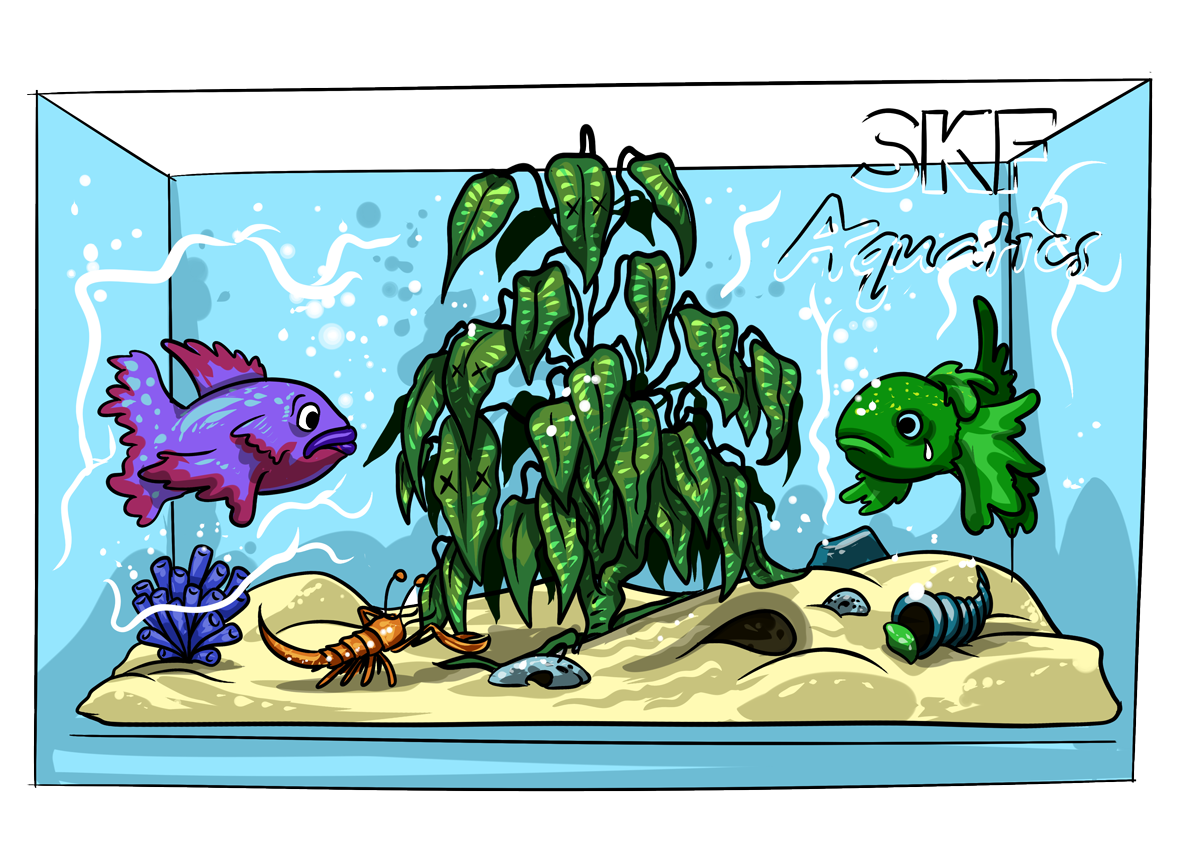 Non-aquatic plants to avoid! When you purchase aquarium plants, it's important that you understand that not all plants available for sale are truly aquatic. Vendors have no qualms offering this plants for sale, because they are very easy to obtain, and it is rare that you will see the designation "non-aquatic." While these plants can often survive as long as a year submerged, more often than not, they begin to decompose in as little as a couple of weeks or months, causing an ammonia spike, which can lead to algae, or worse, prove toxic to fish. These plants are not meant to be grown in an aquarium long-term and it is best that you avoid purchasing them for your benefit and the benefit of the non-aquatic plant. They are terrestrial plants and are meant for either indoor or outdoor gardening. They are at their best when they planted and cared for the right way. Japanese Rush (Acorus gramineus) Often sold in pots with rockwool, this plant will survive in the aquarium upto a year, but prefer cooler temperatures. In warm tropical tanks, this plant will turn to mush very quick. Aquatic alternatives such as Lilaeopsis species, Echinodorus tenellus, Sagittaria subulata, Vallisneria species can be used. Caladium (Caladium bicolor) This plant will only survive in the aquarium for upto 6 weeks (best kept with its leaves out of the water). These are usually sold in pots with rock wool. Aquatic alternatives such as Tiger lotuses and Barclaya longifolia can be used. English Parlor Palm (Chamaedorea elegans) This plant can survive long periods in the aquarium, these are usually sold as seedlings about 20cm tall either in pots or in bunches. In terrestrial environments, these can grow upto 2m tall. Aquatic alternative such as Hygrophilia difformis can be used. Aluminum Plant (Pilea cadierei) This plant may last in the aquarium for a few weeks, but will eventually melt away. Aquatic alternatives is the Blue Stricta. Spider Plant (Chlorophytum comosum) Another plant found in the trade as a potted plant. While it may grow very well in terrestrial form, once submerged it will root very quickly. Alternatively you can use larger Sagittaria species. Lucky Bamboo (Dracaena sanderiana) The lucky bamboo is very common these days among aquarists. If the leaves are kept out of the water, it can survive for a very long time. Once completely submerged, the lifespan is roughly 8 weeks. It is usually sold as rooted stalkes. Fittonia verschaffeltii This compact little plant is usually sold in pots, but unfortunately it will only last a couple of weeks in the aquarium before it begins to decay. Alternatively you can used Staurogyne sp. Purple Waffle Plant (Hemigraphis colorata) One of the most commonly seen non-aquatic plant in the trade. It is often sold in cuttings secured with rubberbands or lead weights. It may survive upto a year in the aquarium but would require high lighting and high iron levels. This plant will slowly deteriorate. Alternatively you can use Lobelia cardinalis. Iresine lindenii A beautiful plant, but completely unsuitable for the aquarium. It is often sold as a potted plant in the aquarium trade. Alternatively you can use Alternantera reineckii. Selaginella moss (Selaginella martensii) Unfortunately, this plant only has a 2-week lifespan in the aquarium and is often sold in pots. However, it makes an excellent paludarium plant. Very similar to Selaginella martensii is Selaginella willdenowii (umbrella fern, peacock fern). Aquatic Alternatives - Aquatic mosses, including Frontinalis antipyretica, Taxiphyllum barbieri and other Taxiphyllum species, and Vesicularia dubyana and it's related species. Peace Lily (Spathiphyllum wallisii) There is a lot of debate regarding the Peace Lily, and it is often seen in the trade as a potted aquarium plant. In Peter Hiscock's book, it is listed as a suitable plant for the aquarium, since it is extremely hardy and can remain healthy in the home aquarium for many months or even years. It is slow growing and can grow with minimal effort and in lower light levels. It is not, however, a true aquatic plant. Arrowhead Plant (Syngonium podophyllum) Though suitable for paludariums, the "arrowhead plant" quickly dies if left submerged. It can, however, be kept in situations where its roots are submerged. It is often sold as a potted aquarium plant. Aquatic alternatives - Hygrophila corymbosa, Echinodorus "Ozelot green", Anubia species Mondo grass (Ophiopogon japonica) Mondo Grass is not a true aquatic plant. It will survive for awhile underwater but will not prosper. Best if taken out after a couple of months. Alternatively you can use Hairgrass or Blyxa japonica If you know any other plants I have missed, please post them below :)1 point