
Leaderboard
-
revolutionhope
Members3Points1179Posts -
Paul Minett
Members2Points160Posts -

jayc
Moderators1Points6248Posts -

inkevnito
Members1Points72Posts
Popular Content
Showing content with the highest reputation on 08/12/17 in all areas
-
2 pointsHad these guys a bit over 2 weeks now and the growth has been amazing they have gone from under 2cm to over 5 which seems amazing until you think about their adult size of 45cm which they can reach in 6 months I'm getting a little worried how do you house 7 of these little monsters lol.2 points
-
2 pointsI know it's going to be a shame to blemish them with the dividers but it's the most efficient way I've decided that I'll be able to do selective breeding without stressing the shrimps having to move them from tank to tank! I also want to dedicate one or two other seperate tanks for oddbods plus those shrimp that I just can't quite bring myself to cull as well as a few of my nicer shrimps popped in there as an insurance policy. The dividers will have no windows with mesh - I will just have 2mm acrylic dividers but with a gap at the bottom of 3cm and a 5cm layer of fairly chunky dark gravel either side of that spanning out 10cm and then a shallower later of either buffering substrate or plain old pool filter sand depending on the tank. I hope that should provide enough circulation. There will be a total of about 400-600 lph of airflow going into the sponges to circulate each tank. I've attached the rough plan for the LEDs here now. The electronics side of it will probably be finished soon. Things are really moving pretty quickly can't wait till the rest of the tanks are ready. Shrimps I will keep (What I already have) - Blue dream Blue body red rili (work in progress) Yellow cherry Bloody Mary Crs Green babaulti Blue dream Tangerine tiger Shrimps I would like to add - Shadow panda Caridina zebra Sulawesi cardinal Mid-dark blue oebt Inverts I have but have not made allowance for (mainly because I don't want to put massive tanks in this room where I'm not sure the floor might cave in and as a result will need to beg the minister of finance to allow me to have 2 tanks in the lounge again) - Macrobrachium Australianese Yabbies (cherax destructor) At this point without naming anyone because the list would be too long I'd like to thank all of the wonderful people in the shrimp keeping community who have helped me to get to the point I'm at now i have learnt a lot in the last 2 and a half years or so since I first signed up on skf. You all know who you are - thank you !!![emoji173] [emoji173] [emoji173] [emoji173][emoji111][emoji445] will2 points
-
1 pointSo bunnings has a special on their DETA led downlights. 5x 12w for $69 so have gone with that option. They are daylight spectrum and rated to 900 lumens - I could only find independently tested specs on them for an earlier model on ledbenchmark.com but those came up pretty decent and I've already been using this brand for close to a year and I'm quite happy with how they perform. My buddy has rigged and tested the deta brand universal dimmer that bunnings also sells - we will put each of the four benches on a separate channel so I can easily turn a single bench on or off manually if/when I need. They will all run on a timer and fade on from 20% - 100% power over a few minutes period. The lights come with clips and we will suspend them inside of pvc tube a little above the tanks to keep them enough out of the way to give good spread over the tank and also avoid wasting too much light. When the LED system is setup I'll ask my mate about the technical side of it and include those details here for those interested. [emoji173][emoji111][emoji445] will1 point
-
1 point
-
 1 point
 -
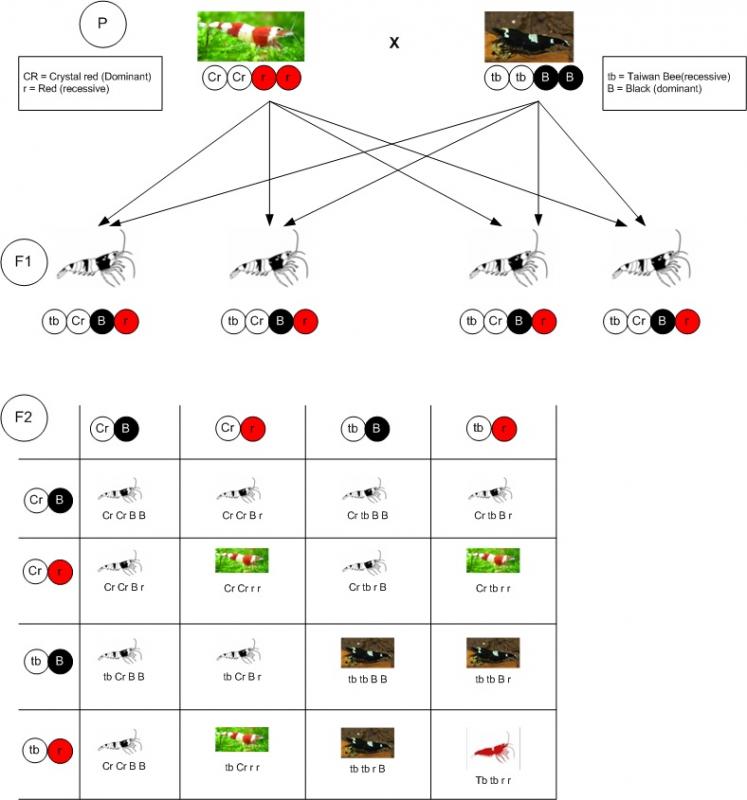
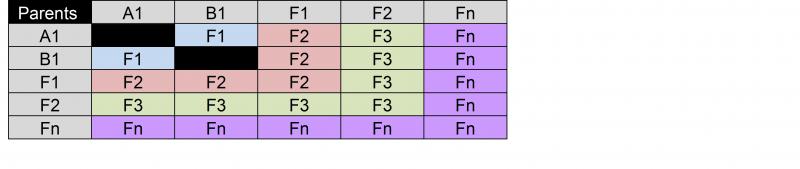
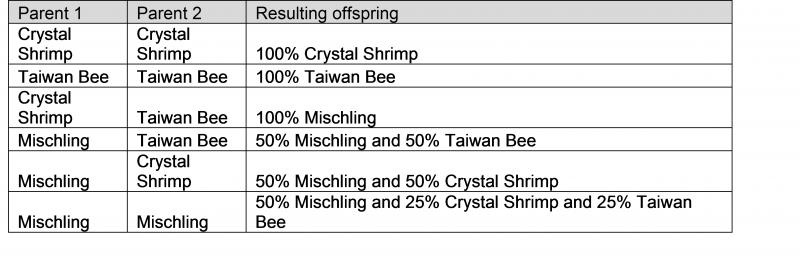
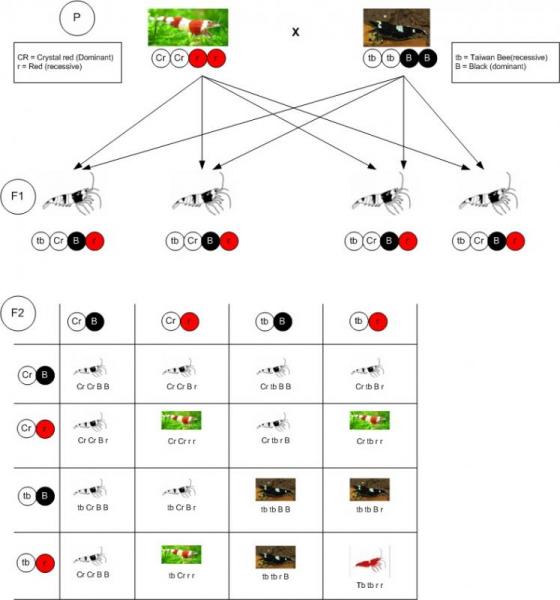
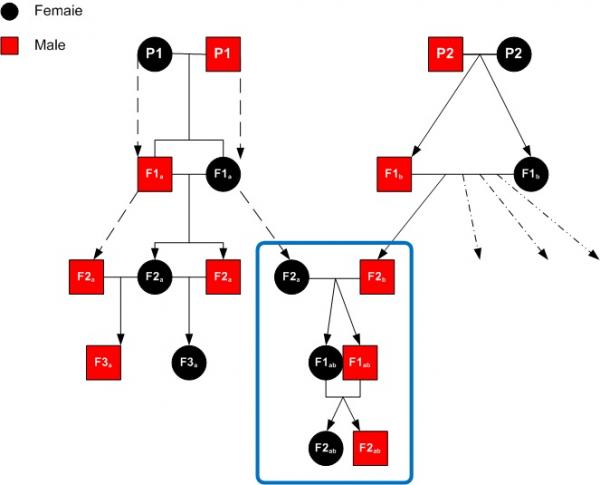
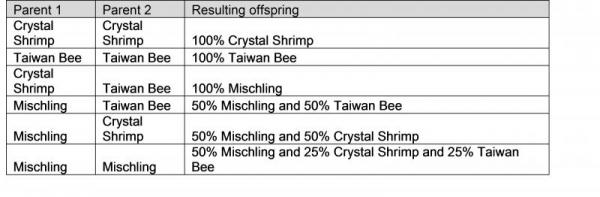
Genetic Linkage from Mendel's Laws To begin defining the F1, F2, F3, etc terminology, we need to cover some basics in genetics and inheritance. Using Gregor Mendel's Law of inheritance, let's observe how genetic traits are handed down from parents to offspring. We will concentrate on the simplified traits of shrimp variants and colour traits (or phenotype) only, which will be easier for everyone to understand. A simplified view of what you would get crossing a Taiwan Bee and Crystal Shrimp. Over simplified Mendel's Law applied to Bee shrimps (click to expand). Of course it is never that simple and it doesn't mean you are guaranteed a % of either offspring. A more detailed result of Mendelian inheritance including the Law of Dominance applied to a Taiwan Bee and Crystal Shrimp is as per this picture I drew up below. (Click to expand) Notice in the F1 generation, the Black trait is dominant, all the resulting offspring look black, but they still carry the recessive red gene. Let's see what happens in the F2 generation. When the F1 generation mate with each other, we see the results in the F2 table above. Notice we get many more Black Crystal shrimp, than Red Crystals. We also have a smaller possibility of getting Black Taiwan Bees. And an even smaller chance of getting a Red Taiwan Bee. So in this example, we have 1 in 16 chance per egg of getting a Red Taiwan Bee. 3 in 16 chance per egg of getting a Black Taiwan Bee. 3 in 16 chance per egg of getting a Crystal Red. 9 in 16 chance per egg of getting a Crystal Black. The F3 generation will dilute the possibilities again of getting a recessive trait. Let's assume you are aiming for that Red Taiwan Bee in the example above. The chances are 1 in 16 or a 6.25% that the right allele (or colour trait) is passed on. Notice I said "per egg". If the shrimp is carrying 16 eggs, it doesn't mean you will get at least 1 Red TB !! This is where the practice of culling is used to keep the variation in dominant and recessive traits to a minimum to achieve a certain result. There are no guarantees with nature. Even when you think you have the Blue genes breeding true in your colony of shrimps, a Red gene could pop up by chance even after 4 generations of Blues. The Blue gene might be dominant, but when two shrimps with the red recessive gene get together by chance ... nature has spun you a curve ball. What is Filial F1, F2, F3, etc ? F1 stands for Filial 1 (or first filial). Filial is a word used to describe sons and daughters, and it means the first generation from a genetic cross between parents. For example, it can be used to describe fish that are first generation from wild parents (ie. the fry have come from wild caught fish), so it's seen as an indication of genetic quality. Definition: the offspring of a genetically specified mating: first filial generation (symbol F1), the offspring of parents of contrasting genotypes; second filial generation (F2), the offspring of two F1 individuals; third filial generation (F3), fourth filial generation (F4), etc., the offspring in succeeding generations of continued inbreeding of F1 descendents. So an F2 would be the 2nd generation from the original parents you are counting from. This could be from the F1 mating with the Original parents or between two F1 siblings. As long as it involves the F1 generation. An F3 would be the 3rd generation. This could be from the F2 mating with the Original parents or between two F2 siblings. As long as it involves the F2 generation. And so forth for F4, F5, etc (Click to expand) A1 Original Male B1 Original Female Fn Offspring Filial number The moment you introduce an individual from a different Parent (and thus genealogy), you can't continue counting the Filial number. So while an F4 Tibee with Parents (A) X another F4 Tibee of a different Parents (B) still produces a Tibee, it is no longer an F4 Tibee. The offspring of two different F4 individuals has different genetics (A & B) now and has to be an F1 again. IF you get two related brother and sister F4 Tibees who share the same P (initial parents), then yes ... it's offspring will be an F5 Tibee. (Click to expand) From a practical point of view, another thing Filial numbers are used for is to determine how stable the genes are in a certain specimen. For example, if you are looking for CRS, then an F8 CRS is going to be more desirable than an F1 CRS. The F8 CRS has more stable genes, than an F1 CRS which might have been an offspring from a mischling or taiwan bee shrimp. And would be closer to being a candidate for a Pure Red Line programme. Thus the F1 CRS is not as "pure" bred as an F8. But on the other hand, it could also be an indication of how far it is from the desirable genetics. Like in the case of fish, an F1 Apistogramma or Discus might be more desirable than an F9 fish. Since the F1 offspring are direct descendants of wild caught fish. And if the breeding stock is small, and offsprings keep breeding with each other, then the F5 generation will have a very small gene pool diversity from it's original parents. <-- not good. Since it will be an increased risk of genetic defects/disorders.

 1 point
 -
 0 pointsI can now confirm that there is a CAL BEP bad batch issue. ?0 points