

Leaderboard
-

gtippitt
Members3Points24Posts -
fishmosy
Members2Points4594Posts -

anthonyd
Members1Points127Posts
Popular Content
Showing content with the highest reputation on 03/22/17 in all areas
-
3 pointsI bought a great new filter for a 55 gallon tank where I want to start a colony of Red Cherry Shrimp (Neocaridina davidi var. red). It is the best filter I have ever used or seen in over 50 years of keeping aquariums, while still being affordable for a hobbyist like me who needs to keep to a budget. It is the first filter I have ever used, with which I didn’t see things I wanted to change or wish had been designed a bit different. I have been running this filter for over 2 months, and I have not found a single thing I would change about its design. It is a wet-dry filter that sits atop a tank behind a light bar, so that it does not have the worries of leaks, siphons, or overflows that plague sump versions of wet-dry filters below a tank. Wet-Dry filters have long had the advantage that their increased aeration provides for growth of beneficial microbes, but they have mainly been used for very large tanks and ponds. The small versions of this filter will work great for small tanks where a sump is impractical. I bought mine from eBay seller TopStore1016 at the link below, and similar designs are available from sellers elsewhere. http://www.ebay.com/itm/Aquarium-External-Filter-Trickle-Rain-Drop-Upper-Fish-Tank-Water-Aqua-Filter-US-/122350271841?var=&hash=item1c7ca4fd61:m:mCXWToKfl6dM8Qiz9-u2BFg These filters are sometimes called "Rain Drip/Drop", "Upper Trickle Box", or "Above Tank Wet-Dry" filters. They are a Bakki Shower for a koi pond, but in miniature for a tank. Of the ones I saw available, I liked this one best. The base that supports the filter and captures the water to be returned to the tank is a very sturdy, yet lightweight, composite. I like that the base and the media containers are black rather than the clear ones I saw elsewhere. While the idea of showing off the filter media might seem cool at first, it will seem less cool once it gets properly colonized with beneficial bacteria and looks brown and gunky. Brown gunky microbes are not what most of us want as the visual centerpiece of a tank. The black acrylic for the boxes which comprise the filter chambers, will have much less problems with algae than clear ones that would allow light to pass through. In the pictures I've seen with the clear versions sitting on a tank, being able to see the media, even when new and clean, causes your attention to be drawn to the filter more than the tank. I don't find the black version of the filter detracts from my tank. In my picture below, the filter is particularly obvious since it is in stark contrast to the white window blinds behind it. When people see the tank, they ask me what the filter is, but they've said that they don't think it detracts from the tank's appearance. One person described it as "mysterious looking but not ugly." The only part of the media you will need to monitor really is that in the top row where I am using a poly fiber matting as a mechanical filter. It’s easy to remove the top lid, inspect the top media layer, and replace or clean it when needed. If you are using a good mechanical filtration media at the top, the lower levels should not require much maintenance at all. I am using a large sponge pre-filter on the pump to prevent small shrimp from getting sucked in, so it is the only media that I expect will need regular cleaning. I love animals and hate that so many people's fish die quickly because they have been sold bad filters at "Big Box Pet Store" chains. I had never posted a YouTube video before, but after using this filter, I was so impressed with it, I posted a video at the link below to show some of why I liked it. https://www.youtube.com/watch?v=H5zhDgD9Whk&t=48s I later found another video from a guy in the UK who is reviewing the same model. He regularly posts videos regarding aquariums and ponds, and his video is much better than mine. While I think the black version of the filter is best for usage, the clear one in his video does allow you to see inside the design much more easily to understand its great features. They got so many little details perfect about this filter, it is difficult to describe them all. One small but important detail is an example of the foresight of its design. Each of the media compartments has an overflow slot where excess water can flow to the next lower level if the media or the drainage holes in the bottom of the box were to become partially blocked and restrict the downward flow of the water. And again, if anything were to drip or leak, the filter sits above your tank, so the water simply returns to your tank rather than your floor. https://www.youtube.com/watch?v=sWKJz9ft2gs&t=432s The Bakki shower design for a bio filter was first developed by the Momotaro Koi farm of Japan, which has long been the world's top breeder of prize winning koi. The design was developed to cope with low O2 levels in ponds during summer. As water temperature is increased, bacteria can often consume more O2 in a system than the fish. This is the reason that wet-dry filters can remove ammonia and nitrite so effectively. When the bio media is completely submerged in water from the tank, the bacterial metabolism of wastes is limited by the amount of O2 that can dissolve in water. With a wet-dry filter, the water flows through the media, but it is also exposed to air, which provides the bacteria with unlimited O2. Throughout nature, the boundary areas between water, air, and land are where life is most abundant. Freshwater sport fishermen in boats spend most of their time near the shore for fish, rather than in the middle of a reservoir. This boundary is where live from its microscopic size to trophy size fish are found most abundantly. The design of Bakki showers takes the wet-dry advantage regarding O2 to its extreme. The layers of media are separated in containers above one another, allowing water drops to rain down from one container to another. As water flows though the media in most other filter designs, it contains progressively less O2, but with a Bakki Shower filter, the opposite happens, as water is aerated more as it passes through the chambers. Where other bio filters can deplete the available O2 dissolved in the water by the time it returns, the shower design results in the water leaving the filter being higher in O2 than when it enters! There is much information available about Bakki showers, so I won’t try to duplicate it here any further. Wikipedia has a fairly concise description, which if a good place to start if you want to read more about the design. The home I purchased 6 months ago has an old concrete in ground swimming pool, which needs significant repairs before it would be suitable for swimming. I am instead planning to use it as a 30,000 gallon koi pond. While I was planning my tank for Red Cherry Shrimp, I was also reading about pond filtration, so I was very excited to find this tank filter based upon the design of these pond filters, which are considered one of the best pond filtration systems available. There are two things about the filter that I should mention, as some may see these as drawbacks. It does not include a pump nor any filtration media. Some may see this as a drawback, but I saw it as an advantage. Depending upon the tank with which one plans to use the filter, the type and flow rate of the pump one wants can vary considerably. If the manufacturer included a pump, this would add to the cost and could never have a pump that was best for every tank. I liked that instead the price was lower, and I could pick the pump I wanted. This does add a little complexity to the initial setup. The filter provides all of the connections needed from the tank to the filter, but the buyer must find whatever is needed to adapt the filter's connector to the pump to be used. I simply took the connector from the filter and my pump to my local hardware store, and they quickly found the adapters and hose I needed. Similarly, many filters come with media that is not what I want to use. In the worst cases, filter makers design their systems so that it is difficult to use media other than the pads they sell for the filter. This filter lets you use whatever filter medias that you want, and does not increase the cost by proving media that isn’t what you want to use. I used a combination of ceramic rings and poly fiber matting. This provided the balance of cost, weight, and effectiveness that I wanted. I filled each of the media boxes with a sandwich of poly fiber matting with ceramic rings between. My 15 box version now holds 10 pounds of ceramic rings (about 2 gallons) and 600 cubic inches of poly fiber matting. The matting I am using is fluffy on one side and more dense on the other. I have it placed where the fluffy side is up so that water quickly soaks in, and the lower more dense side ensures that water is spread out evenly as it falls and does not channel straight through leaving dry areas. I have also found that the filter is almost silent since I added the layers of poly matting above and below the ceramic rings. The wet matting does an excellent job of absorbing the sound of the water dripping through the filter chambers. If you let the water run directly from the filter's output and splash down onto the water surface in the tank, it will make a significant amount of noise. A clear pipe is supplied with the filter that can be attached to the outlet to prevents this splashing and its sound. When trimmed to reach just into the tank's water, it is barely visible and still muffles the sound. This filter makes less noise than a small HOB filter I have on a nearby 10 gallon quarantine tank. After I made the video that I posted, I tinkered a bit with the water’s return from the filter before I got my shrimp. I’m using a 400+ gallon per hour pump because I wanted to make sure water quality was always good as my colony hopefully increases in size, but I didn’t want too much current to make life too difficult for baby shrimp in fast water. I eventually replaced the exit pipe provided with the filter and used one that is closed on the end and has lots of horizontal cuts to allow water to disperse with less agitation. I’m getting good agitation at the surface for gas exchange, while only one corner of the tank has lots of water agitation. With minimal DIY skills, this can be easily adapted this for your tank’s requirements if needed. My shrimp now spend most of their time in the 3/4 of the tank that is calm, but some also seem to enjoy going to play in the currents for a time each day. Besides its great design, the best thing about this filter, is that it is available for tank sizes from 10 gallons and up. The seller was out of stock of the 18 box version to fit my 48 inch long 55 gallon tank, so I ordered the 15 box version. It provides more than enough capacity for my plans for the tank, but its support arms at each end would not reach the ends of the tank. To cover my tanks, I like the “egg crate” material used as a diffuser in commercial lighting applications. It keeps things from falling into a tank, prevents fish from jumping out, while allowing light and air to pass freely. It is easy cut to size or remove wholes using side-cutting wire pliers. I now have sheet of this on top of the tank, and it easily supports and distributes the weight of the filter and wet media. If you have a large tank that already has other filters, but you would like some additional bio filtration capacity, the smaller sizes of this filter could easily be added above one end of a tank. My other fish tank where I keep an assortment of tetras and barbs, uses a canister filter I made from a 5 gallon bucket filled with ceramic rings. It provides good filtration for the most part, but I don’t like that the water returned from the filter has very low O2 levels. With summer approaching here in the US, I am a bit concerned that lower O2 levels at higher temps will be problem. Even with air stones and plants to maintain acceptable O2 levels for the fish, the effectiveness of the cannister will decline, and higher temps will need more bio filtration capacity. I am planing to order the small 6 box version of this shower filter that is the size for a 10 gallon tank to solve this problem. The pump in my canister filter is strong enough to lift the return water the short distance to the top of the new filter, so I can simply attach the canister’s return to the input of the new filter. The low O2 water will get aerated before it is returns to the tank, as well as giving me additional bio filtration capacity as temperatures rise. The small 6 box size of this filter would also work wonderfully for a 10 gallon tank. People often buy 10 gallon tanks because they are cheap and don’t require much room, but they are easily overstocked. Getting enough bio filtration capacity for them can then be difficult because HOB filters can create excessive water agitation for shrimp or fish that prefer calm water, and there is limited room inside the tank for sponge filters. An external canister filter requires additional space, which is often not available since a small tank was chosen because of space limitation. This filter can sit atop a tank behind an LED light bar, without requiring any additional space footprint. Without taking up much space inside a small tank or creating excessive agitation, a small and inexpensive low-flow power head with pre-filter can provide plenty of water flow through the filter, since the aeration within a wet-dry filter greatly improves the ability of microbes to remove wastes. I do not have any financial stake in the sales of these filters, I simply love mine and wanted to share my thoughts on how it can improve water conditions in your tank. I gave the eBay seller some advice on how to better describe the filter for buyers, and it’s listing at the link at the top provides lots of pictures to show how the filter works. In the picture below, the water looks bad because I let algae grow uncleaned on the back for Red Cherry Shrimp to feed upon. The water is actually very clear, and little algae needs to be cleaned from the front, since that on the back sucks up nitrates in the water. I'm also a bad photographer using a cheap phone, but it shows the shape of the filter, which is what I was trying to accomplish. If you have any questions about it that I might answer, let me know. Greg
 3 points
 -
1 point
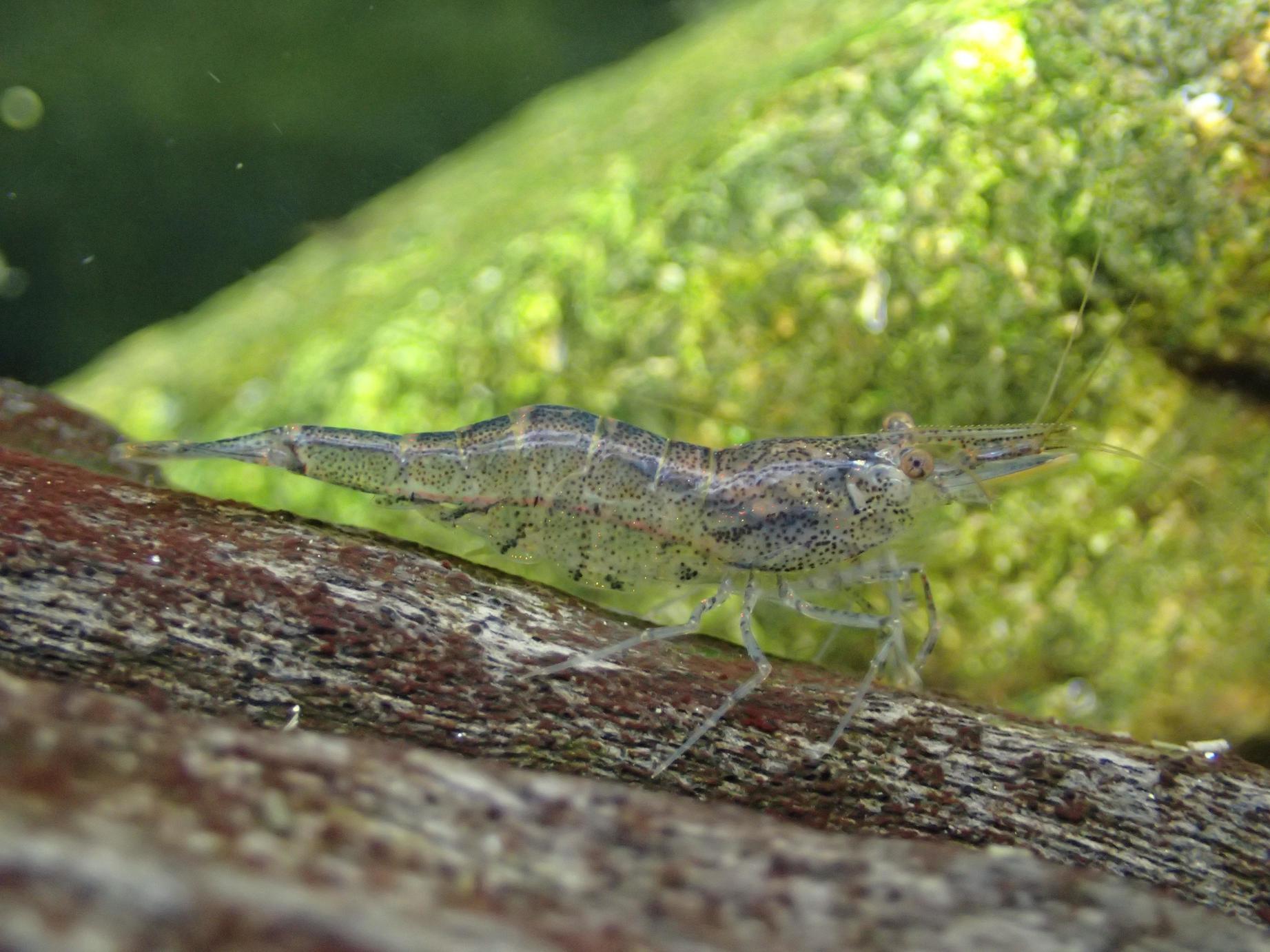 Glass Shrimp: Paratya from Australia By: Dr. Benjamin Mos Paratya are probably one of the most under-rated shrimp in Australia.The common names 'glass shrimp', 'ghost shrimp' and 'clear shrimp' don't do this group of shrimp justice. Nor does their widespread use as live food. This species complex (a group of closely related species that are currently described as a single species) is very suited to life in aquaria, tough, are good algae eaters, wide spread and easily collected, and yet breeding them will provide a challenge for the most hardcore of shrimp keepers. Why are Paratya so awesome? In a word, potential. Paratya have a huge amount of potential for breeding new variations, as algae eaters in aquascapes, as tough shrimp for beginners, as a brackish water specialist for biotopes, and much more. Paratya come in a variety of colours (blue, green, clear, black, orange and even full red individuals) and patterns (dorsal stripes, 'tiger-stripe' patterns, speckles and blotches). There is very little known about whether their colouration can be controlled by diet, stress or other environmental factors, or whether line breeding could result in fixed colour variants, so there is great potential for breeders to work on fixing colours/patterns. Current status of the taxonomy of Australian Paratya The genus Paratya in Australia has an interesting taxonomic history. Paratya australiensis was first described by Kemp in 1917. In 1953, Riek proposed several new species and sub-species of Paratya. However in 1979, Williams and Smith reviewed the genus and declared all the Paratya from the east coast of Australia were a single species, P. australiensis. Recent phylogenetic analysis (comparisons of the DNA from individuals from different locations) suggests P. australiensis is probably a group of closely related species - a species complex (Baker et al., 2004; Cook et al., 2006; 2007; Hughes et al., 2003; Hurwood et al., 2003). Currently, Australian taxonomists are working to unravel the Australian Paratya species complex. It appears the 'species' we call P. australiensis will likely be broken up into between 9 and 11 new species. This work may also shed light on the relationships among Australian Paratya and Paratya found elsewhere in the Indo-Pacific. The fact that Paratya from Australia are a species complex has important implications for hobbyists in terms of breeding, hybridization and collecting, and these issues will be examined in detail later in this article. Where are Paratya found? Species from the genus Paratya are not limited to Australia. They are found through-out the western Pacific, with "a disjunct northern range in the North Pacific (Japan, Korea, Ryukyu Islands, Siberia) and South Pacific (Australia, New Zealand, New Caledonia, Lord Howe, Norfolk Island)" (Page et al. 2005). The Paratya species from New Caledonia (see Choy & Marquet, 2002) are very attractively coloured and appear in the hobby (see link below). Whilst this article focuses on the Paratya from Australia, the information on captive husbandry and breeding should be useful for species collected and kept elsewhere. In Australia, Paratya are found all along the east coast of Australia, from the Atherton Tablelands near Cairns in the north to the east coast of Tasmania. They are also found further inland, through the Murray-Darling system. Approximate distribution of Paratya species in Australia In these areas, Paratya are found in creeks, rivers and estuaries, but also frequently in static water, such as dams. Juveniles and adults from south-eastern Australia are very tolerant of brackish water up to a salinity of around nearly full seawater (33ppt, Walsh and Mitchell, 1995). However, juveniles and adults also live quite happily (and breed) in freshwater 10's or 100's of kilometres from the nearest ocean (e.g. Hancock, 1998). This leaves almost infinite scope for using Paratya in biotope aquariums, from brackish tanks with sand, nerites and plants all the way through to freshwater tanks with leaf litter and rocks, but no plants. Some freshwater habitat pictures from the Mid North Coast of New South Wales Paratya do not appear in the western half of Australia, and 'glass shrimp' caught on the west coast near Perth are likely to be a entirely different shrimp, Palaemonetes australis, although there have been reports of an introduction of Caridina indistincta from eastern Australia into several rivers near Perth (see link below). This is a good reminder why it is important never to release any aquarium organism, including shrimp, into the wild. http://www.fish.wa.gov.au/Documents/biosecurity/freshwater_pest_fact_sheet_indistinct_river_shrimp.pdf Also see paper by Harris et al. 2017 http://projectpenguin.com/timcv/Harrisetal2017BiolInv.pdf How do I know if I have Paratya? I've realised whilst researching for this article that identification of Australian 'glass shrimp' is no where near as straight forward as what I had initially thought. Paratya can be easily confused with other native shrimp kept in aquaria, and it doesn't help that they have been mistakenly called 'cherry shrimp' in the past. Two types of shrimp that are really easy to confuse with Paratya are juvenile Macrobrachium spp. and Caridina, particularly species from a group of shrimp currently known as Caridina indistincta. Caridina and Macrobrachium species are found alongside Paratya in the same habitats. In NSW Australia, you will often catch all three types at once! How to tell Paratya apart from Macrobrachium? Many of the pictures on the internet which are labelled Paratya are actually Macrobrachium spp., including adults which are at least three times larger than any reported size for Paratya. The mistake is easy to spot if you know what to look for. To rule out if your shrimp is a juvenile macro, here is what to look for. If it has 'arms', its a Macro! Paratya have 10 legs roughly the same length Macrobrachium spp. have 8 legs roughly the same length and 2 legs much longer (in technical terms, the second pair of pereiopods are very enlarged). In juvenile Macrobrachium, the longer legs are clear rather than black, but are still obviously longer. How to tell Paratya apart from Caridina? NOTE: If you have collected your shrimp from Victoria or South Australia, they are almost certainly one of the Paratya species and not a Caridina. The number of species of Caridina shrimp generally decrease from northern to southern Australia, and have not been found south of around the Shoalhaven River in New South Wales. If do you find a Caridina south of this region, please contact me as I'd be very interested to see it! Once you've seen Paratya alongside many of the shrimp from the genus Caridina, they are fairly easy to tell apart given differences in their body shape and size, size of the rostrum, egg size, and sometimes coloration and patterning on the body. For example, one of the closest shrimp in looks to Paratya is Caridina longirostris, but their small Australian distribution in northern Queensland means they aren't likely to be collected by most people and they aren't widespread in the hobby. Note that there is also a species of Caridina (undescribed) from the Northern Territory that looks almost identical to Caridina longirostris - the Darwin Algae Eater (DAE) or Caridina sp. NT nilotica. This species is more widespread in the hobby because it is farmed in the NT and made available to the bobby via a well known supplier. Caridina longirostris - Note the large body size, very small green eggs, long rostrum and red striations. Together these characteristics can help differentiate this species from Paratya without the need to examine specimens under the microscope. If you want to be doubly sure about what shrimp you have, then use the method below for distinguishing Paratya apart from any Caridina. According to the taxonomic key by Choy and Horwitz (1995), there are two characteristics that distinguish 'P. australiensis' from all Australian Caridina shrimp; the presence of supra-orbital spines and the presence of exopods on all the pereiopods. Now you are thinking 'what the hell does that mean?' and 'where the hell can I find those things on the shrimp?' 1. Supraorbital basically means 'behind the eyes'. So supraorbital spines are spines that are found behind the eyes. Paratya are the only small freshwater Australian shrimp that have these spines (Choy and Horwitz, 1995; Williams and Smith, 1979), so if your shrimp have these, well done you have a solid ID. All species of Caridina, including indistincta, do not have supraorbital spines. Here is what the supraorbital spines look like. Top view 2. Like all shrimp, Paratya have five pairs of legs (10 in total), plus some maxillipeds (arms) around the mouth to assist when feeding. The legs are called pereiopods and are used for walking around and picking up food, ect. Exopods are basically little 'legs' that are attached to the pereiopods (or the main legs). Paratya have an exopod on every pereiopod (Williams and Smith, 1979). In C. indistincta and other Caridina, exopods are absent or, in rare cases, found only on the first pair of pereiopods. In the picture below, red is the exopods, blue is the pereiopods. Yellow is the third pair of maxillipeds (there are two pairs closer to the mouth that cant be seen here). You'll also notice that the front two pairs of pereiopods have chelae ('fingers' or 'pincers'). These are used during feeding to grab food. In fact, Paratya have been recorded using these to filter-feed like the Australian riffle shrimp, Australatya striolata (Gemmell, 1978). And just to further confirm that the pictures are of a Paratya sp.. Here is the rostrum (nose). There are 9-36 spines on the dorsal (top) side of the rostrum and 0-11 on the ventral (bottom) side of the rostrum for 'P. australiensis'. The one in the pic has 30 dorsal and 11 ventral (yes, I counted them!). The number of spines is so variable because the number of spines increases as they grow (Williams and Smith,1979). C. indinstincta has only up to 8 spines on the ventral side of the rostrum (Riek, 1953). And heres some pictures of the tail just because the colours look awesome.Notice there are both red and blue coloured spots. Note also that the presence/absence of spines on and around the tail can be used to differentiate between different shrimp, particularly shrimp in the genus Caridina. One thing you will have no doubt noticed is that both the supraorbital spines and the exopods are pretty small. The above pics were of a 35mm female, which is pretty much as big as 'P. australiensis' get (William and Smith, 1979), under a dissecting microscope (approx. 10 - 20 times zoom), and these features are still small. I could only just see the supraorbital spines with the naked eye in the right light at the right angle, and the exopods appeared only as a blur of movement above the legs. The point is that you will need some source of magnification to view these features. Unfortunately not many people have access to a laboratory spec dissecting microscope, but luckily you don't need to! A lot of the point and shoot cameras available today have built in macro modes. Simply take a picture of your shrimp using the macro mode and zoom in on the photo if you need to. I often use my point-and-shoot camera in the field for getting quick IDs of shrimp, instead of using a portable dissecting microscope. Here is one such photo - test yourself, is this a Paratya? (Answer at the end). How to keep Paratya in aquaria? So now you know you have Paratya. Now how should you go about keeping them? The answer is easily. Paratya are hardy aquarium inhabitants, and tolerate a wide variety of pH, TDS and GH/KH, and some even tolerate high salinity - perfect for those with brackish set-ups. I've successfully kept Paratya in a variety of tanks including planted aquascapes with soft, acidic water conditions to a tank with small African cichlids with hard, high pH water conditions. In my experience, Paratya are peaceful and can be housed alongside pretty much any shrimp. Likewise they are happy alongside fish that are too small to consume them. Like most freshwater shrimp, Paratya live to around two years of age (Hancock and Bunn, 1997; Williams, 1977; Williams and Smith, 1979). In general, the below water parameters should keep your Paratya happy and healthy. Temperature: optimal 20-26*C, but will tolerate extremes 8-30*C in the wild. Salinity: 0 - 33 ppt (nearly full seawater). Note Paratya is not found in brackish water in Queensland, but is found from 0- 33 ppt salinity in estuaries in Victoria (Kefford et al., 2004; Walsh and Mitchell, 1995). pH: optimal at around 7.0 but handles 6.0 - 8.2. TDS: not important as long as extremes are avoided GH/KH: not important as long as extremes are avoided Ammonia: 0 Nitrite: 0 Nitrate: Optimally as low as possible Feeding Paratya is relatively straight forward as well. They will eat anything that any other shrimp eats, and additionally are good algae eaters. In the wild they have been recorded feeding on biofilms** (Burns and Walker, 2000; Moulton et al., 2012), particularly those that form on leaves (Schulze and Walker, 1997) and on aquatic freshwater plants, like Myriophyllum salsugineum (Piola et al., 2008). In fact, they have been kept alive and bred in the laboratory by being fed on pieces of Elodea that were covered by algae dominated biofilms (Hancock, 1998). Interestingly, these are one of the few shrimp to eat cyanobacteria (Burns and Walker, 2000; Piola et al., 2008), more commonly known as the dreaded Blue Green Algae (BGA), but I'm unaware of any instances where these have been used successfully to treat BGA in aquariums. My opinion is that they would likely go for other easy-to-access foods prior to eating BGA, but they may be useful in preventing BGA out-breaks. **Note: An informative thread on biofilms (what they are and how they form) can be found here: How to breed Paratya? Now comes the tricky part of keeping these shrimp. In the wild, breeding occurs in the warmer spring and summer months, and stops over winter (Hancock and Bunn, 1997; Richardson and Cook, 2006; Richardson et al., 2004; Williams and Smith, 1979). Breeding seems to be triggered by warmer temperatures and females will not become berried at low temperatures or after a temperature drop. Some females will breed twice within a season (Hancock and Bunn, 1997). It is certainly possible that breeding could occur in aquaria year round. There is one important tip I can offer for shrimp keepers thinking of breeding these guys that could mean the difference between success and failure. In fact, this may apply to most, if not all, Australian native shrimp. If you can, obtain 'headwater' shrimp to breed from. What I mean by this is, try to collect your adults from areas that are well away from estuaries, as far inland as possible and better yet, above a natural block to upstream migration (like a waterfall). The reason for this is that shrimp collected from these areas will have a natural tendency to produce large eggs (Cook et al., 2007; Fawcett et al., 2010; Hancock, 1998; Hancock et al., 1998; Walsh, 1993). Why? Because larvae in these areas have to develop quickly before they are washed away downstream (e.g. over a waterfall). Why are large eggs important for breeding in aquariums? Because it means that: larvae from headwater adults are more likely to develop completely in freshwater larvae from headwater adults are likely to develop quickly before settling onto the substrate and feeding like adults. In contrast, low-land shrimp have longer larval stages and may need to be raised in brackish water to develop properly. This is especially true for larvae from adults found in brackish water. Headwater adults may even be a different species from lowland shrimp, and if so, will be adapted to living in pure freshwater and may even have direct-developing larvae (i.e. larvae that hatch out looking like mini adults instead of larvae that develop through a series of stages in the water column before settling onto the bottom as juveniles). Therefore larvae from 'headwater' adults will be far easier to raise than larvae from adults collected from low-land areas. More in depth analysis of the topic of egg size in lowland and headwater shrimp can be found in Cook et al. (2007), Fawcett et al., (2010), Hancock (1998), Hancock et al.(1998) and Walsh (1993) but this literature is probably too in depth for the average aquarist. Here are some examples of the difference that having headwater shrimp makes to breeding them: Hancock (1998) used the following method to culture headwater 'P. australiensis': Berried females were collected from freshwater creeks and kept at 11, 18 and 21*C. Females were fed Elodea. Eggs kept at 11*C took 60 days to hatch, whilst those at 18 -21*C took 20-25 days. Once the eggs hatched, the larvae were fed with algae scraped from the walls of an aquarium kept outside. Water changes were made every two days (no filter mentioned). All the larvae kept at 11*C died, whilst those at 18 and 21*C developed normally. Larvae took between 15 and 28 days to develop before settling onto the bottom. In contrast, Walsh 1993 used the following method to grow 'P. australiensis' collected from brackish estuaries: Adults were collected from 0.5 - 1.5 ppt salinity. Upon hatching, seawater was added to boost the salinity to 15ppt (within one hour). Larvae kept at salinity below 5ppt didn't survive. Survival was highest at 15ppt. Larvae hatched at night on approximately the 25th day from the females being berried. Larvae swam near the bottom with their tails pointing upwards Water was changed every 2-3 days Larvae were fed with newly hatched Artemia (Baby Brine Shrimp or BBS). Larval development took 28-45 days, by which time the larvae reach 4-5mm The larvae then settled onto the bottom and began feeding like adults. Other authors (e.g. Hancock and Bunn, 1997) fed larvae using FPOM (Fine Particulate Organic Matter) which is organic matter less than 1mm in diameter. This ranges from microalgae and diatoms to decomposing plants, leaves and wood. With this in mind, powdered algae, like Spirulina, or finely ground shrimp food may make the perfect larval food. There are also multiple online reports of successful breeding of P. australiensis in aquariums. However there is little variation in the methods used from those I have summarised above and often less detail, so I won't repeat them here. One final thing with regards to breeding. It is very likely that many of the Paratya 'species' can interbreed. In fact a scientific paper recently published in the journal 'Journal of Heredity' by Wilson et al. (2016) describes such an event occurring in the wild due to an introduction of one Paratya type into a stream where they did not naturally occur. This highlights the need for aquarists to be responsible with the shrimp they keep. Do not release any shrimp into the wild, even if you collected the shrimp from the same location previously. I encourage everyone to try keeping and breeding these shrimp. They really deserve to be more highly considered than only as a live food. Best of luck with your shrimp endeavors. References: Baker, A. M., Hughes, J. M., Dean, J. C., & Bunn, S. E. (2004). Mitochondrial DNA reveals phylogenetic structuring and cryptic diversity in Australian freshwater macroinvertebrate assemblages. Marine and Freshwater Research, 55(6), 629-640. Burns, A., & Walker, K. F. (2000). Biofilms as food for decapods (Atyidae, Palaemonidae) in the River Murray, South Australia. Hydrobiologia, 437(1-3), 83-90. Choy, S.C. & Marquet, G. (2002). Biodiversity and zoogeography of Atyid Shrimps (Crustacea: Decapoda: Natantia of New Caledonia. Mémoires du Muséum national d'histoire naturelle 187: 207-222. Cook, B. D., Baker, A. M., Page, T. J., Grant, S. C., Fawcett, J. H., Hurwood, D. A., & Hughes, J. M. (2006). Biogeographic history of an Australian freshwater shrimp, Paratya australiensis (Atyidae): the role life history transition in phylogeographic diversification. Molecular Ecology, 15(4), 1083-1093. Cook, B. D., Bunn, S. E., & Hughes, J. M. (2007). A comparative analysis of population structuring and genetic diversity in sympatric lineages of freshwater shrimp (Atyidae: Paratya): concerted or independent responses to hydrographic factors?. Freshwater Biology, 52(11), 2156-2171. Fawcett, J. H., Hurwood, D. A., & Hughes, J. M. (2010). Consequences of a translocation between two divergent lineages of the Paratya australiensis (Decapoda: Atyidae) complex: reproductive success and relative fitness. Journal of the North American Benthological Society, 29(3), 1170-1180. Gemmell, P., 1978. Feeding habits and structure of the gut of the Australian freshwater prawn Paratya australiensis Kemp (Crustacea: Caridea, Atyidae). Proc. linn. Soc. N.S.W. 103: 209–216. Hancock, M. A. (1998). The relationship between egg size and embryonic and larval development in the freshwater shrimp Paratya australiensis Kemp (Decapoda: Atyidae). Freshwater Biology, 39(4), 715-723. Hancock, M. A., & Bunn, S. E. (1997). Population dynamics and life history of Paratya australiensis Kemp, 1917 (Decapoda: Atyidae) in upland rainforest streams, south-eastern Queensland, Australia. Marine and Freshwater Research, 48(4), 361-369. Hancock, M. A., Hughes, J. M., & Bunn, S. E. (1998). Influence of genetic and environmental factors on egg and clutch sizes among populations of Paratya australiensis Kemp (Decapoda: Atyidae) in upland rainforest streams, south-east Queensland. Oecologia, 115(4), 483-491. Harris, A., Page, T. J., Fotedar, S., Duffy, R., & Snow, M. Molecular identification of the precise geographic origins of an invasive shrimp species in a globally significant Australian biodiversity hotspot. Biological Invasions, 1-6. Hughes, J., Goudkamp, K., Hurwood, D., Hancock, M., & Bunn, S. (2003). Translocation causes extinction of a local population of the freshwater shrimp Paratya australiensis. Conservation Biology, 17(4), 1007-1012. Hurwood, D. A., Hughes, J. M., Bunn, S. E., & Cleary, C. (2003). Population structure in the freshwater shrimp (Paratya australiensis) inferred from allozymes and mitochondrial DNA. Heredity, 90(1), 64-70. Kefford, B. J., Dalton, A., Palmer, C. G., & Nugegoda, D. (2004). The salinity tolerance of eggs and hatchlings of selected aquatic macroinvertebrates in south-east Australia and South Africa. Hydrobiologia, 517(1-3), 179-192. Moulton, T. P., Souza, M. L., Brito, E. F., Braga, M. R. A., & Bunn, S. E. (2012). Strong interactions of Paratya australiensis (Decapoda: Atyidae) on periphyton in an Australian subtropical stream. Marine and Freshwater Research, 63(9), 834-844. Page, T., Baker, A., Cook, B., & Hughes, J. (2005). Historical Transoceanic Dispersal of a Freshwater Shrimp: The Colonization of the South Pacific by the Genus Paratya (Atyidae). Journal of Biogeography, 32(4), 581-593. Retrieved from http://www.jstor.org/stable/3566210 Piola, R. F., Suthers, I. M., & Rissik, D. (2008). Carbon and nitrogen stable isotope analysis indicates freshwater shrimp Paratya australiensis Kemp, 1917 (Atyidae) assimilate cyanobacterial accumulations. Hydrobiologia, 608(1), 121-132. Richardson, A. J., & Cook, R. A. (2006). Habitat use by caridean shrimps in lowland rivers. Marine and freshwater research, 57(7), 695-701. Richardson, A. J., Growns, J. E., & Cook, R. A. (2004). Distribution and life history of caridean shrimps in regulated lowland rivers in southern Australia. Marine and Freshwater Research, 55(3), 295-308. Riek, E. F. (1953). The Australian freshwater prawns of the family Atyidae. Records of the Australian museum, 23(3), 111-121. Schulze, D. J., & Walker, K. F. (1997). Riparian eucalypts and willows and their significance for aquatic invertebrates in the River Murray, South Australia. Regulated Rivers: Research & Management, 13(6), 557-577. Walsh, C. J. (1993). Larval development of Paratya australiensis Kemp, 1917 (Decapoda: Caridea: Atyidae), reared in the laboratory, with comparisons of fecundity and egg and larval size between estuarine and riverine environments. Journal of Crustacean Biology, 456-480. Walsh, C. J., & Mitchell, B. D. (1995). The Freshwater shrimp Paratya australiensis (Kemp, 1917)(Decapoda: Atyidae) in estuaries of south-western Victoria, Australia. Marine and Freshwater Research, 46(6), 959-965. Williams, W. D. (1977). Some aspects of the ecology of Paratya australiensis (Crustacea: Decapoda: Atyidae). Marine and Freshwater Research, 28(4), 403-415. Williams, W. D., & Smith, M. J. (1979). A taxonomic revision of Australian species of Paratya (Crustacea: Atyidae). Marine and Freshwater Research, 30(6), 815-832. Wilson, J. D., Schmidt, D. J., & Hughes, J. M. (2016). Movement of a Hybrid Zone Between Lineages of the Australian Glass Shrimp (Paratya australiensis). Journal of Heredity, 107(5), 413-422. Further Reading: Bool, J. D., Witcomb, K., Kydd, E., & Brown, C. (2011). Learned recognition and avoidance of invasive mosquitofish by the shrimp, Paratya australiensis. Marine and Freshwater Research, 62(10), 1230-1236. Page, T. J., von Rintelen, K., & Hughes, J. M. (2007). Phylogenetic and biogeographic relationships of subterranean and surface genera of Australian Atyidae (Crustacea: Decapoda: Caridea) inferred with mitochondrial DNA. Invertebrate Systematics, 21(2), 137-145. Smith, M. J., & Williams, W. D. (1980). Infraspecific variations within the Atyidae: a study of morphological variation within a population of Paratya australiensis (Crustacea: Decapoda). Marine and Freshwater Research, 31(3), 397-407. Answer to 'Is this a Paratya'? - No. This specimen does not have supra-orbital spines, and is in fact a species of Caridina, most likely in the nilotica complex.1 point
 -
1 pointCoincidence or not, within 5 days of using this product, breeding started again in the tanks where the shrimps took a breeding winter break ??1 point
-
1 pointNew breeding project. Green strain from tang tigers. Love the banded pattern on the legs.1 point