
Leaderboard
-

zn30
Members5Points264Posts -

Baccus
Members5Points1365Posts -

newbreed
Members4Points3152Posts -

jayc
Moderators2Points6248Posts
Popular Content
Showing content with the highest reputation on 07/30/16 in all areas
-
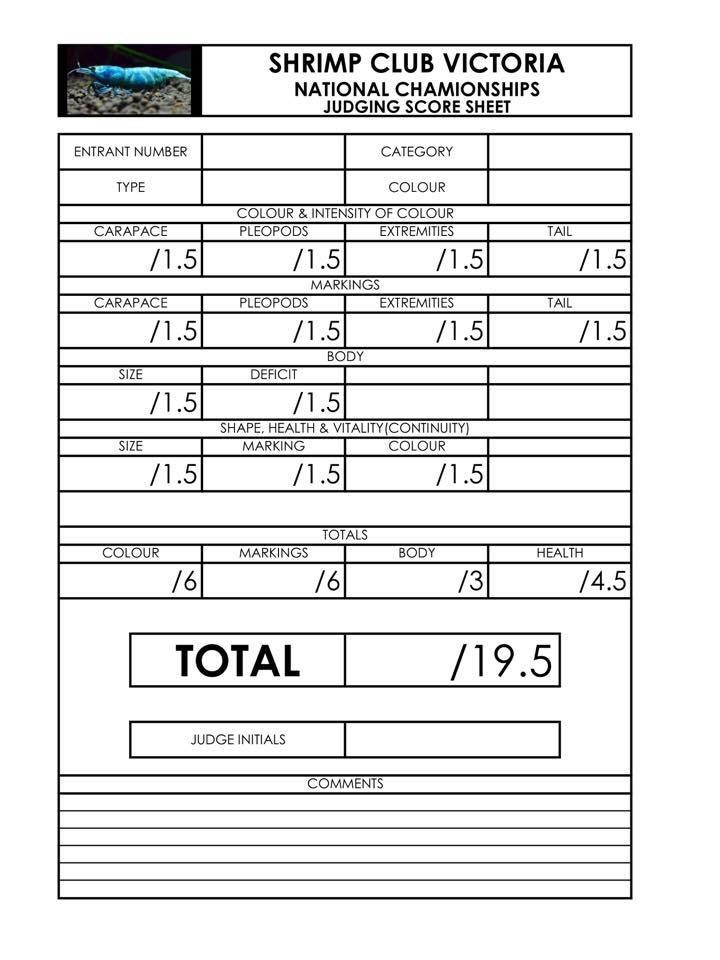
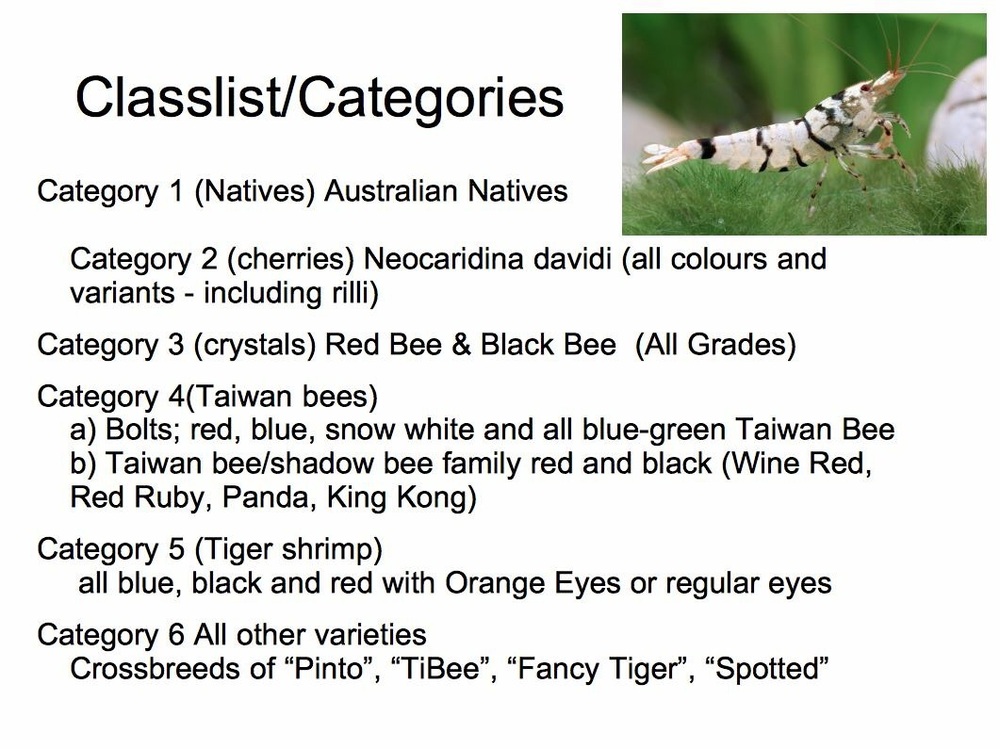
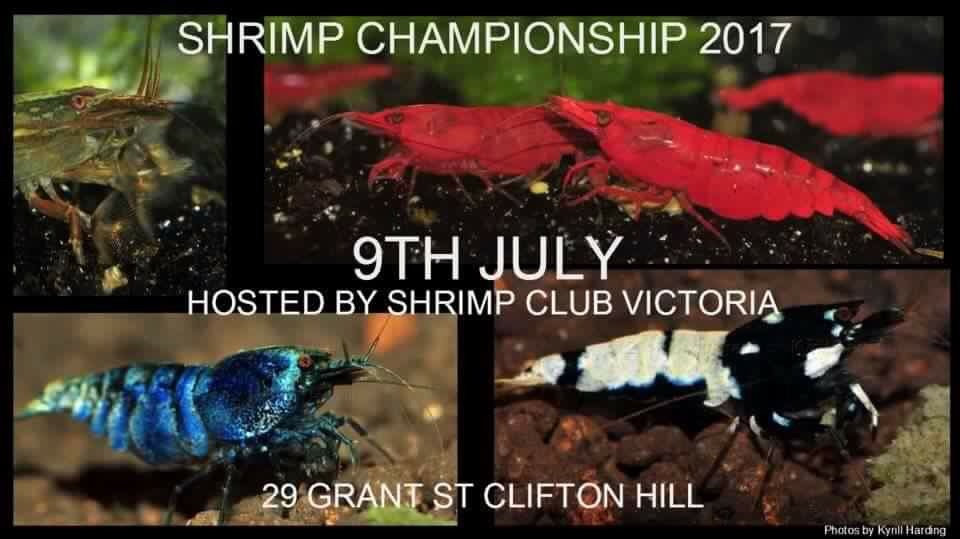
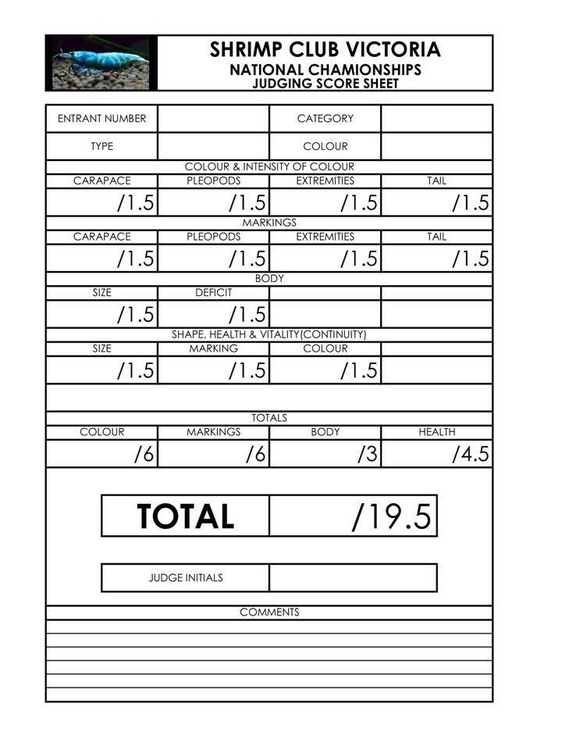
2 pointsSo a date has been set and locked in stone!! Australian Shrimp Championships 2017 9th July 2017 29 Grant St, Clifton Hill, VIC 3068 We wanted to give as much notice as possible, so we can get breeding programs set and so anyone considering travelling down/up/across can take advantage of flight and accommodation deals as they arise! Categories/Groups as below: (may be altered closer to date, but don't see a need personally!) Also, one adjustment of note. On the above chart Snow Whites are listed under group 4, this is incorrect and they are judged under group 3, with the other Crystals. ? Judging criteria as below, this may help you decide on which lines to work with: Special Note: Continuity row is based on similarity of colour, size and patterns of group entered. The more similar your three judged shrimp are, the better you will score in this area. Was wonderful to see many interstate breeders at this year's event, hopefully we can get more of you to attend next year!! ???
 2 points
 -
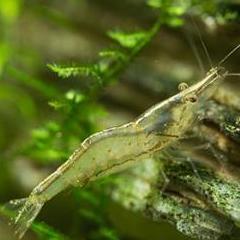
2 pointsThe other day I did a total rescape on my 4ft corydoras tank that also houses Dwarf Neon Rainbows a couple of remaining threadfin rainbows, otocinclus, Borneo Suckers, Fly Specked Hardy heads and Riffle Shrimp. It involved removing every critter I could find in the tank including the notopala snails and all the plants and structure, all this disturbance made a huge chameleon shrimp break cover, she was/is what appears to be the sole survivor of the time I had chameleon shrimp in the tank with only the corydoras, threadfins and riffle shrimp. She has since been relocated into my normal native tank that houses Chameleon shrimp, Darwin Red Nosed Shrimp, Darwin Algae Shrimp, Blackmore River Shrimp and Spotted Blue Eyes as well as a few thousand pest snails and a couple of desired snails like notopala. Sorry about the clarity of the picture but the big girl is the one behind the more expected sized chameleon shrimp. She really is much chunkier and bigger than all the other chameleons in the tank and positively dwarves the tiny Blackmore River Shrimp. I don't know if she got so big simply because of the size of the 4ft tank with limited competition for all the free pickings of food. If she was just genetically prone to being bigger bodied, or if she pushed her growth to avoid possible predation, or if I am just prone to breeding giants since it was in one of my other tanks I ended up with a hulk of a wild type cherry shrimp. Either way I think she is a stunner who I hope becomes a breeder, to produce bigger bodied chameleon shrimp, giving more body area for their various patterns and markings. I think one of the reasons so many of chameleon shrimp tend to show extremely dark colours is thanks to the huge tank dominating hollow log that fills a lot of the floor space, although I do see the odd chameleon shrimp with a clear body overlaid with bands of white and faint brown. Even if chameleon shrimp will not play ball and hold one particular colour or pattern I think they are well worth the effort to keep them, even if its only to see how varied they can decide to be, and they are not as tiny as Blackmore River Shrimp or (usually not) as chunky as cherry shrimp.2 points
-
2 pointsSome more pictures, in the flesh she doesn't look so red. Looking at the camera is a large DAS and infront of the rock up against the glass is most likely a little Blackmore River shrimp or a juvi DAS. Its nigh on impossible to tell them apart due to lack of distinct pigmentation or obvious differences. Sorry about the dodgy clarity but its the same big girl with a DRN. With another little dark chameleon photobombing in the back of the picture hiding under the log. Her again in a sea of Blackmore River Shrimp (BRS) with an out of focus DAS in the back ground.2 points
-
2 pointsWill be great to see you there @zn30! Hopefully we will have a whole colony of shrimpkeepers descending on Melbourne for the weekend. May give us a chance to arrange a SKF catchup dinner/lunch/thingy at some stage too!!2 points
-
 1 point
 -
A cackle of hyenas, LOL ? Shrimp, troop or swarm the latter I suppose being appropriate for bee shrimp. A group of people would normally be called simply that, a group "a group of shrimpkeepers" however still like a colony of shrimpkeepers.??1 point
-
 1 point
 -
Things can only grow from here as the support for this hobby gets bigger, interesting shrimpkeepers in a group or gathering is now known as a colony, well done @newbreed apologies if anyone else has stated this previously however this is the first we have seen the use of a colony used in reference to a group or gathering of shrimpkeepers.1 point
-
Thank you @newbreed this will ensure that the date will be cleared and remain cleared for this event. We will definitely be in attendance in 2017 and thank you to all who were involved in bringing us the highlights and updates for the Shimp Championship 2016, it was really appreciated and also made us a little envious as well.1 point
-
 Test @NoGi looks like it's fixed now - great work and thankyou!1 point
 -
It will be very interesting to find out the true name/ species of the QLD colour changing shrimp largely because it strikes me as strange that the Chameleon Shrimp (C. sp WA 4) are fresh water breeders while the QLD equivalent apparently does not. To my mind the NT (well the northern coastal parts at least) are closer to Asia than most of QLD is and to my mind you would think that the breeding habits would be the other way around. It seems the same is true for the Red Nosed Shrimp, with the NT species ( C.sp Gulf 1) being campable of breeding in fresh water while the QLD species ( C. gracilirostris aka Needlenose Shrimp) is not capable of this ability. I would dearly love more morphology to be done on our "glass" shrimp because I have caught all sorts of colours ranging from plain to DAS type markings to blacks and blues with solid stripes down their backs. Sadly they never keep the colour for long once caught and then tend to look like typical glass shrimp and when trying to identify them too many people trot out the good old catch all phrase " their glass shrimp" and then wipe their hands of any more information. As much as I like some of the overseas shrimp and bemoan the fact that there are so many I will never keep, I still believe that in Australia we are sitting on a wealth of potential aquarium shrimp that could make the rest of the world drool1 point
-
 1 pointThey only need to clutter your freezer during the winter! The rest of the year you can collect fresh (and maybe have a small stockpile). Or be kinda nutty and buy a mulberry tree. I snuck mine in under cover of darkness after a late night Bunnings run (to get tin snips to chop up SS mesh for moss for the shrimp, of course...). I have to say - your free bee pollen supply comment was a great laugh.1 point
 -
 1 pointHey Jarad, thanks a lot for the tips. I will take a look there! Best regards!1 point
 -
1 pointHave state the obvious @jayc I suppose this is the food for bee shrimp??? All jokes aside I will try this, thanks for the tip, as I have a shrimplets explosion in my CRS tank and my cherries also are constantly producing bubs.1 point
-
 Well looks like I signed up nearly twelve month ago. Been keeping shrimp on and off for a few years now. Mainly via a nano tank on my office desk. Just set up an aqua one 17ltr this week. Looking to stock with some CBS or the like. Sent from my SM-G920I using Tapatalk1 point
 -
1 pointPreparing leaves: Fresh leaves need to be blanched (boiled 3-4 minutes), cooled and then dropped into the tank. Shrimps can't eat fresh leaves like caterpillars. They usually wait till the leaf is soft, which could be a week after you add the leaf. Dried leaves can be dropped straight into the tank. Frozen leaves can be frozen from fresh without boiling. Frozen leaves can be dropped straight into the tank. In all cases, make sure the leaf is washed and no pesticides were used on the tree/plant at all. You can feed flowers too. Flowers are soft and don't need to be blanched. Straight into the tank it goes. Just make sure the flower is edible. Search for my Edible Flower post in "Food & Nutrition".1 point
-
1 pointWe haven't used mulberry leaves as yet, however we have just purchased a white mulberry tree for our shrimp. We use dried almond leaves, blanched spinach which we freeze then when required use boiling water from the kettle to make it soft enough for the shrimp. We have watched videos on YouTube that shows how to prepare mulberry leaves for shrimp.1 point
-
 1 pointI've had some luck since we discussed this subject. I've just found eves on one of my soon to be pride and joy :-) Sent from my SM-N920I using Tapatalk1 point
 -
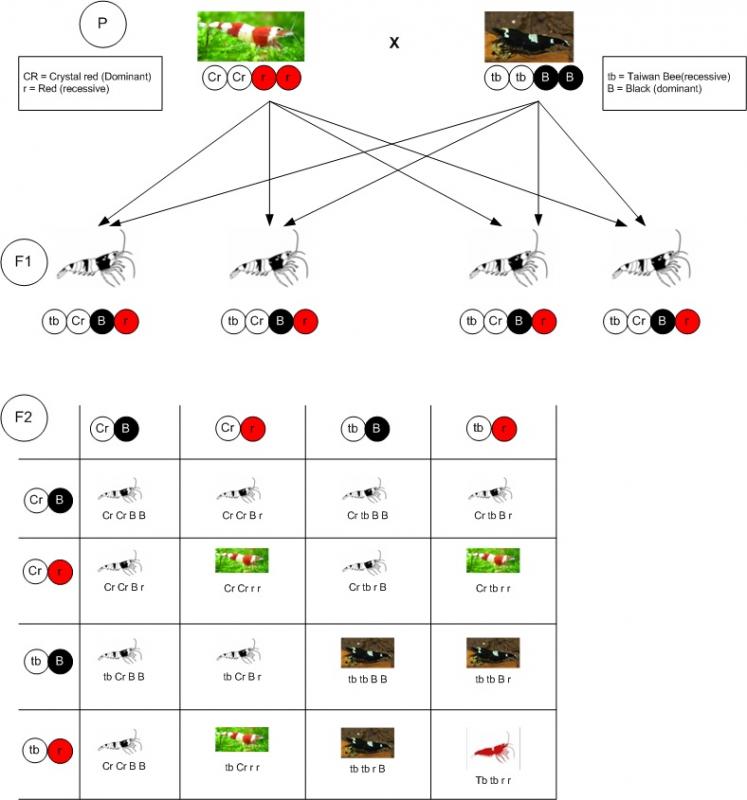
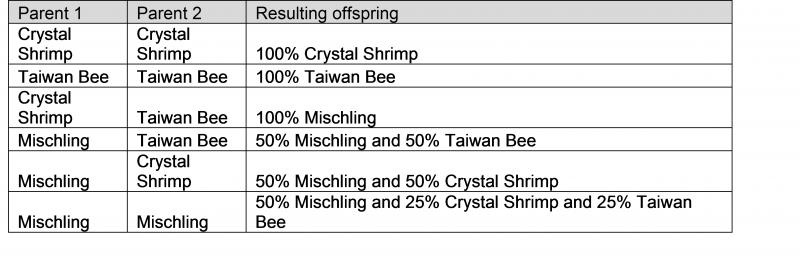
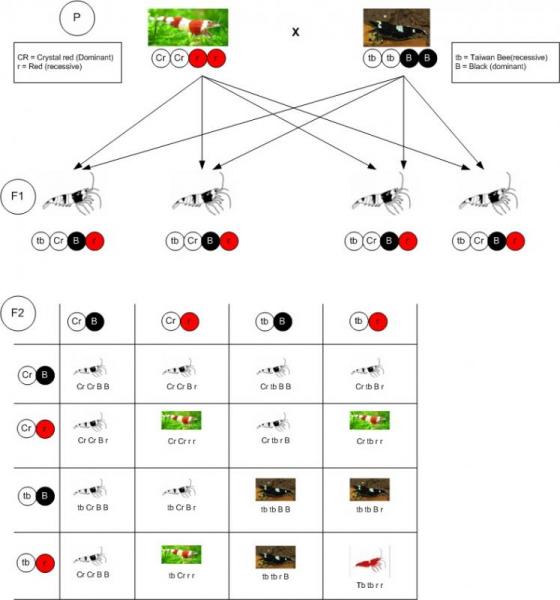
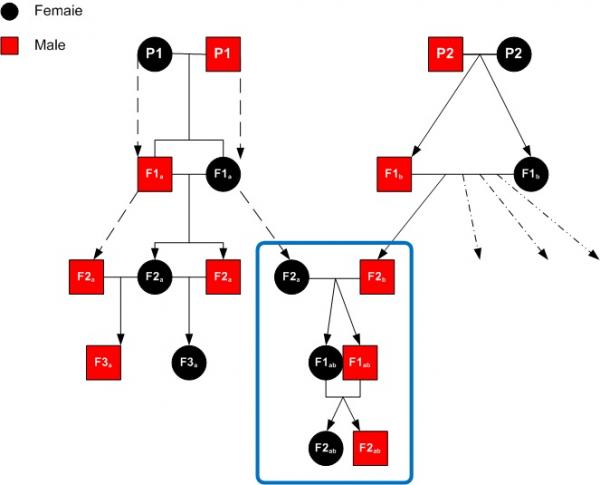
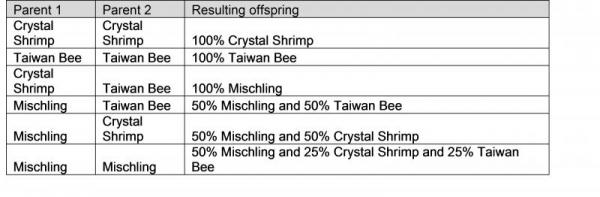
Genetic Linkage from Mendel's Laws To begin defining the F1, F2, F3, etc terminology, we need to cover some basics in genetics and inheritance. Using Gregor Mendel's Law of inheritance, let's observe how genetic traits are handed down from parents to offspring. We will concentrate on the simplified traits of shrimp variants and colour traits (or phenotype) only, which will be easier for everyone to understand. A simplified view of what you would get crossing a Taiwan Bee and Crystal Shrimp. Over simplified Mendel's Law applied to Bee shrimps (click to expand). Of course it is never that simple and it doesn't mean you are guaranteed a % of either offspring. A more detailed result of Mendelian inheritance including the Law of Dominance applied to a Taiwan Bee and Crystal Shrimp is as per this picture I drew up below. (Click to expand) Notice in the F1 generation, the Black trait is dominant, all the resulting offspring look black, but they still carry the recessive red gene. Let's see what happens in the F2 generation. When the F1 generation mate with each other, we see the results in the F2 table above. Notice we get many more Black Crystal shrimp, than Red Crystals. We also have a smaller possibility of getting Black Taiwan Bees. And an even smaller chance of getting a Red Taiwan Bee. So in this example, we have 1 in 16 chance per egg of getting a Red Taiwan Bee. 3 in 16 chance per egg of getting a Black Taiwan Bee. 3 in 16 chance per egg of getting a Crystal Red. 9 in 16 chance per egg of getting a Crystal Black. The F3 generation will dilute the possibilities again of getting a recessive trait. Let's assume you are aiming for that Red Taiwan Bee in the example above. The chances are 1 in 16 or a 6.25% that the right allele (or colour trait) is passed on. Notice I said "per egg". If the shrimp is carrying 16 eggs, it doesn't mean you will get at least 1 Red TB !! This is where the practice of culling is used to keep the variation in dominant and recessive traits to a minimum to achieve a certain result. There are no guarantees with nature. Even when you think you have the Blue genes breeding true in your colony of shrimps, a Red gene could pop up by chance even after 4 generations of Blues. The Blue gene might be dominant, but when two shrimps with the red recessive gene get together by chance ... nature has spun you a curve ball. What is Filial F1, F2, F3, etc ? F1 stands for Filial 1 (or first filial). Filial is a word used to describe sons and daughters, and it means the first generation from a genetic cross between parents. For example, it can be used to describe fish that are first generation from wild parents (ie. the fry have come from wild caught fish), so it's seen as an indication of genetic quality. Definition: the offspring of a genetically specified mating: first filial generation (symbol F1), the offspring of parents of contrasting genotypes; second filial generation (F2), the offspring of two F1 individuals; third filial generation (F3), fourth filial generation (F4), etc., the offspring in succeeding generations of continued inbreeding of F1 descendents. So an F2 would be the 2nd generation from the original parents you are counting from. This could be from the F1 mating with the Original parents or between two F1 siblings. As long as it involves the F1 generation. An F3 would be the 3rd generation. This could be from the F2 mating with the Original parents or between two F2 siblings. As long as it involves the F2 generation. And so forth for F4, F5, etc (Click to expand) A1 Original Male B1 Original Female Fn Offspring Filial number The moment you introduce an individual from a different Parent (and thus genealogy), you can't continue counting the Filial number. So while an F4 Tibee with Parents (A) X another F4 Tibee of a different Parents (B) still produces a Tibee, it is no longer an F4 Tibee. The offspring of two different F4 individuals has different genetics (A & B) now and has to be an F1 again. IF you get two related brother and sister F4 Tibees who share the same P (initial parents), then yes ... it's offspring will be an F5 Tibee. (Click to expand) From a practical point of view, another thing Filial numbers are used for is to determine how stable the genes are in a certain specimen. For example, if you are looking for CRS, then an F8 CRS is going to be more desirable than an F1 CRS. The F8 CRS has more stable genes, than an F1 CRS which might have been an offspring from a mischling or taiwan bee shrimp. And would be closer to being a candidate for a Pure Red Line programme. Thus the F1 CRS is not as "pure" bred as an F8. But on the other hand, it could also be an indication of how far it is from the desirable genetics. Like in the case of fish, an F1 Apistogramma or Discus might be more desirable than an F9 fish. Since the F1 offspring are direct descendants of wild caught fish. And if the breeding stock is small, and offsprings keep breeding with each other, then the F5 generation will have a very small gene pool diversity from it's original parents. <-- not good. Since it will be an increased risk of genetic defects/disorders.

 1 point