
Leaderboard
-

geraldatwork
New Member2Points1Posts -
revolutionhope
Members2Points1179Posts -

jayc
Moderators2Points6248Posts -

ineke
HOF Member1Points9026Posts
Popular Content
Showing content with the highest reputation on 06/06/16 in all areas
-
2 pointsI have dozens of Red Cherry babies in my 5 gallon tank. I have a couple of blue version females that are about to give birth. It will be interesting down the line what kind of versions I come up with.. Thanks for the chart2 points
-
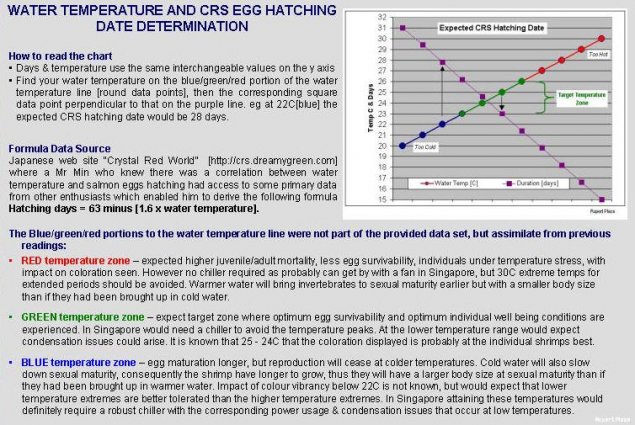
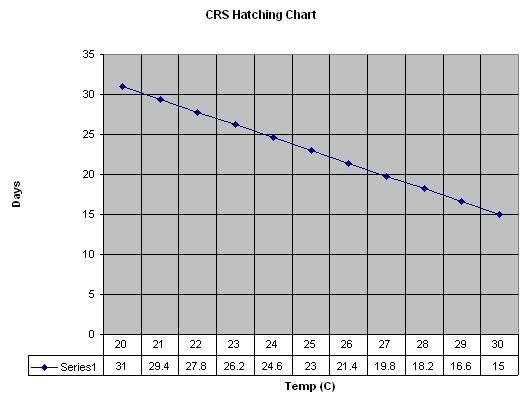
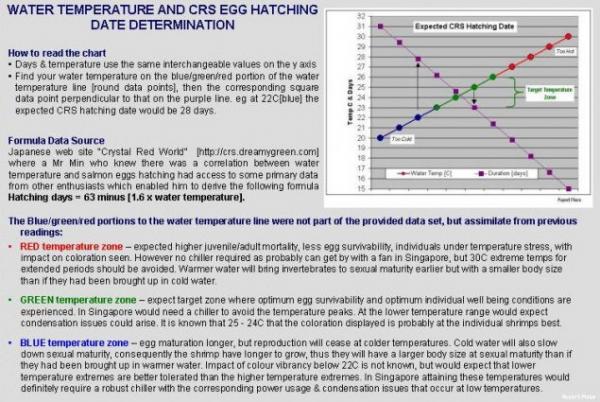
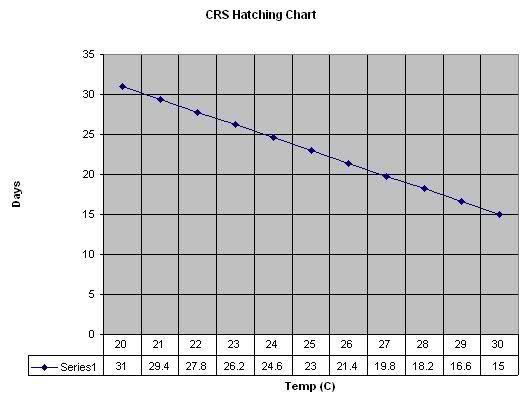
While surfin in the quest to gain more knowledge about shrimp and shrimplets, I stumbled across this chart (it's not my own and I don't claim any credits for it, I don't know who created it either apart from the text within it that mentions a name and site) Same info in a simpler chart. This is great info for an estimation of how long eggs will be held for before hatching. However, this got me thinking. Does the temperature of the water determine the sex of shrimp? In most fish, as in mammals as well, their gender is determined by the presence of a pair of sex chromosomes present in each cell of their body. External environmental factors normally have no impact on their gender. In the case of some species however, it is now clear that the temperature is the crucial factor which controls the gender of their young. Known as temperature-dependent sex determination (TSD), this method of reproduction is most commonly associated with reptiles, such as certain Crocs and turtles which lack sex chromosomes, but also present in some fish. I have apistos that generally tend to develop more males in warmer temps, and more females in cooler temps. Of course temperature is not the only thing that determines the gender of the species, chemicals in the environment also plays a role. But for the sake of simplicity, we are concentrating on temperature only. So my thought was ... does TSD also affect shrimp? I don't know for sure. There are some vague articles on the net, but not conclusive (not the ones I've read). But some articles shed some light of hope that temperature might determine the gender in shrimp (different kind of shrimp, not the ones we keep). There was one forum post (forgotten the site now) of a Singaporean (think hot weather) shrimp keeper who tends to get more male shrimplets than females. This might be a good experiment for some breeders out there especially if they are trying for more males (higher temp) or for more females (lower temp). We are only talking about a shift of 2-3deg C higher/lower. So assuming 24degC is ideal for CRS, then you'd adjust temps to 21-22 for more female shrimplets; or 26-27degC for more male shrimplets. This is only for the 3-4 week duration while the mama is berried until hatching. You don't want to keep them in temps that are not close to ideal for too long. Happy to hear if anyone else has experienced similar or has more insight into the subject.
 1 point
 -
 1 point
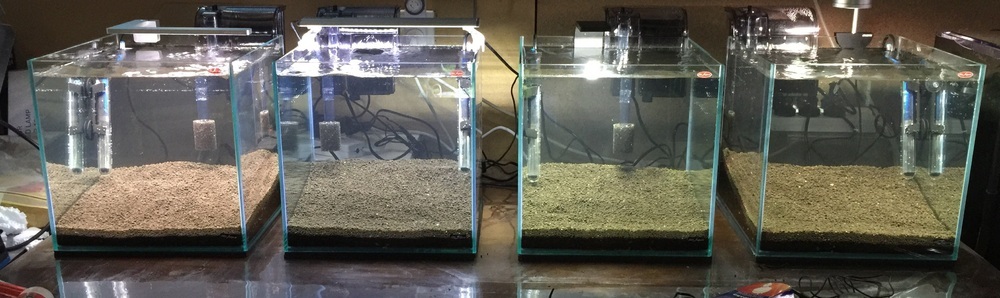 So I had the opportunity Friday to setup some new 30cm cubes, which will be used for guppies (maybe shrimp later on!) I then decided it would be great to run a side by side comparison of the lights we sell online. All tanks have same heaters, filters and substrate (shirakura red bee sand). Left to Right: Aqualighter Nano Aqualighter Pico Up Aqua Y series 18cm ATLEDTiS E6 Left to Right: Flexi Mini Aqualighter Nano Up Aqua Y series 18cm ATLEDTiS E6 Left to Right: Flexi Mini Up Aqua ProZ 30cm Up Aqua Y series 18cm Up Aqua Y seties 25cm Left to Right: Flexi Mini Up Aqua ProZ 30cm Aqualighter Nano ATLEDTiS E6 Very surprised by the blue content in the Y series lights, though these still work well wih mosses and low light plants. Really Pleased with the ATLEDTiS E6 as it probably hd the most natural colour. I knew the Flexi minis were bright, and this is the original version, but when directly compared it outshines all. The ProZ has a nice even white colour to it as expected. Not a very scientific study, but amazing to see the side by side comparison. Hope it helps with any future plans for smaller tank setups. Will definitely give me a better base for recommendations in the future. Also have planted some tissue culture plants in each tank, again same plants across all tanks, so will be fun to watch the growth rates of each. As all other factors are the same, light will be the ultimate factor to growth.1 point
 -
 1 pointI have the chihiros a series and aqua zonic clip on back led. I reckon there both great.1 point
 -
 1 pointOkay so I want to put my 2 favourite (best colour) cherrys in with my CRS to select breed them but at the same time I don't want this to cause CRS to not want to breed. Would both live N breed happily sharing tank together for a short time ?1 point
 -
1 pointGood point. Unfortunately for me I would be stoked if my ycs outnumbered my crs! Still no sign of shrimplets grr Sent from my SM-N920I using Tapatalk1 point
-
1 pointMany of us keep both species together. It is best to make your water parameters suit the Caridinas the neocaridinas will adjust to their water better than the other way round. Initially the cherries may slow down with their breeding but they will breed again without issue. Just make sure the cherries don't start to out number the crystals1 point
-
1 pointAbsolutely fine @Mitch91. Of course cherry shrimps will proliferate more in harder water than crystal shrimp like. Also many report that cherry shrimp look brightest and best in neutral->alkaline conditions. But no there is absolutely no issue with breeding neocaridinas and caridinas together in the same tank :-) love n peace will1 point
-
1 pointDon't bother altering parameters until the cycle is complete, as the parameters will keep changing with a cycling tank. Once you have no ammonia and nitrites, look at raising pH up to near 7.0. You can do that with treated tap water or a small handful of coral chips. Report back with your water parameters again after cycling is complete, and we will have a better idea of what needs changing.1 point
-
 1 pointHi Thanks for your replies :-) I am considering starting with Red Cherry Shrimp, as I've read they are a good beginners Shrimp. My tank her been cycling for a week today with Nutrafin Cycle. The parameters tonight are : Ph 6.4; Ammonia 0.25; Nitrite 0;Nitrate 5; Kh 3; Gh 4; Phosphate 0. The temp in the tank is varying between 26.7 to 28 C My local water contains chloramines so I always register 0.25 Ammonia. I have been assured by the local Aquarium that this is usual for around here. Thanks Roscoeb1 point
 -
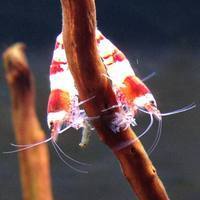 yea, but since he already stained it, these just as easy, but yea thats what i did on mine1 point
 -
 1 pointHi @roscoeb, What shrimp are you planning on keeping? What substrate did you get? For soft water shrimp you might require volcanic shrimp soil to keep the pH down... Below is a cool chart for dwarf shrimp types with approximate parameters so that you can get an approximate indication of environment: http://www.discobee.com/blogs/news/17030569-dwarf-shrimp-water-parameters1 point
 -
 1 pointLooks like it was due to the fact that the tank was cycling. The output looks OK now that it's cycled. It's not bursting like crazy like before and spitting water everywhere. ? Cheers @OzShrimp for your help!1 point
 -
 1 pointHi @neo-2FX, glad you like it. You can see the Neutrik connectors in the photo, (black & yellow), one just to the right of the CO2 tank & 2 more just to the right of the filter, with the obligatory 'drip loop'. Yes you have to cut the cable and fit them, and you buy them as a male & female connector (sold separately - $12 each). To connect them you simply push together & twist, and a slide (yellow) locks them together. To disconnect, you pull back the yellow slide back and twist in the opposite direction. Now the way they are designed, it locks the electrical cable solidly into the connector, using compression, and the whole thing, once connected, strentgh wise, it's as if there is no connector. (does that make sense?) I bought them from Derringer Music in Adelaide, (hugh place, servicing individuals to bands), as they are most commonly used connecting electronic musical instruments, amplifiers, etc. They simplify setting up and breaking down concerts. You should be able to find them at a similar place in Melbourne. The tool hangers are primarily 3M Command clear picture hooks & cable clips (all removable), except the acrylic hanger (for syringes), on the lower section of the left door, (I designed it & a local acrylc fabricator made it up for me), and the commercially bought acrylic aquascape tool hanger (eBay), on the upper section of the right door. This one though is in two sections, one piece you can screw to a wall or door, and then the tool hanger section slides into it. Where are they used? The cable clips are the white clips on the left door, which hold my flexible pipe cleaner, and the 3M Command hooks are used for the rigid bottle brushes (top of left door), and 2 of them to hang the stainless steel sand flatener, on the right door. The blue mat on the floor of the cabinet is a piece of 'yoga mat' cut to size (completely eliminates any vibration from the filter & acts as a sound dampener). I also used a strip on the left wall for the CO2 bottle to rest against, and a small piece on the right hand door, to stop the sand flattener making a noise every time I opened or closed the door. Hope that answers any questions. :-D1 point