

Leaderboard
-
ageofaquariums
Members2Points178Posts -

jayc
Moderators2Points6248Posts -
NoGi
HOF Member1Points5858Posts -
fishmosy
Members1Points4594Posts
Popular Content
Showing content with the highest reputation on 11/13/15 in all areas
-
 1 pointHi all, I successfully moved my 3 ft across melbourne with zero deaths. Its a planted tank ( Needle Leaf and normal Java Ferns, Java Moss, Bolbitis heudelotii, Stauogyne Repens, Hemianthus Micranthemoides, Blyxa japonica, sunset hygr) with medium level lighting, an internal filter, no heater and no CO2 injection. I have seven white clouds, and about 17 Red Cherry Shrimp, and I think its about time I get a third and final type of tank mate. Visually, my tank is black (kaito soil), green (plants) with the grey slately/granite looking rocks. You see the odd red flash of the shrimp, and of course the white clouds. Does anyone have suggestions regarding a fish or shrimp that will compliment the tank? I'd love neon tetras but they wont go well in a non-heated tank, and there are not many other small fish I would trust to not make a habit of eating the shrimp... so I reckon I will get another type of shrimp in there. I guess maybe another type of cherry? Also, I am quite new to the hobby and also seek to have the tank as low maintenance as possible. I will no doubt make mistakes as I go, so looking for something more hardy which will cope in the current conditions - I do not at this stage wish to add C)2 or a heater or need to overhaul my parameters. Is there a suckerfish type that will do well in a non-heated tank? I wanted some ottos to keep the algae low, but was told by the good folk at Subscape in RIchmond they are warm only!1 point
 -
Buck has pretty much summed it up, but here are some of my thoughts... There are Pros and Cons of each method- one large tank divided or individual nano tanks. It really is up to your preference and future plans, and budget. I like individual tanks personally since I keep Cherries and CRS/CBS, which have different water parameter requirements. That way one tank can be tailored to cherries, and another tank can be tailored to CRS, and yet another tank can be tailored specifically to tigers. I also like the idea that any outbreak in disease is contained to the one tank only. But there doesn't seem to be a right way or wrong way, nor even one that might be significantly better than the other. Both methods can work, as proven by many people. As for filtration - if you choose the 'one large tank divided into sections' route, then add a canister filter. Overfiltration is never a bad thing, especially in small nano tanks where you don't have as much volume of water. Heating is not too critical in Sydney. If you have one tank divided, then one heater will be sufficient near the outlet of that canister mentioned above. The heated water will be pushed to the other sections. Any brand of heater will be sufficient, as long as you trust the brand. As mentioned heating is not too critical, however it is the heat of summer that is the bigger issue. My cherries in my garage survives our Sydney winter. You will need to look into chilling eventually. One chiller to chill one tank is already expensive. Let alone 2, 3, 4 or 5 tanks. This is the point where it becomes the deciding factor for many shrimp keepers. Buy one chiller to chill a larger tank divided into several sections is going to cost less than buying several chillers to chill many tanks. Considering chillers can cost $400+ each, it becomes a no brainer. Lastly my thoughts on substrate. As mentioned by Buck, inert substrate is fine for cherries. But at pH7.8 water, it doesn't hurt to use a little plant substrate to reduce that to a more neutral pH7.0. You probably only need a very thin layer to reduce the pH from 7.8. The best substrates (that we can easily get in Aus) to use would be Cal Labs Black Earth Premium, Benibachi soil, or ADA Amazonia. Proper cycling of the new tank with these substrates need to be observed.1 point
-
1 pointI find shrimp won't start eating veges or leaves until they are really, really soft. Which means either blanching them longer, really boil the heck out of it, or just leave it in the tank. Indian Almond leaves and mulberry leaves are always good, and the fish leave them alone. Same with flowers. No blanching needed, straight into the tank, as long as you are sure there was no pesticide on it.1 point
-
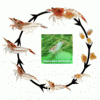 1 pointyeh im stoked with this gear, pH is rock solid at 6.4 now :-) i should have gone with it in the first place, never going to bother with fulvic grains again that's for sure! my 2 berried ladies are hanging on. i got rid of that fake seachm matrix rubbish i had in the filter (FUN JOB when it's all mixed in with those little eheim balls arghghh!!) currently i'm doing a 50% waterchange today (ongoing since this morning, will be finished 20-24 hours after i started lol, fingers crossed that doesn't disturb them at all :-) falling in love with CRS... woooops bad move i feel a case of MTS coming on... as for BEP i hope it buffers forever after men. love n peace will1 point
 -
1 pointyep straight rain water. that's basically what they live in anyway. @Shrimpmaster Check out my thread in the field trip section to see the natural habitat and water conditions that these shrimp naturally live in.1 point
-
1 point