

Leaderboard
-

The Tech Den
Members5Points241Posts -
fishmosy
Members5Points4594Posts -

anthonyd
Members4Points127Posts -
NoGi
HOF Member2Points5858Posts
Popular Content
Showing content with the highest reputation on 10/20/15 in all areas
-
 2 pointsHey guys and girls just wanted to show my setup. Firstly i want to say a massive thanks to Baz (disciple) for holding onto this tank for me so i could sort myself out. The setup didnt come with a stand so i started with this Then after a bit of reinforcing, some 12mm ply for the shelf, fronts and sides, a tin of stain i was ready to pickup the tank. Now coz the tank was running and had shrimp in that were coming with it i was crapping myself about getting them here alive and well anyhoo i got it here along with 90% of the water and started to setup Then once all shrimp mosses and driftwood were in place i added the light and panels and this is the end result So all in all im absolutely stoked with how it came up and the move was much easier than i thought ( although i pondered how i was gonna do it for weeks lol) so stay tuned and over the next week or so I'll show you guys each division and whats in there cheers for taking the time to have a look2 points
 -
Yes, the above article is in need of an update. Both issues @Grubs has correctly raised have been discussed in other threads regarding riffles, but its worth repeating them here. 1. Larvae of riffles (and other natives) can have two life history modes: the first is where the larvae hatch out and undergo only a couple of developmental stages prior to settling to the bottom. These come from adults in headwater streams (larger eggs so the larvae are more developed when they hatch). I discuss this in more detail in my article on Paratya australiensis. I suppose its misleading to say they hatch out as mini adults, and that should be clarified in the article. The second life history mode is the one described by Grubs - the larvae hatch out into the plankton and develop through a series of larval stages that may or may not include some time spent in brackish water before heading back upstream to freshwater. Grubs: Given what you have said, its highly likely that the riffles you obtained were collected from lowland streams and not headwater streams. I'd highly recommend trying a brackish period much the same as you've had success using for other natives. 2. There is some evidence to suggest that riffles are actually two separate species (northern and southern) but further DNA analysis and taxonomic investigations are required. @ura may know which stage this investigation is presently at. @northboy also knows of a population of riffles on the Atherton Tablelands that are reportedly huge, and no males have been found. Is this yet another species of riffle? Why are no males found with the females? Do the males get as big as the females and, if so, does this indicate that these riffles are not sex changers? A trip to collect some specimens for taxonomic analysis is high on the list of field trips for Bob and I when I can get back to Cairns.2 points
-
2 points
-
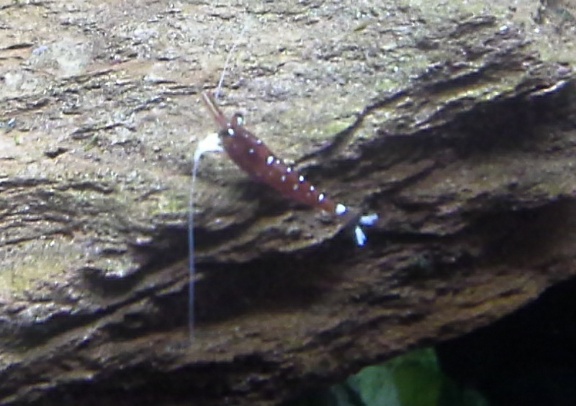
2 pointsI finally managed to take a picture with my phone of a dennerli shrimplet.
 2 points
 -
 1 pointHi Neo, I have just used scoria (Lava rock) as substrate in all my shrimp tanks on my rack. I have also been using it for many years in caninster filters. I will remove the various things like bio-balls or noodles etc and replace with scoria. It is a fantastic filter media and allows beneficial bacteria because of the amount of holes in it. I have always purchased mine from a landscape supplier and it has only cost me $7 for a 20kg bag. You have to wash it quite a few times before using in the tank but even from a look perspective it has given my tanks a completely new and cleaner look. It is available in 20mm, 15-10mm and also quarter minus grade. This is the cheapest way to buy it. The scoria I used in the tanks was only available in the larger size at the time so I simply used a hammer to make it small and to varying sizes. It was a bit of a pain but quite easy to do and good stress release.....LOL I also use the clay balls that are available from hydroponic stores and the cost I last paid was about $5 a litre. It takes a little while to absorb water and sink and I have also found that no matter what there are some that will continually float. No big deal because of the low cost. They are excellent at absorbing and I have also used them for many years. They only pain is they tend to get stuck in the hose I use to clean tanks. They look very similar to hydrocorn but are more symmetrical in shape.1 point
 -
Thanks Grubs. If I can sample the isolated population, I'll grab some for you. Just to preface my following paragraphs: Cryptic species are species that are morphologically identical (i.e. They look exactly the same) to another species but are actually seperate. The best way to tell is DNA analysis. In the below example with Caridina indistincta Clade C, DNA analysis indicates that two species live in the same river in the same areas, yet don't cross breed. One is only found in that river, the other is widespread. The cryptic species would be the one only found in that river. Just to clarify with the Cook paper: The genetic analysis indicates that there are two distinct types (northern and southern) but within each of the northern and southern types, their genetics are homogenous. That is, there are no cryptic species within either the southern or northern types. This is substantially different from say Caridina indistincta which can be divided into five clades (A-E), however there also appears to be some cryptic species found within some of the clades. Clade C in particular has around five groups within it that each could be a cryptic species. Some are found only in one river system, whereas others are widespread.1 point
-
 Nice wrap up @fishmosy If I can time it right I'll try some larvae in brackish greenwater (I have a pot of typus cooking now). The scientific literature seems to suggest they have marine larvae more than fresh (though I'm aware of a few people that have had success in fresh water too). I'd love to see some big-egg direct developers. If ever you get some from isolated fresh headwaters send me some for comparison :) though I know Bob has stories of them climbing waterfalls so even headwater populations might still mix with the occasional ocean born mother. The genetics seems to suggest the northern and southern pops are genetically homogeneous (of course they might not have sampled isolated headwaters) Cook et al 20121 point
 -
 1 pointneo-2FX, if you decide to try this, please let me know how it performs for you. My next experiment will be testing it out as a fluid bed system, i reckon it would be effective when used in a sump chamber instead of K1.1 point
 -
1 pointWith regards to the PH readings increasing while using Gold Label Hydrocorn, my test i have been carrying out over the last 24hrs show no significant increase. I have made several tests using API PH testing method, each test i used both samples from RODI water and water from my test vessel which was simply a 20lt bucket with an air stone and 1lt of Hydrocorn added to the RODI water. The only increase i noted was using my EC test meter, an increase from 4 microseimens to 30, this could be attributed to dust particles from the Hydrocorn as it does require vigorous washing before use. Hope this may be of some help to those thinking about using this media as i certainly will continue to do so.1 point
-
And draft version to include with actual photos. If you have good quality macros please send them to me, without watermark as I'll add them in during post processing. Just let me know what to say in the watermark.
 1 point
 -
1 pointIts possible, but I held them in a temporary tank at much higher TDS than the TDS in their natural habitat aka Short Creek with no deaths. This tank developed a coating of algae quickly whereas their current tank has not. I think this is a sign that the tank is being slow to mature.1 point
-
 1 point
 -
1 pointYeah and I'm guessing because the other page was copy and pasted straight in. There, fixed it.1 point
-
 1 pointStill looking impressive In the flesh the little yellow spikes sticking up from the front of the shell only looked yellow, but in the picture they appear blotchy like the snails foot. It doesn't really show it in this picture but he still has the yellow mouth/ moustache its just that he was swinging his head around searching for the algae I had dropped in and the other shots ended up blurry.1 point
 -
1 pointAll good, had plenty of times like this. 1000s of $$ worth of fish die overnight, ect. Thought many times about closing down my tanks. Its been either the challenge of completing the goal I set for myself (breed species X) or buying a new species that kept me going. If it is easy, is it really worth doing? Chin up, mate.1 point