
Leaderboard
-
fishmosy
Members5Points4594Posts -
neo-2FX
Members3Points723Posts -

jayc
Moderators2Points6248Posts -
jc12
Members2Points385Posts
Popular Content
Showing content with the highest reputation on 10/15/15 in all areas
-
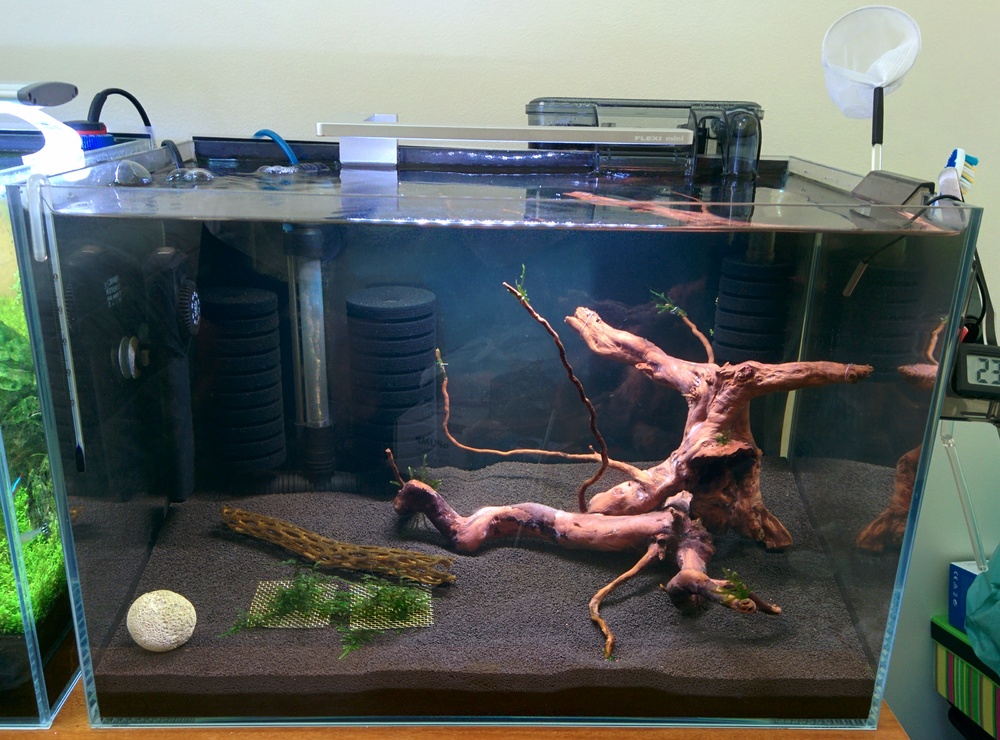
3 pointsShe's ready! Could have cycled in 3 weeks but cycle stalled due to low pH and me not noticing. Big thanks to @Disciple for all the help!
 3 points
 -
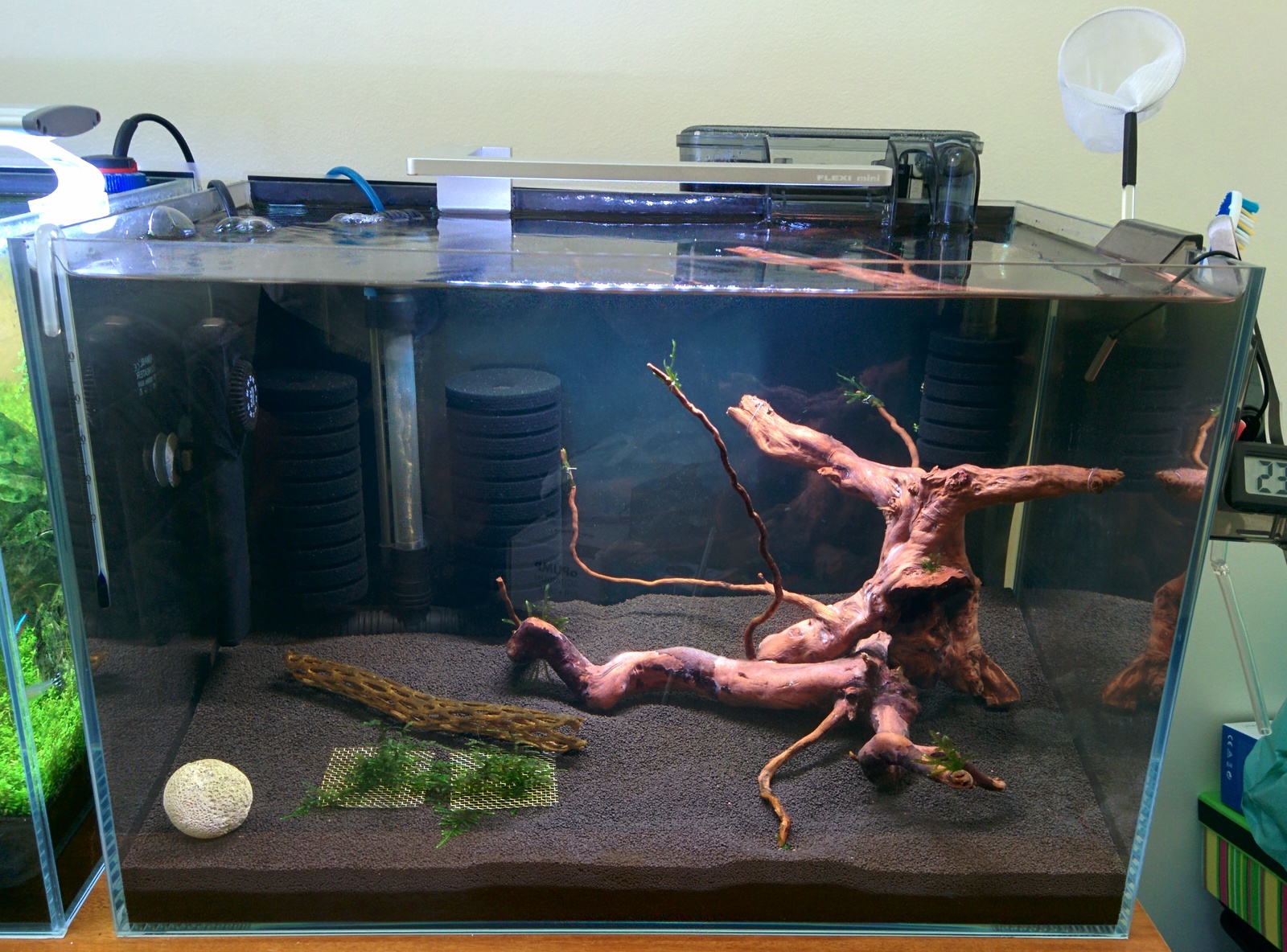
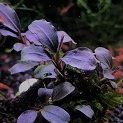 2 pointsSo thanks for the input. I have decided that this will be the layout for the hardscape minus the rocks weighing the driftwood down. I have moved some of the smaller stones on the right . Will eventually replace the heater with an inline one. I'm quietly chuffed because the interior ministers comment was.... Oh that's nice I'd have that in the house minus the pipes(hello glass lily pipes ;p )2 points
 -
2 pointsUsually it is mechanical followed by biological and lastly chemical filtration. I.e. coarse/fine sponges => ceramic rings/marine pure => purigen/carbon/macropore. Hope this helps.2 points
-
2 pointsStenomelania cf. aspirans The "cf." means they haven't been formally identified but are similiar to, and likely to be, aspirans which is found throughout the Pacific, e.g. Solomon Islands If you picked them up in a shop, firstly congrats because they are a rare find, and some shop owners refuse to sell them, and secondly its highly likely they were originally collected by Northboy aka Bob, which is where I got mine. Do not keep them in acidic conditions, they will fade away and die. Neutral to around pH 8 seems to work well. These guys dont produce live young like MTS, Stenomelania denisoniensis and some of the other native snails, so they cant get out of control in your tanks. Instead they release pelagic larvae that float downstream (assuming to brackish or marine water) and may or may not feed on microscopic algae. Unfortunately this means they are basically impossible to breed for the average hobbyist. I keep a half dozen or so in with my Bloody Mary cherrys. They seem to do well under those conditions but I've yet to see mine spawn. I wish they would because i have lots of experience growing marine larvae. I need to convince Bob to show me the habitat where they are found so I can get a better idea of what may trigger spawning ect.2 points
-
 Grubs if you can raise the temp for a day or two to around 30 I have about 10 berried girls had a few very hot days a couple of weeks ago where the temp in the tank hit 30 after each of the hot days I would find a few more berried girls they seem to like the high temps. I had the same thing as you last year very few girls berry still have the same in another chilled tank no berried girls. so worth a try if you want some berried girls.1 point
 -
1 pointI've had some for more than two years, the survivors of my mistake keeping them in acidic tank. The rest I got in May when I last saw Bob in Cairns. These are my favorite snail, although I wish we could get the sulawesi snails. I'll check the paper regarding lifespan.1 point
-
 1 pointLooks awesome so far @inverted, this would make an awesome natives tank, looks great!1 point
 -
1 point
-
1 point@albash, if you need to use purigen, it should be in a bag (obviously), and should be placed at the top of the canister. That way you can remove it easily. It's job is not a mechanical filter to remove solids, nor is it for a primary biological filter. Purigen and it's similar cousin, Macropore, along with media like carbon, zeolite is primarily used as a chemical filtration media. To remove chemicals and dissolved solids. Note: purigen shouldn't be used on a long term basis, only if you need to reduce Nitrates for example. With all chemical media, it gets exhausted eventually, and looses it's ability to absorb further. So the point is, it's not meant for long term use. Don't add and forget. It needs to be removed periodically according to the manufacturers suggestion. Chemical media should only be used on an as needs basis. The space is much better utilised by biological media. <edit> - beaten by jc12 by 2 seconds.1 point
-
1 point+1 to what @neo-2FX said. API Bio Chem Zorb ... isn't that just a carbon & purigen combo? Also not needed until it is really needed. Like the carbon pad. Leave it out. The proposed media setup seems to have too much mechanical media, not enough biological media. The sponges are there to trap solids. But you need more surface area for the beneficial bacteria to go to work on the dissolved solids ie. Ammonia NH3, Nitrites NO2 and Nitrates NO3. Things like ceramic rings and marine pure will serve this purpose. It lets the solids pass by while the dissolved solids traverses through the media to the bacteria where nitrogenous wastes are processed. So your canister needs to order the media as neo-2fx said. In order of water flow. Usually from the bottom of the canister to the top. Course sponge first (at the bottom of the canister) to filter out the big solids which might clog the biological media.Medium sponge as an option if you have space to remove more solids.Then Biological media, which needs to be the bulk of the overall media. Fit as much as you can into a canister. This goes for HOBs too. Fit as much bio media into HOBs where you can. I like marine pure for the sheer amount of surface area it offers. Each MP ball has a huge surface area, and at it's centre, there is enough density to create an anaerobic environment for Nitrate reducing bacteria. But you can use things like ceramic noodles/rings, bakki balls, eheim substrat, etc. It's your choice. But pack biological media in ! I have 70% bio media (marine pure) to 30% mechanical filter in my canister as a guide. The last media is a fine sponge to polish the water and remove the finest of solids before the water returns into the tank. But why waste this layer to just any old fine sponge. The best media for this last layer is Poly filter. http://www.thetechden.com.au/Poly_Filter_20cm_X_10cm_8_in_X_4_in_p/pf4080.htm1 point
-
 great news. I've been trying to breed my riffles for a couple of years. last year only 2 (of 10) got berried and I didn't get any larvae - havn't seen a berry since! Wishing you luck with bubbas.1 point
 -
The other thing I have been asked about is feeding. And this relates far more to water parameters than you might think. Firstly in tanks with inert substrate, food is going to be the major contributor to increases in TDS. More food equals greater increases in TDS. As we know, zebs like low TDS. I minimise any increases in TDS caused by food by: - Feeding only every two or three days, although 1 mulberry leaf is always available and replaced when it is completely consumed - feeding small amounts which are totally consumed overnight (excluding snow which tends to be consumed over several days) - feeding foods that are low in protein (Benibachi kale pellets, Boss Aquaria Snow). Proteins are high in nitrogen. If the food rots, the proteins decompose straight to ammonia. When the shrimp eat and use the proteins, they release the nitrogen stored in the proteins as wastes. This increases the TDS of the tank, but also exposes the shrimp to 'high' levels of nitrogenous wastes. Nitrogenous wastes are not detectable in the water of their natural habitats so any level where these are detected is really too high.1 point
-
I've been asked by a member to provide some more information about how I keep my zebs with particular reference to water changes and parameters. The water parameters I provided above are accurate and I try to maintain these water parameters by doing water changes using RO. I change approximately 20% of the water in the tank every 1-2 weeks. To replace the water, I keep the RO in a 20L drum in the same room as my tank (the tank is unheated) so the water is exactly the same temperature as the water in the tank. I add the RO directly to the tank then I add tiny amounts of Benibachi directly to the tank to boost the TDS to 40-50ppm. The substrate I use is completely inert - granite and a bit of quartz. I do not use coral or any other pH boosting substrates, nor any pH decreasing substances such as peat. I believe a big part of how pH is maintained in my tank is that I have over-filtered the tank and ensure there is lots of water movement and agitation. I'm using an Eden 511 filter on the tank (60L) with a spraybar that faces back towards the pane of glass that the spraybar is mounted on. This stops the tank from turning into a whirlpool and agitates the surface. Why is this important? Well pH is related to two things - how much CO2 is dissolved in water as well as the dissolved minerals in water that buffer against acids. We know that water that is low in TDS is low in dissolved minerals. This means that there is little minerals that can buffer against acids. When CO2 dissolves in water, it forms a weak acid (carbonic acid). So in water with low TDS, it doesn't take too much CO2 for the pH to drop. Agitation is important because it tends to gas off CO2 out of water. That is agitation causes CO2 to move out of the water and back into a gas. Zebs like to have a fairly neutral pH (6.8-7.0). They also come from areas with lots of water falls and riffles (places where CO2 is gassed off). So its important to have plenty of agitation in a zeb tank. An air stone or sponge filter are a couple of options if you think you need to increase your agitation.1 point