
Leaderboard
-
revolutionhope
Members3Points1179Posts -

Guest
Guests3Points0Posts -

jayc
Moderators3Points6248Posts -
Mark49
Members3Points57Posts
Popular Content
Showing content with the highest reputation on 03/24/15 in all areas
-
3 pointsGiving good solid advice for a noob like me! [emoji3] has given me confidence and now im motivated to take my shrimpkeeping to the next level3 points
-
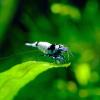
3 pointsThank you. I hope I am able to give Shrimpy Daddy a run for his money as he is the man currently mentoring me in shrimp keeping and photography. In a way, I like to believe that I am getting better under his mentorship so it is a great honor for me when folks genuinely like my photos. I still have a lot to learn from Shrimp Daddy and I feel like he is still leaps and bounds ahead of me. Slowly but surely, I will learn and play catchup. As for photos of my other shrimps. I didn't know if folks would be interested. I have a few photos on the PC of my Taiwan Bees. ^She is currently my favorite Blue Bolt. Her shade of blue is so strange and different. She's full bodied but her off-blue color is what makes her so special and interesting to look at. ^Blue Faced Monster! She's 1 of 5 original Japanese BlackBees. My biggest and "The Den Mother" of the tank. She consistently has the biggest brood and highest breeding frequency among females inside my tank. ^Typical Full Bodied Blue Bolts folks are more accustomed to seeing ^Mothra Bee from Japan (Mosura Bee) ^Unique Headgear Blue Bolt ^Typical Shadow Panda ^Deceased Blue Bolt ^Does he look familiar?3 points
-
Here is my formula for re-mineralising RO or Rain water: Powdered compound Grams needed: Calcium Sulphate CaSO4 Heptahydrate (so it dissolves easily) or Dihydrate if you can't find it, but dihydrate is not as soluble. 58gm Magnesium Sulphate (Epsom Salt) MgSO4 37gm Potassium Sulphate (aka Sulphate Of Potash) K2SO4 11gm Iron Sulphate (optional) FeSO4 0.30gm Manganese Sulphate (optional) MnSO4 0.16gm Total weight 106.46gm Multiply accordingly if you need to mix bigger batches. Alternatively, Iron and Manganese can be replaced with a Micro-nutrient (trace element) mix of 0.46gm. Again micro nutrients or trace elements are optional, but a small amount of these minerals can be beneficial for shrimps. They will get it elsewhere if it is not added here. You can either use it in powder form, adding small teaspoons to your water change until a TDS of 140-160 is reached. OR You can premix this in 500ml bottle of RO water, and drip it into your water change until the desired TDS 140-160 is reached. If you have a TDS pen, you can check how much 1gm will raise TDS in 1L of water. Similarly you can also test GH/KH raise in 1L of water. It is very important you test this yourself, since there can be a number of variables between your mix and my mix. This mix will not alter pH. You will be able to find all you need at www.aquariumonlinestore.com.au <--- Back in business as of Jan 2018! It is getting more difficult sourcing Calcium Sulphate heptahydrate. The best source I can find is from home brew shops. keg-king.com.au/calcium-sulphate-1kg.html - $9.75 for a kilo. This is food grade stuff. removed - never seem to be in stock. https://www.keg-king.com.au/calcium-sulphate-caso4-300g.html.html https://www.ebay.com.au/itm/111974621019 - $20.89 for 1kg of Calcium Sulphate. https://www.bunnings.com.au/manutec-1kg-epsom-salt_p2960980 - 1kg of Magnesium Sulphate. https://www.bunnings.com.au/richgro-1kg-soluble-powder-sulphate-of-potash_p2980321 - 1kg of Potassium Sulphate (Potash). Alternatively, if you need a remin mix for Neocaridina or Tigers, you can replace 15g - 20g of Calcium Sulphate with Calcium Carbonate or Calcium chloride. Calcium chloride is probably easier to dissolve in water and that would be the preference. This will raise KH a bit. http://keg-king.com.au/calcium-carbonate-caco3-300g.html - $4.95 for 300g of Calcium Carbonate.1 point
-
 1 pointThis morning I was watering trees in my back yard, as I was watering the Longan what I thought was a grass hopper jumped into the pool around the tree, I have small banks around my trees to hold the water and that allows it to soak in, any way this grass hopper?? stayed in the water?? so when the water soaked in I picked up said grass hopper, NOT it was a 3cm Riffle shrimp, what the F. For the last 2 days I have had 30 Riffle shrimp in a bucker with a loose lid getting ready to ship= no food. The bucket is 30 meters from the trees, it is a 20lt bucket that is 1/3 full, when I looked at the bucket after finding the Riffle, there is about 10 missing, this means they have climbed the bucket, I already knew they could do this, but they got out under the lid? pushed it up? and this one walked through the grass in the direction of the Mulgrave river, the river is about 150mts from my house. What I want to find out is how long can they stay out of water and how far can they travel with there gills full of water like a lot of land based crabs and mud skippers do?? If they lend them selves to being dry but moist, shipping gets a lot easier. I know they climb a local water fall that is 90mts straight drop, this fall is right beside the Barron falls and connects to Streets creek near Kuranda. Wow, that opens a whole new can of worms, now to get one of the local Scientists= Boffins interested. Now I wonder, where are the others and will they make it to the river, they do how ever have to cross two roads and a rail way line to make the first part of the river. DAM I have to go to work, I will add this arvo. Shrimp are tough Bob1 point
 -
 1 pointGeneral Hardness (GH) is the measurement of the level of dissolved minerals our water contains, which is predominantly represented by calcium & magnesium, but also contains other mineral ions. GH does influence PH like KH, and there’s no direct co-relation to KH. It is critical to the health of shrimps. GH can affect the function of internal organs and hinder proper growth as well as affect egg fertility and hinder breeding capacity. Shrimps may adapt to survive in different GH levels, but will encourage issues with breeding. GH is especially important to shrimp because Calcium Carbonate is vital in a shrimps molting cycle and growth. Shrimps grow by sheding their existing smaller exoskeletons every so often to grow a newer and bigger one. For a successful moult, it is very important for them to have enough calcium carbonate present in the water for them to absorb and to create a strong and healthy new shell in the molting process. Any GH deficiencies, wont allow them to create a strong enough shell to properly fend off diseases, infections, and stress and will eventually die. Calcium Carbonate also helps in food digestion and absobtion, and assist the immune system to fight toxins, and diseases in the body and can reduce overall stress in your shrimps. Magnesium is the key to unlocking Calcium Carbonates potential. It is able to make Calcium absorbable in shrimps bodies. Without it they would suffer from lack of calcium. It is needed for a healthy calcium absorbtion and balance as well as healthy muscles and nervous system. The ratio of GH:MG for shrimps is generally a 4:1 to 3:1 (Calcium:Magnesium) Formula to calculate Mg & Ratio 1. Get your GH Value (dGH) 2. Get your Ca Value (ppm) 3. Mg = ((GH*17.86) - (Ca*2.5)) /4.1 i.e. 1. If GH is 4 dKH 2. If Ca is 20 ppm 3. Mg = ((4 x 17.86) - (15 x 2.5)) / 4.1 = 5.23 Therefore - Ca:Mg is 20:5.23, approx. 3.8:1 GH The API Ca Test Kit Instructions.. [TABLE=width: 199] [TABLE=width: 199] 5ml Bottle 1 - 10 Drops [TD=colspan: 3]Bottle 2 - 1 Drop - 20ppm [/TABLE] [/TD] [/TD] [/TABLE] If your Ca is <20ppm, instead of a 5ml, a 20ml can be used, thus... [TABLE=width: 199] [TABLE=width: 199] 20ml Bottle 1 - 10 Drops [TD=colspan: 3]Bottle 2 - 1 Drop - 5ppm [/TABLE] [/TD] [TD] [/TABLE] I use CaS04 to increase my Calcium levels, and MgSO4 (Epsom Salts) for my Magnesium Levels. There are also many Ca booster products, like the Shirakura Ca+ etc... Alternatively, to reduce Ca/Mg, WC with RO water. Experimenting with these ratio's does have it's issues......dosage needs to be gradual, i.e. 0.5ppm per day etc...., and really for the more experienced hobbyist, who like to tinker. Most products like Salty Shrimp, Seachem Equilibrium etc...have these ratios, so there really is no need for adjustments, unless there'a a specific (i.e. higher) level of GH you want to attain. In these situations, adding just a CaSO4, without taking into account the Ca:Mg ratio will create issues as mentioned above for the shrimps. Please use this article as a reference guide to understand GH, and the Ca:Mg ratio. If you plan to "tinker", do your research, "measure twice, cut once", to ensure there's no bad experiences etc...., and ALL is done accordingly. :sleeping:1 point
 -
 Been breeding these guys for about 2-3 years now at A and S grades. Finally I have picked up some nicer shrimps and have decided to start culling for better colour and pattern. They are living on a high co2 environment so the breeding process is very slow. I will be keeping a journal on here of my shrimp and there colouration. Here is a picture of my best shrimp to start it off. Louis1 point
 -
 1 pointHmm... Then I will suggest you putting a heater inside to stabilise the temperature. Shrimp dies very easily with temperature fluctuation. This has been proven by myself and my friends. With heater + fan, it will ensure the temperature is stabilised. If you are planning to use heater, I will suggest you use a reliable thermometer to adjust the temperature setting. Relying on the heater's setting on the knob is a bad idea. It is never accurate.1 point
 -
1 point"From what I have read, many people keep their CRS at 22-24°C" <--- This is a myth I busted recently. For your case, I will suggest 25C (77F) on your new tank. Don't apply on your existing tank (unless it is just 1 degree difference). Temperature shock will kill shrimp easily. You could consider setting this in your new tank. ;)1 point
-
 1 pointLol. Oz you have created the intrigue now! Inekes kind offer to share some of her wonderful shrimp unfortunately brought out some 'interesting' comments from one particular character with a massive chip on his shoulder! Definitely not someone you would want any association with, let alone invite over to gaze across your shrimp tanks. Such a shame her good intentions were tarnished by this! But I can highly recommend having a shrimp club / meet up day, it has become a great place for us Victorians to meet other shrimp folk on a regular basis. Good to see many regular attendees but also meet new faces each time too!1 point
 -
 1 pointThanks lodo I have so much to learn about Betta but everyone has said the same there doesn't seem to be a right or wrong way as long as they are healthy and given the right conditions. I will setup the breeding tank again but I will make it a little less sterile this time, a few more leafy plants and better hiding places. I followed the instructions given to me by a breeder but it was very naked just a jar for her, a heater a sponge filter- not on yet- and a half foam cup plus I put in one floating plant. I will soften it up with a few bunches of leafy plants. It might not be needed but it will make me feel happier!1 point
 -
 1 pointI find the term diamond eye seems to be a way to push a fault to be fancy :s only been coming up recently. Seen scaled eyes for a while though. Spawning will come. We generally condition for at least a week before even introducing female to the male. Then we put her in jar to see the male. Main thing with bettas everyone does it differently so keep experimenting until you find a way that works for you1 point
 -
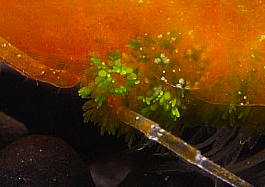
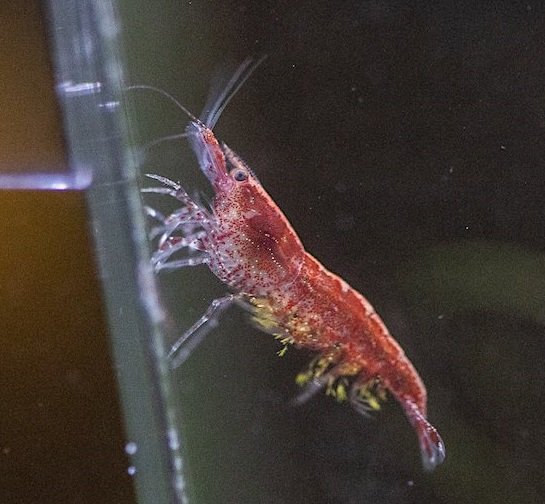
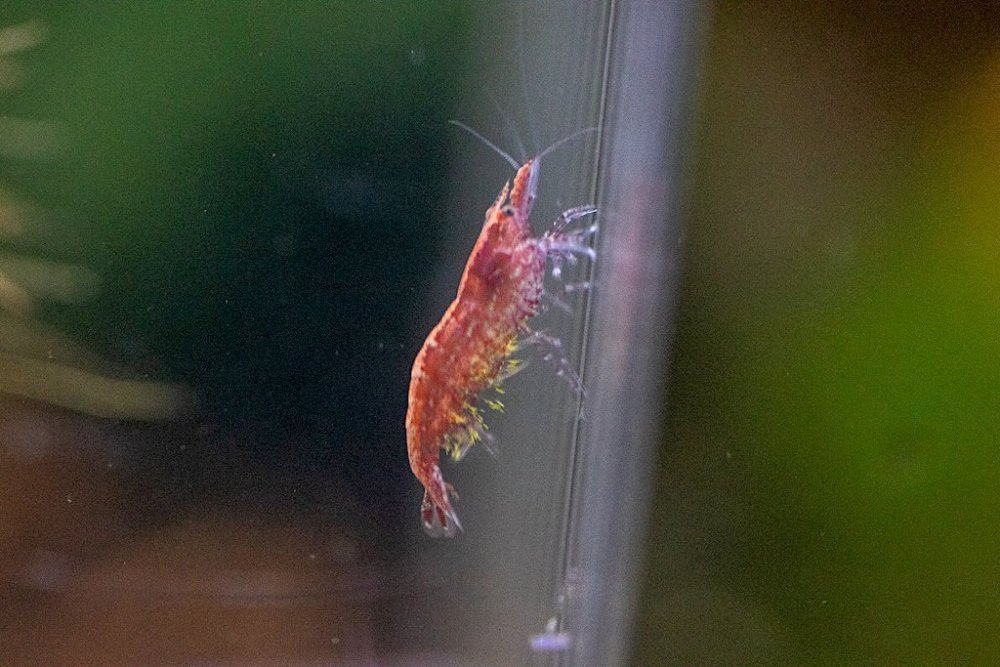
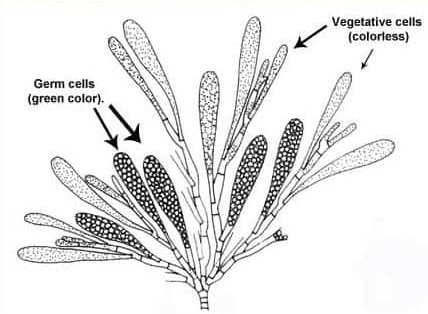
1 pointParasitic dinoflagellates and ellobiopsids (Ellobiopsidae) or Cladogonium ogishimae I will refer to both here as there is little studies on these parasites and a general lack of evidence of both types of parasites. Plus a lot of people have been calling this ellobiopsidae for many years. What we deal with in freshwater shrimp is more likely Cladogonium ogishimae, rather than ellobiopsidae. The reason Cladogonium ogishimae fits better is because it: Infects freshwater shrimp, found on the shrimp's pleopods, and turns green eventually. Ellobiopsidae, of which there are thousands of species and many of them are parasitic. Dinoflagellates and ellobiopsids are major parasites in marine invertebrates and fishes. Ellobiopsidae seem to appear on the tops of shrimps, rather than on the pleopods. The possible treatments for both will remain the same. These parasites invade the host's eggs, digestive tract, soft tissue and blood of the organism, who eventually, succumbs resulting in mortality. They propagate by spores, and if any are seen on your shrimp, care must be take to remove the infected shrimp immediately to minimise the spread to other shrimp. Diagnosis: In freshwater shrimps, the Cladogonium ogishimae or ellobiopsidae appear as green to yellow-green vegetation, reminiscent of a fungal infection. Often the infected area is between the swimming legs of shrimp and the swimmerettes (or pleopods). It has a mould like appearance. It's been mainly seen on shrimps imported from Asia. Possibly from poor water conditions. Treatment: There is evidence that a dip in formalin (Attention: carcinogenic and toxic!) could be successful. The only treatment that I know of that has worked is medication with Formalin & Malachite green combo. Separate infected shrimp immediately. And treat the infected shrimp outside of the tank in a hospital tank or a temporary container. Follow the product's instructions for dosage amount and duration. Some off the shelf products with Formalin that also includes malachite green include Fritz Mardel QuICK Cure is one such product. Aquasonic has one too. https://www.aqualifeaquarium.com.au/aquasonic-formalin-malachite-green-solution-100ml Kordon Rid Ick Plus also uses the same ingredients. Seachem Paraguard Eco Labs BSDT32 Broad Spectrum Disease Treatment https://a.co/d/97dwbNn Chances of success and survival of the shrimp depends on how early you diagnose the issue. If left for too long, the shrimp might not survive the formalin & malachite green treatment.

 1 point
 -
 1 pointFrom my experience once you see the eyes they usually hatch within the week but as you have said it is usually up to 30 days. It should be quite interesting to see when she pops. Yeah after a stressful day at work and once I put the kids to bed i'll spend about 30 to 60 mins staring at the shrimp tank. I find it quite relaxing just looking at them swim around lol.1 point
 -
1 pointYou're welcome dude. It's an appreciation that flows both ways - the guys and gals on SKF motivate me in this hobby as well.1 point
-
1 pointReally cool picture Wot_fan. As you have mentioned I like how you can see the eyes. Not long now I think before they hatch. I guess I like to be on the safer side, Just in case it could spread to your other shrimps but saying that If it was going to spread it would probably have done it by now. So how does it feel seeing the little shrimplet around? I still get excited haha.1 point
-
 Fishmosy was talking about bleach but pool chlorine does the same job. If you just add pool water you won't know how much chlorine you actually added - perhaps you're not worried. You can use Milton tablets too or any other convenient source of chlorine if this is the path you've chosen. JiCi, I knew you were talking about Alum. Thanks for adding that info, I had never imagined that use for it either.1 point