
Leaderboard
-

Squiggle
Members5Points10433Posts -
Shrimpy Daddy
Premium Members3Points388Posts -
Disciple
Platinum Members3Points2092Posts -
inverted
Members1Points605Posts
Popular Content
Showing content with the highest reputation on 01/29/15 in all areas
-
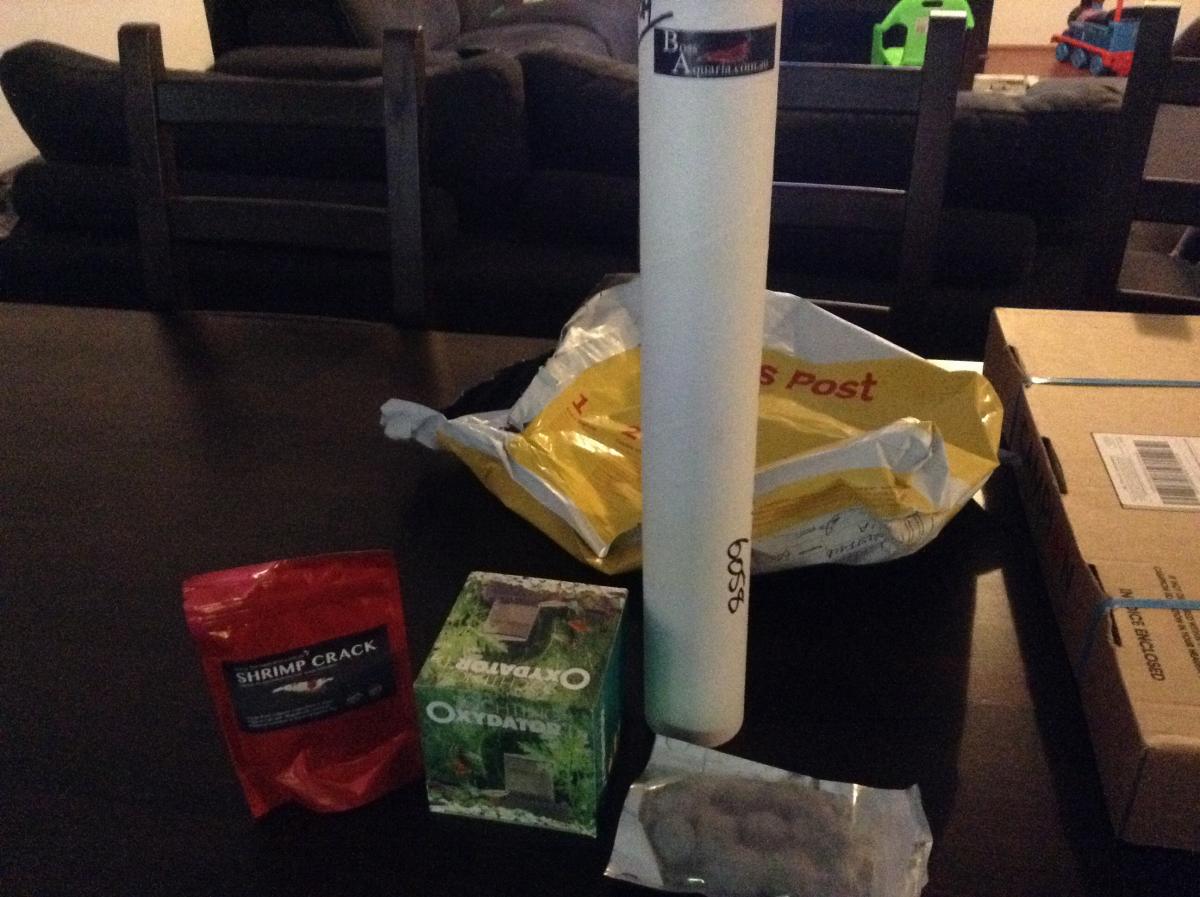
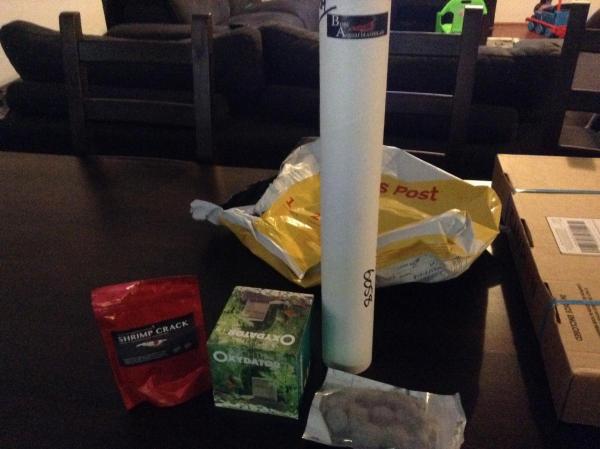
2 pointsThanks Jay. I received my package today even though I gave Jay the wrong address lol. (dont ask) Thank you very much for the extra gift. I am very happy with it!
 2 points
 -
2 pointsHi all, Recently, I did some testing on buce for about 2 month to find out what will be the best method to accelerate the grow. Hence, I would like to share some of my findings (initially I wanted to post on my blog but my blog is under-maintenance). Lighting - Buce prefers much higher lighting than anubias. However, if you keep them at very low light, it will survive and colour up but not growing much. The colouring up includes turning the emerged-grown leaves into submerge colour. But when you turn up the lighting to medium intensity (similar to the intensity for growing Staurogyne Repens) and does not inject CO2, the growth and colouring up stop. Once you inject CO2 the, the growth and colouring accelerated much faster. But it will concentrate on growing new submerge leaves instead of colouring up the old emerged-grown leaves. As such, I conclude the best lighting will be medium-low. If you planning to use stronger intensity, Otocinclus is must. Or else, the buce will be covered by diatom. Another interesting part of lighting is that when the plant receive sufficient lighting, they will grow leaves at the bottom instead of the top. Hence if you plant them into substrate at bright area and when you see them never grow any new leaves, use the twister and lift them up a little. You will see tons of leaves growing below. You may need to do this once in awhile. Before you do this, make sure there are some roots that attached to the substrate. CO2 - Tested from 5ppm to 40ppm and there is no significant differences. The key factor is as long as you inject CO2. Just a tiny bit at 5ppm will be good enough. NO3 - Tested from 5ppm to 25ppm and there is not really significant differences (I increase CO2 and lighting intensity when I increase NO3). However if the NO3 is below 5 and below and when lighting is strong, the leaves will turn yellow and diatom will form. As such, I will recommend maintain the NO3 at 10ppm (provided your pH is above 5.8). PO4 - All my tanks are consistently with 0.75 to 1ppm of PO4. Hence, I can't tell from my experiment whether they will affect buce or not. Trace Fertiliser - They love trace fert. The more you dose, the better the colour and the thicker and rubber the leaves. This makes me suspect the logic for them not growing new leaves fast. I think they have priority on using energy and nutrients to improve existing leaves, instead of growing new leaves like most plants. Best Way to Propagate - Trim them as often as possible. Once they grow to a decent height, they will grow very dense leaves. Once this happens, it is almost impossible to cut at their rhizome. For a new plant you bought, if the rhizome is long, cut them to small multiple leaves. A 2 to 4 leaves new plant grows best initially. If the rhizome has cut and the leaves are little, they will grow many leaves at one time. I did an experiment by taking a long rhizome with 2 leaves and use pen knife and do multiple cuts. End up, I get like 8 leaves growing at the same time (even in non-CO2 injected tank). Planting Area - The roots and rhizome loves substrate. Hence, they grow even much faster if you plant them into rich substrate (this is align with my finding on they love trace nutrients). The rhizome will not rot like Anubias. As such, Buce could be plant almost every where you like, except area that is high up and next to the lighting. Temperature - Tested 26C and 30C and they are doing just fine. Many claims that they melt at high temperature. I think this got to do with nutrients level, which is the same as lighting intensity. Higher temperature will have higher metabolic rate that may have the same effect as high light intensity. If sufficient nutrients (including CO2) are provided and lighting intensity is not too strong, don't worry about the leaves melting. They will grow back later on. Personally, I prefer them to melt away all the emerge-grown leaves and grow out the smaller, rubbery, thick and colour leaves. But there is one annoying thing you need to take note (not much people observed). Buce's young leaves are tender and tasty. Shrimp and Otocinclus love to much them. If you are keeping buce with them, make sure they are well fed. Or else, you will find your buce leaves start to have bit and pieces being bitten off. Hope these information help. ;)2 points
-
2 pointsThis would be where you got the name from, this was produced by Imke some time ago & has widely been accepted into common use. Having said that, the term "White Rili" has been used & accepted foras long if not longer on this forum, so both can be considered correct.2 points
-
1 point
-
1 pointIn this case, don't dose NaHCO3 anymore. Before you put in the shrimp, you will need to do a water restart to clear all excess stuffs you added for the past weeks.1 point
-
1 point
-
 1 pointAs I mentioned on other forums, you do not need oxygenators and air stones. Air stones don't aerate the water directly. The act of the bubbles breaking the water surface, hence surface tension, causes oxygen exchange. As you said, air stones also degass the CO2. All I do is have the outlet of my canister 1 inch below the surface and blowing horizontally across the water. This creates small ripples which again break the surface tension and aerates the water. I have 30 cardinal tetras, 10 lemon tetras, 100+ RCSs, 10 Caridina Typus and hundres of pond and ramshorn snails all in a 165L tank with CO2 at 2BPS fully dissolved with a massive external CO2 reactor and have no issues with fish gasping for air. Here is a photo of the famous Tom Barr's tank with the surface ripples for oxgenation.1 point