
Leaderboard
-

jayc
Moderators4Points6248Posts -

Chels
Members1Points37Posts -

Tracy
Members1Points5Posts -
.jpg.ec335bf747246c605262ed8e75a949b0.jpg)

Cosmo
Members1Points20Posts
Popular Content
Showing content with the highest reputation on 01/19/21 in Posts
-
3 pointsThose are the extremities of the range where they will survive. You don't want to be near those extremes. Lifespan will be greatly reduced. Keeping it to the ranges we suggest will mean the shrimp are living in a more tolerable conditions. It also means you leave room for swings either way with enough time to catch it and correct it. It's like saying "Humans like 10deg C to 50deg C." That statement is correct and incorrect at the same time. Yeah, we might survive in those temperatures, but we certainly prefer it to be 20-26deg C. I certainly don't like 50Deg C temps. Likewise with shrimp. When GH is too high, the excessive calcium content will make moulting more difficult, and the shrimp expends too much energy trying to shed their old shells. This is a number one cause of deaths apart from bacterial infection. The high calcium content also makes the eggs harder and males trying to fertilise eggs becomes an issue. When GH is at the opposite spectrum of the scale and is too low, their shells are not going to be strong enough and you might get deformities. KH impacts your water parameter like pH. When KH is too high, your pH increases. When KH is too low, pH drops. The key to to maintain stability wit your water parameter. Just enough KH to get the right pH reading with out it swinging wildly in a short amount of time. Settling on a value of 2-4 dGH for KH is the Goldilocks number. Just enough to get pH to the right value, not too much and not too little. Keeping water parameters at the extreme ends of their tolerance will also result in a stressed shrimp, leading to lower immunity and increased possibility of catching diseases.3 points
-
1 pointok, that is the BEST ANSWER I've ever seen! Thank You! is there an article post explaining this? If not, there should be. Thank you so much for your time answering these questions.1 point
-
1 point
-
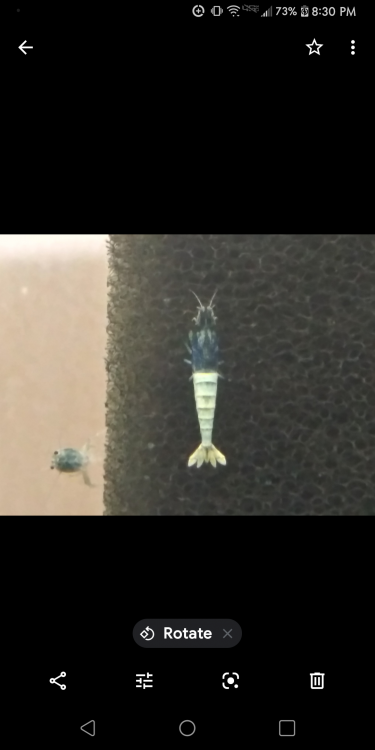
1 pointHello, SKFAQUATICS! Thanks for adding me to the group. I adore everything about aquariums but I am addicted to the tiny but mighty Caridina shrimp!
 1 point
 -
Thank you again for all of the excellent advice!! Yes!! I didn't actually introduce the trumpet snails on purpose. Either the plants from my local independent pet store had hitchhikers or the plants from Petco had some. I rinsed them thoroughly didn't quarantine them so it's my fault. I will catch all but 1 and put them in my turtle tank. Never a short supply of algae in there even with 4 snails and a bn pleco. Neon tetras are super readily available here. I introduced a single snail and it hasn't reproduced yet. It's black and I can't remember the name. And with a bristlenose pleco there is still a lot of biofilm and small food particles to clean. I really did a number overfeeding because there's food all over even after sectioning the substrate + 2 WCs. I'm feeding a teeny tiny amount every few days on top of the biofilm. They take hours to eat it all. It's hard to tell how much to feed, I wish there was a care guide just on that part. I have omnivore shrimp pellets which are discs, I feel 1/4 of those and a tiny piece of a pleco pellet (disc) and a few tiny granules of herbivore invert pellets. That's every 3 days but I could probably go 4 or 5 with all the biofilm. I have a heater but never use it except for the biofilm. It's a favorite for grazing and it's now spotless. Had a gross crust a few days ago.1 point