

Leaderboard
-

jayc
Moderators1Points6248Posts
Popular Content
Showing content with the highest reputation on 01/17/21 in Articles
-
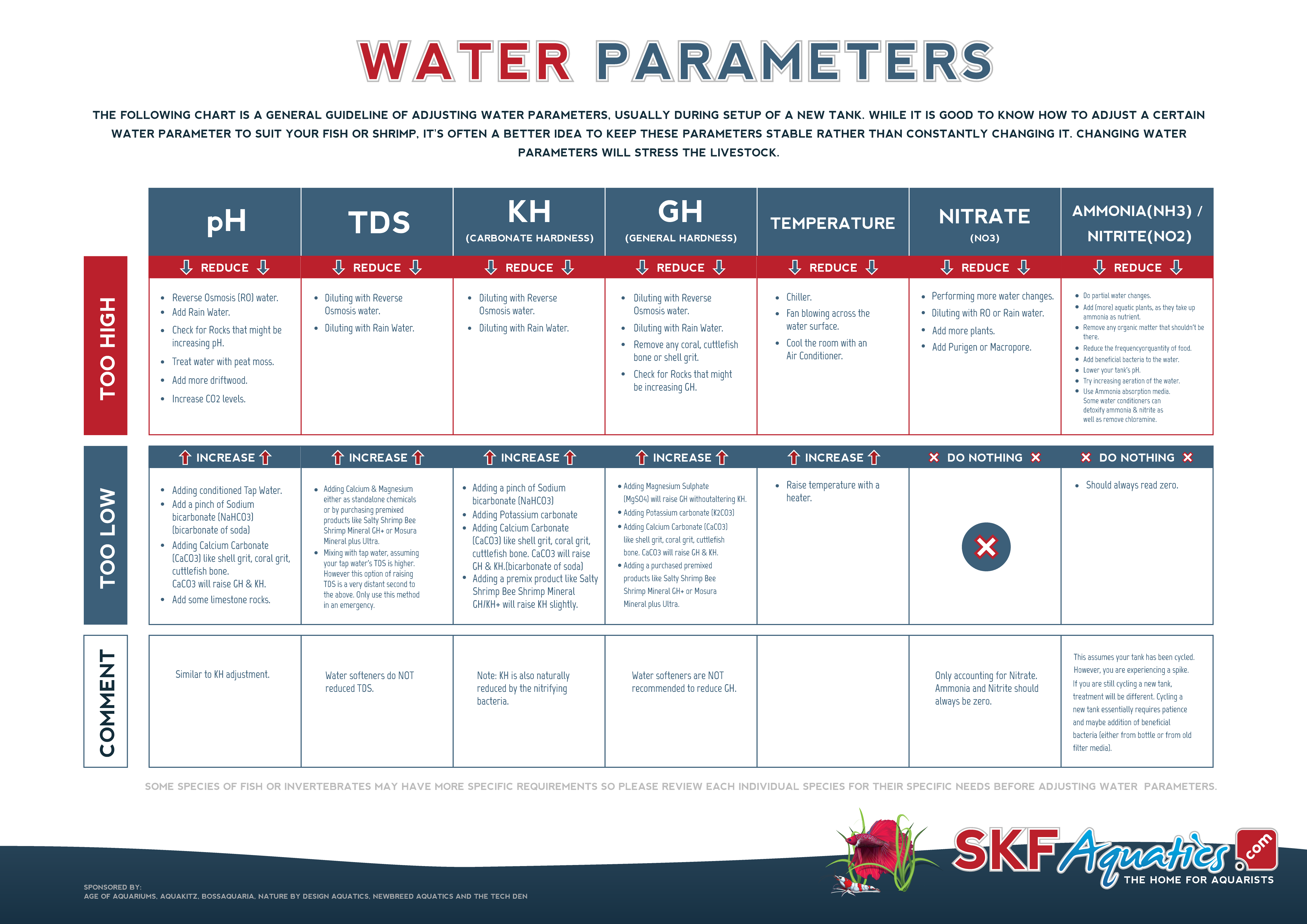 Someone asked for a guide on adjusting water parameters. As I don't recall one being made on SKF, I thought I'd start a little Cheat Sheet for adjusting water parameters. The following chart is a general guideline of adjusting water parameters, usually during setup of a new tank. While it is good to know how to adjust a certain water parameter to suit your fish or shrimp, it's often a better idea to keep these parameters stable rather than constantly changing it. Changing water parameters will stress the livestock. Some species of fish or invertebrates may have more specific requirements so please review each individual species for their specific needs before adjusting water parameters. Too High Too Low Comment pH Reduce pH with: Reverse Osmosis (RO) water. Add Rain Water. Check for Rocks that might be increasing pH. Treat water with peat moss. Add more driftwood. Increase CO2 levels. Increase pH by: Adding conditioned Tap Water. Add a pinch of Sodium bicarbonate (NaHCO3) (bicarbonate of soda) Adding Calcium Carbonate (CaCO3) like shell grit, coral grit, cuttlefish bone. CaCO3 will raise GH & KH. Add some limestone rocks. Similar to KH adjustment. TDS Reduce TDS by: Diluting with Reverse Osmosis water. Diluting with Rain Water. Increase TDS By: Adding Calcium & Magnesium either as standalone chemicals or by purchasing premixed products like Salty Shrimp Bee Shrimp Mineral GH+ or Mosura Mineral plus Ultra. Mixing with tap water, assuming your tap water's TDS is higher. However this option of raising TDS is a very distant second to the above. Only use this method in an emergency. Water softeners do NOT reduced TDS. KH (Carbonate Hardness) Reduce KH by: Diluting with Reverse Osmosis water or Diluting with Rain Water. Raise KH by: Adding a pinch of Sodium bicarbonate (NaHCO3) (bicarbonate of soda) Adding Potassium carbonate (K2CO3) Adding Calcium Carbonate (CaCO3) like shell grit, coral grit, cuttlefish bone. CaCO3 will raise GH & KH. Adding a premix product like Salty Shrimp Bee Shrimp Mineral GH/KH+ will raise KH slightly. Note: KH is also naturally reduced by the nitrifying bacteria. GH (General Hardness) Reduce GH by: Diluting with Reverse Osmosis water. Diluting with Rain Water. Remove any coral, cuttlefish bone or shell grit. Check for Rocks that might be increasing GH. Raise GH by: Adding Magnesium Sulphate (MgSO4) will raise GH without altering KH. Adding Potassium carbonate (K2CO3) Adding Calcium Carbonate (CaCO3) like shell grit, coral grit, cuttlefish bone. CaCO3 will raise GH & KH. Adding a purchased premixed products like Salty Shrimp Bee Shrimp Mineral GH+ or Mosura Mineral plus Ultra. Water softeners are NOT recommended to reduce GH. Temperature Reduce Temps with a: Chiller. Fan blowing across the water surface. Cool the room with an Air Conditioner. Raise Temps with a Heater. Nitrate (NO3) Reduce Nitrate by: Performing more water changes. Diluting with RO or Rain water. Add more plants. Reduce feeding amounts. Add Purigen or Macropore. Do nothing Only accounting for Nitrate. Ammonia and Nitrite should always be zero. Ammonia(NH3) / Nitrite(NO2) To reduce NH3 and NO2: Do partial water changes. Add (more) aquatic plants, as they take up ammonia as nutrient. Remove any organic matter that shouldn't be there. Reduce the frequency or quantity of food. Add beneficial bacteria to the water. Lower your tank's pH. Try increasing aeration of the water. Use Ammonia absorption media. Some water conditioners can detoxify ammonia & nitrite as well as remove chloramine. Should always read zero. This assumes your tank has been cycled. However, you are experiencing a spike. If you are still cycling a new tank, treatment will be different. Cycling a new tank essentially requires patience and maybe addition of beneficial bacteria (either from bottle or from old filter media).1 point