
Leaderboard
-

DNTM_Shrimp_Breeders
Members5Points4Posts -

jayc
Moderators3Points6248Posts -
Cesar
Administrators2Points255Posts -

KeenShrimp
Members2Points270Posts
Popular Content
Showing content with the highest reputation on 10/18/19 in Posts
-
3 pointsI am sorry for some reasons the picture did not go through the last time ? Also, I am cycling 3 more tanks for a new journey with Taiwan Bee shrimps ?
 3 points
 -
2 points
-
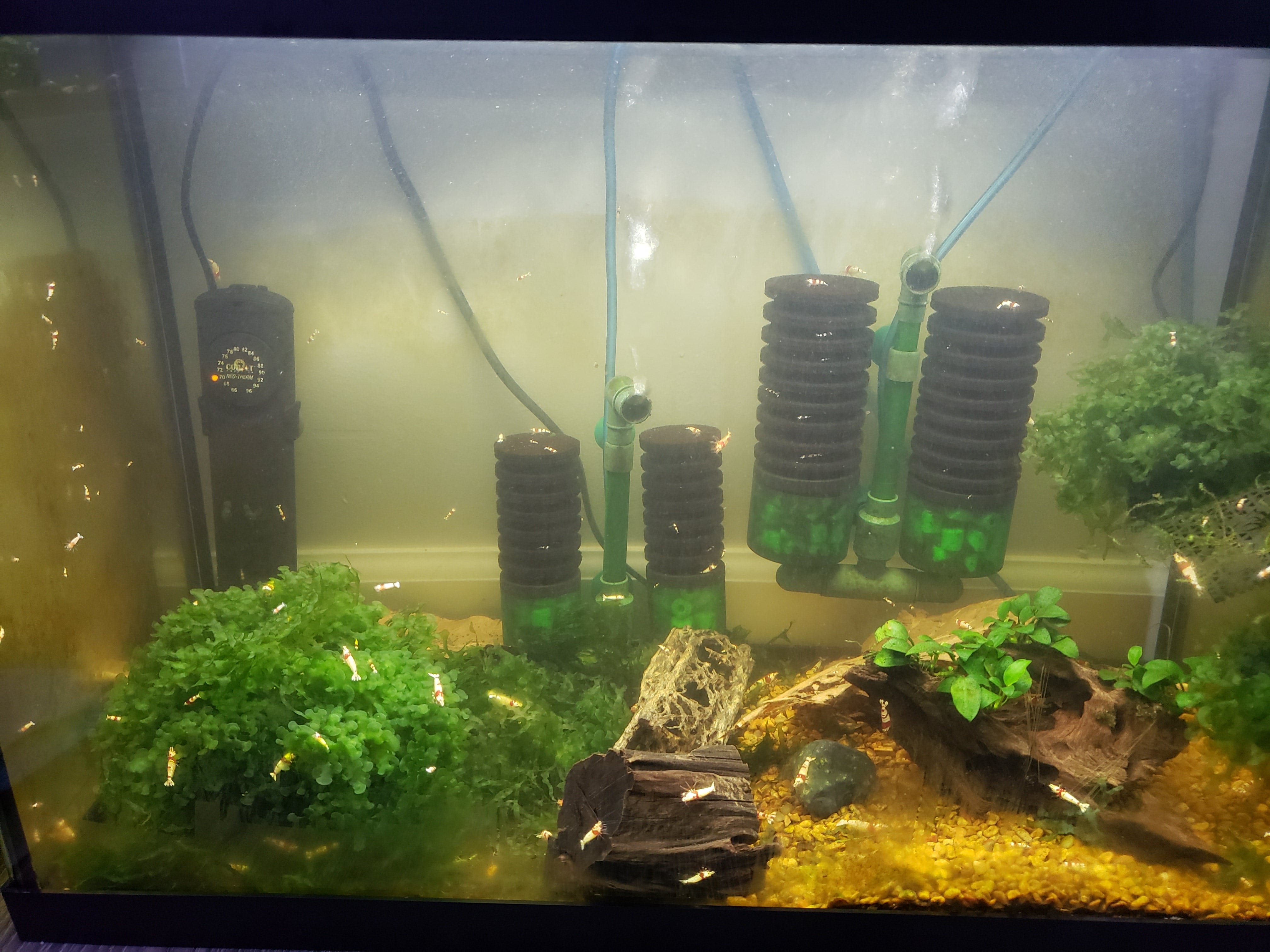
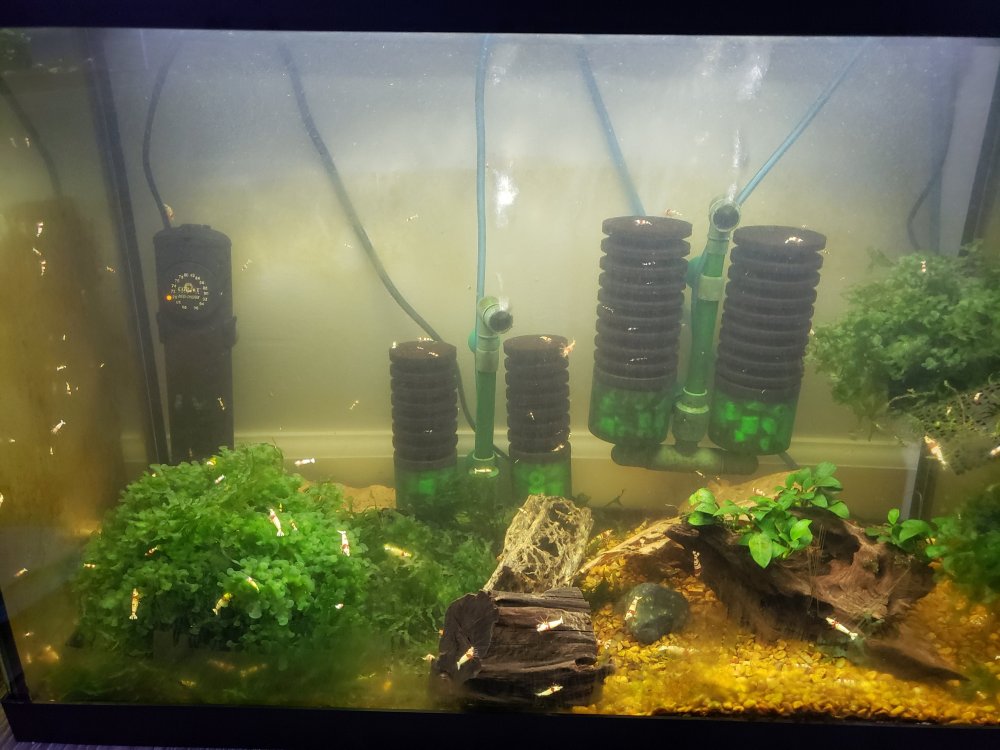
1 pointHello everyone, This is my first post at SKF Aquatics forum. I came across this forum by reading the amazing post about breeding Taiwan Bees shrimp written by Jayc. Regarding my first post, I just want to share with everyone the result that I've got from my little experiment with my current colony of PRL CRS. A little bit about myself, I've been keeping all kind of shrimps over the last 3 years, starting with ghost shrimps, then move on the Amano shrimps, then cherry shrimps, and now I have 4 tanks of 2000+ PRL CRS and CBS. About 6 months ago, after having some difficult time of finding ADA at a good price, I decided to start an experiment on keeping PRL CRS in a tank without active substrate to see if it's possible as well as if there are any problems of not having an active substrate. I setup a 20 gallon tank with regular cheap gravel, 1 driftwood, 1 cholla wood, some annubias, and some subwassertang. I use RODI water and remineralize it to the TDS of 130. pH of my RODI water is 7.2 to 7.5. I did not cycle the new tank because I was using two sponge filters from the other existing tanks. I then moved 25 PRL CRS from well-established tank that has pH of 6.6 and TDS of 135 to the new tank. After about 6 months, the result that I got is pretty amazing. I've got tons of baby shrimps and lots of berried female. Attached is the picture of the experiment tank ?1 point
-
1 point@sdlTBfanUK pH is around 7.4 in the morning and 7.2 at night. I know it's dangerous and easy to have pH swing when you don't have active substrate. That's why I measure pH at least twice a day using the pH meter.1 point
-
1 pointIf there are no shrimps in the tank, you can do a 100% water change with water that is adjusted to your liking with Salty shrimp GH/KH+.1 point
-
1 point
-
 1 pointAgain, thanks for all the help. I ordered the Shrimp GH+KH minerals and they arrived today and did a 20l water change. I plan to do 20l on Saturday and 20l on Tuesday when I'm off, so that'll be over 100% water change. If my tank stats come back o.k, I might finally look into getting some shrimp next week.1 point
 -
1 pointArguably the worlds leading crustacean expert, Chris Lukhaup mentioned in his lecture at Seahorse Aquarium ( 3-part lecture available on YouTube) that they suspect that the Orange eye tigers might be blind, but it does not sound like anyone knows for sure. I have spent a bit of time searching on Google Scholar without success. Where is a crustacean ocular expert when you need one?!1 point
-
1 pointAwesome post guys, @LaxLogic, I have been trying to find confirmation on the blindness of the orange eye shrimp in literature. Have you perhaps come across any literature that can shed more light on this for us? The most information that I could come across was that the blindness might be due to the complete lack of rhodopsin in the eyes, but I could not find any literature confirming this a hundred percent that it would result in no vision. I have been doing a few movement experiments outside my tanks and at the moment it looks like they have very poor vision, but not zero vision. I do also question the ethics of this as and would appreciate any scholarly information on this. @waffle, I have a whole new respect about the fearlessness of these shrimp and would attribute that to their aggression factor. I had 4 adult tigers shipped to me from a very reputable breeder. One female was very large. When the package arrived, there were only 3 tigers left: they managed to eat a Whole adult shrimp in 2 days! My large tiger female is so aggressive that she beats my ottos over the head when they come near food that she fancies...I feed her meat once a week just in case she tried to eat my cherries..1 point
-
There are other sources of Calcium for your shrimp apart from dosing Calcium sulfate or dropping shells and cuttlefish bones into the water column. These sources come from the foods we feed the shrimp. These are all natural sources of food, so should be okay to feed your shrimp, just be careful you wash them properly and ensure no fertiliser/chemical residue is on the veg/fruit. If you grow it yourself, you will be sure of what was sprayed on the plants. Here is a list of vegetables and fruits by mg of Calcium content per 100gm of food. Vegetable (mg Ca) Arrowhead 1 Chives (per tablespoon) 2 Peppers, Sweet 6 Alfalfa sprouts 10 Pumpkin leaves 15 Asparagus 14-28 Coriander (cilantro) 16 Chard, Swiss 18 Radish seed sprouts 19 Lettuce, Cos, Romaine 20 Lettuce, Romaine (100g) 20 Squash, Zucchini 20 Jerusalem artichoke 21 Pumpkin 24 Endive 26 Squash, Summer 26 Cauliflower 28 Purslane 28 Radishes 28 Carrots 30 Eggplant 30 Cabbage 32 New Zealand Spinach 32 Kohlrabi 34 Lettuce, Looseleaf 38 Peas, Green 36 Turnips 39 Cress, garden 40 Watercress 40 Broccoli 42 Mung bean sprouts 42 Celery 44 Beet greens 46 Snap beans 46 Parsnips 47 Spinach 56 Mustard Greens 58 Green Onions 60 Peas, Edible pod 62 Rutabagas 65 Celeriac 68 Chinese cabbage 74 Parsley 78 Salsify 80 Borage (Starflower) 82 Okra 82 Kale 94 Lettuce, Iceberg 102 Dandelion greens 103 Turnip Greens 105 Kale, Scotch 137 Chicory greens 180 Mulberry Leaves ~200 Collard Greens 218 Fruits mg Ca Plum 4 Peach 5 Nectarine 5 Casaba Melon 5 Blueberries 6 Honeydew Melon 6 Banana 6 Cranberries 7 Apple(with skin) 7 Pineapple 7 Persimmon 8 Watermelon 8 Mango 10 Grapes 11 Cantaloupe 11 Pear 11 Grapefruit, Red & Pink 11 Grapefruit, White 12 Apricots 14 Tangerine 14 Strawberries 14 Sweet Cherries 15 Raspberries 22 Papaya 24 Lemon (peeled) 26 Kiwi fruit 26 Blackberries 32 Lime 33 Orange 40 Seedless Raisins 49 Just a word of caution. These foods contain Phosphorous and could have an ill effect on your water quality. It might even cause an algal bloom if the levels of phosphorous become too high. Common sense applies when feeding ... not too much too often, and if there are any leftovers, remove it. For those Phosphorous conscious people out there, this is a table of Calcium to Phosphorous ratio: Calcium:Phosphorus Ratio - Vegetables 14.5:1 -- Collards 10.0:1 -- Mulberry Leaves 7.5:1 -- Spinach, Mustard 4.5:1 -- Turnip Greens 4.3:1 -- Lambsquarters 3.2:1 -- Dill Weed 3.0:1 -- Beet Greens 2.8:1 -- Dandelion Greens 2.8:1 -- Chinese Cabbage (pak-choi) 2.7:1 -- Lettuce, LooseLeaf 2.4:1 -- Mustard Greens 2.4:1 -- Parsley 2.4:1 -- Kale 2.1:1 -- Chicory Greens 2.0:1 -- Spinach 2.0:1 -- Watercress 2.0:1 -- Cabbage 1.9:1 -- Endive 1.6:1 -- Celery 1.5:1 -- Purslane 1.4:1 -- Cilantro 1.4:1 -- Lettuce, Butterhead 1.3:1 -- Okra 1.1:1 -- Swiss Chard 1.1:1 -- Turnip 1.1:1 -- Chard, Swiss 1.0:1 -- Squash (winter, all varieties) 1.0:1 -- Green Beans 0.8:1 -- Lettuce, Romaine 0.8:1 -- Sweet Potato 0.8:1 -- Rutabaga 0.7:1 -- Broccoli 0.7:1 -- Cucumber (with skin) 0.6:1 -- Carrots 0.6:1 -- Squash (summer, all varieties) 0.6:1 -- Carrots, Baby 0.6:1 -- Brussels Sprouts 0.5:1 -- Cauliflower 0.5:1 -- Kohlrabi 0.5:1 -- Pumpkin 0.5:1 -- Alfalfa Sprouts 0.5:1 -- Parsnips 0.5:1 -- Peppers,Green 0.5:1 -- Peppers,Red 0.4:1 -- Sweet Potato Leaves 0.4:1 -- Beets 0.4:1 -- Asparagus 0.2:1 -- Tomato .02:1 -- Corn, White Calcium:Phosphorus Ratio - Fruits 4.8:1 -- Papaya 2.9:1 -- Orange 1.8:1 -- Lime 1.8:1 -- Raspberries 1.6:1 -- Lemon (no peel) 1.5:1 -- Blackberries 1.5:1 -- Grapefruit, White 1.2:1 -- Grapefruit, Pink and Red 1.2:1 -- Tangerine 1.0:1 -- Pineapple 1.0:1 -- Pear 1.0:1 -- Apple (with Skin) 0.9:1 -- Mango 0.9:1 -- Watermelon 0.8:1 -- Cherries, Sweet 0.8:1 -- Grapes 0.8:1 -- Cranberries 0.7:1 -- Casaba Melon 0.7:1 -- Apricots 0.7:1 -- Kiwi 0.7:1 -- Strawberries 0.6:1 -- Cantaloupe 0.6:1 -- Honeydew Melon 0.6:1 -- Blueberries 0.5:1 -- Persimmon, Japanese 0.5:1 -- Raisins, Seedless 0.4:1 -- Peach 0.4:1 -- Plum 0.3:1 -- Nectarine 0.3:1 -- Banana So Collards are a good choice as they have a high Calcium to Phosphorous ratio While Bananas are not such a good choice as they a low Calcium to Phosphorous ratio.1 point