
Leaderboard
-

kvinnyy
Members5Points9Posts -

jayc
Moderators3Points6248Posts -

Steensj2004
Platinum Members2Points273Posts -
Cesar
Administrators1Points255Posts
Popular Content
Showing content with the highest reputation on 09/25/19 in Posts
-
2 pointsMontmorillonite for most part won't sky rocket your TDS but it does release magnesium and calcium over time. The clay also helps binds and traps toxic compounds apparently. It's suppose to be beneficial for shrimps. I have had one stone in there for a while and figured I should replace it because I read that it loses its effects over time and should be removed. You can see the saddle sometimes through a transparent gap behind their head. It's grey in colour. And yes, I assume the vegetables I feed them are organic and I washed them in filtered water and boil them in filtered water and then rinse them in ro water before putting it in the tank.2 points
-
1 pointI made the switch to ro water + remineralising with diy sulphate mix (ca, mg , potassium) because I was seeing less activity during the winter and thought it would be my water. My parameters initially were: pH: 6.8 gH: 3 kH: 2 Temp: 18-20c TDS: 140-160 Every so often, I would see shrimp deaths so I thought it was a good idea to increase it a bit. It was also getting colder and at one point, temperatures in the tank reached as low as 16c. This scared me and I put a heater in there to get the temperature up to 22c from the average 18c. I also put another montmorillonite mineral rock in there in attempts to increase calcium and magnesium levels a bit. But my shrimp started dying and I don't know if it was the sudden temperature swing or the mineral rock. It's been about a month but I still keep seeing deaths. So I gave the ro + remineralising a go. For the past week I have been dripping water that I mixed into the filter at the rate of about 1 drop per second. The water I was dripping in has gH of 6, kH of 0, TDS of 140. I have managed to raise the gH of the tank to 4 now but my shrimp are spazzing out and jumping all over the place and dying. I don't know what I should do now. My tank parameters now are: pH: 6.8 gH: 4 kH: 0-1 Temp: 23 TDS: 168 - 175 (rises during the night, don't know why) Ammonia: 0 Nitrite: 0 Nitrate: 0-5 ppm I have a 20 gallon tank if that helps and at the moment I'm dripping ro water into the tank to try to lower the TDS to 140-150.1 point
-
1 pointVery interesting video... I didn't know that they slow down breeding during winter and that probably explains why I haven't seen any berried shrimp at all for a couple of months now. I've been trying to look for the saddle too and couldn't see any darkened areas on the carapace of my females. I thought it was because I wasn't feeding them enough. I feed my shrimp snowflake foods, blanched vegetables, bee pollen and tried shrimp cuisine by Hikari. When I tried the shrimp cuisine, that was the point where I noticed a rise in tds from 150 rising up to almost 180. I only fed my shrimp like 5 pellets one time and my TDS kept rising and rising for the next couple of days. Shrimp were dying left and right. It was at the same time when I installed the heater and added an extra montmorillonite rock. It's hard to pinpoint what went wrong that started all these deaths but I started to question whether or not it was the shrimp cuisine because I had a look at the ingredients and it did say it contained copper. I stopped feeding them shrimp cuisine after finding out that. It could also have been the sudden swing in temperature that caused the deaths. I'm really not sure anymore.1 point
-
 1 pointOne of my early attempts at betta was a tank with 3 females that I bought from a shop but it turned out one must have been a male as one day there were 10s of babies which I wasn't prepared for???? Gave a few away but most didn't survive very long as I didn't know what I was doing at that stage. It did make me aware that I don't want to breed them again................. Simon1 point
 -
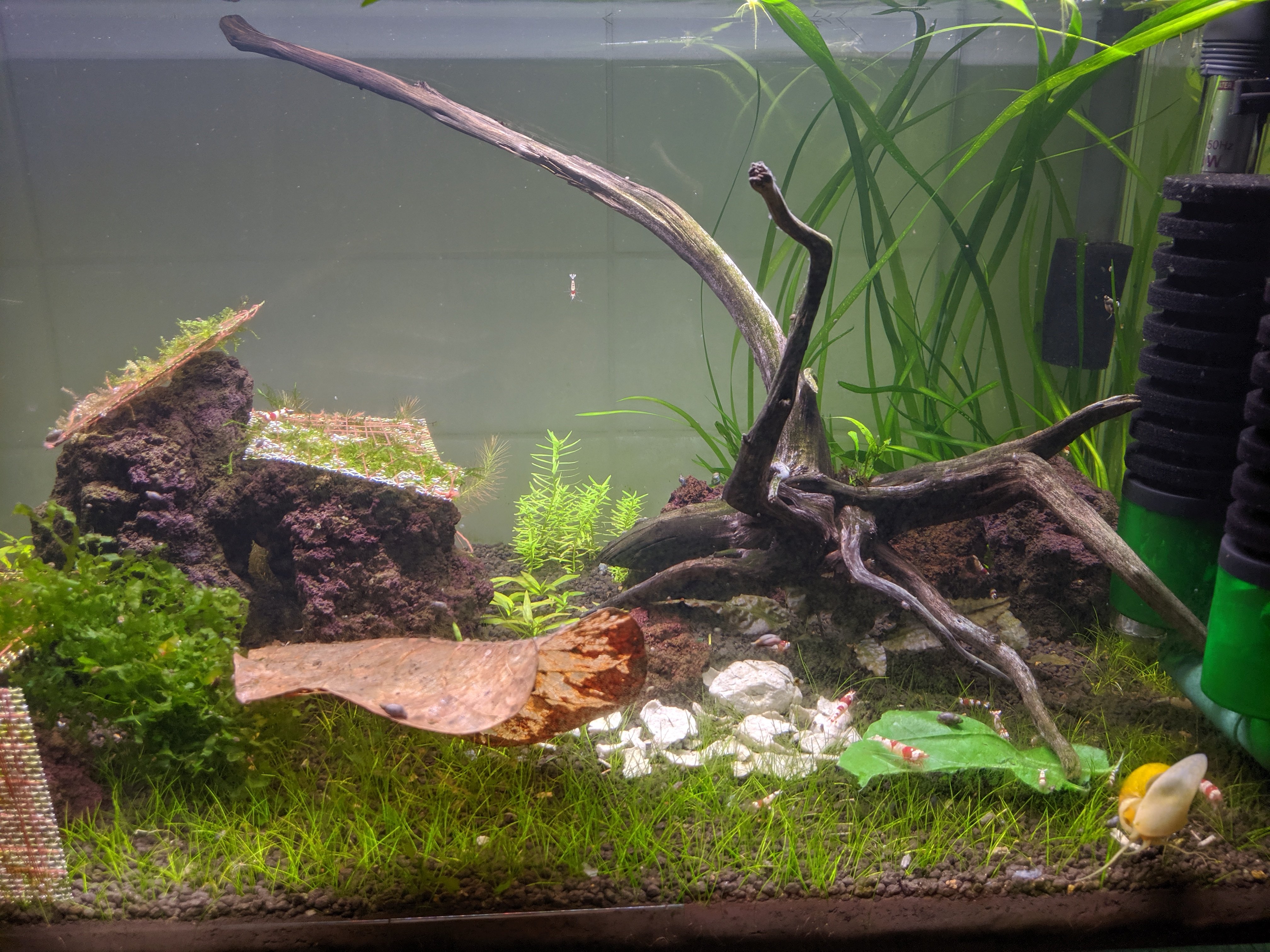
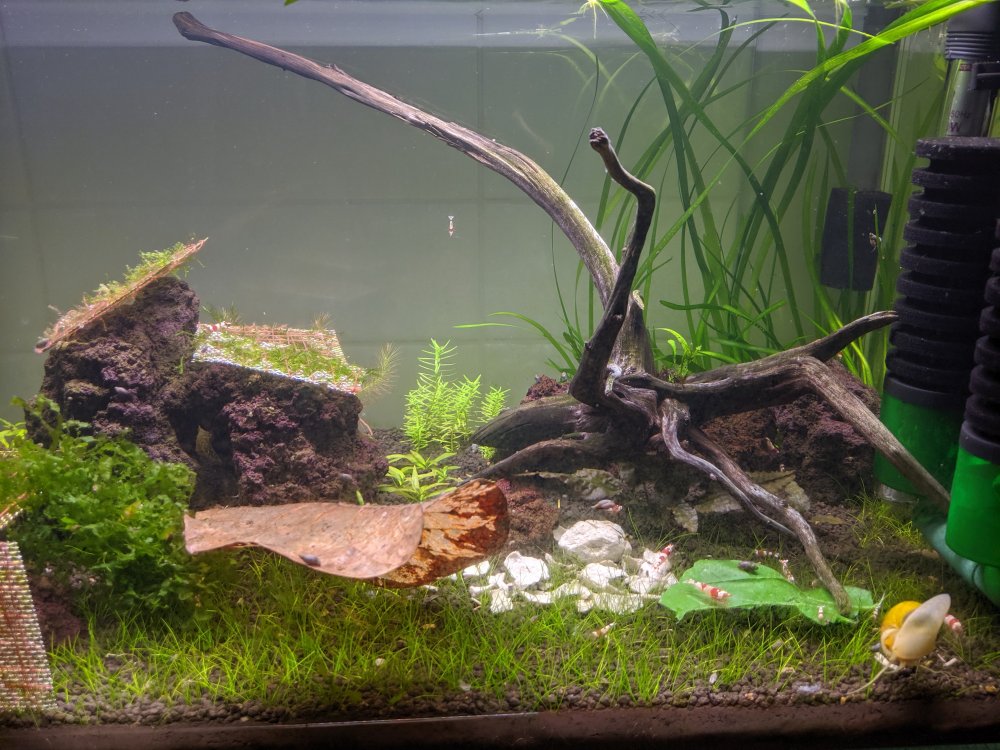
1 point1) I keep caridina shrimp. Pure red lines. Have 2 mystery snails, bunch of ramshorns snails and pond snail babies in the tank. Also have a small bristlenose catfish. 2) I live in Sydney, inner west suburbs but I haven't been using tap water recently. 3) No lid, it's an open tank. It's next to the washing machine. One possibility is that specks of detergent powder could have made its way into the tank. 4) I have Amazonia substrate, lava rocks, drift wood, stainless steel mesh with various kinds of moss tied down with cotton string. Have had this tank for about 2 years and have never experienced anything like this. 5) Tank runs on an aquaclear filter with ceramic noodles and a sponge filter driven with an airpump. 6) I used an aquascaping spade/shovel to mix the solution with the ro water in a clean bucket. The mix I used was the one you suggested. 58g CaSO4: 37g MgSO4: 11 K2SO4. I also should add that not every shrimp is acting this way. The adult shrimp seem to be fine, just the juveniles and sub adults seem to be losing their ability to swim properly. Some swim upside down/do loop de loops ? eventually losing their colour and lying at the bottom sideways as if they are struggling to molt.
 1 point
 -
1 pointI cannot see anything immediately wrong with your water parameters. What shrimp are we talking about here? And where are you located? Shrimp spazzing out means that there is something toxic in the water that is affecting them, unlike a wrong water parameter which is usually a slow affect on the shrimp. If it's getting critical, get the shrimp out into a temporary container and perform a 100% water change asap. Including the water in external filters. Refill the empty tank with your RO water treated to the correct parameters. Then reintroduce the shrimp by slowly drip acclimation. Can you post a picture of the whole tank? Is there a lid on the tank? Describe what else you have in the tank as detailed as possible. List all decorations, plants, rocks, wood, etc. Does your tank run on air pumps? And has anyone sprayed insecticides (fly or roach sprays) nearby lately? Can you show us what was used to mix the ca, mg, K? And what ratios of each? Apologies for all the questions, just trying to get a picture here to see if we can help you.1 point
-
I’ve heard lower temps decrease breeding. Do higher temps yield more males or females? I assume you want more females. I’m currently at 74, should I go up?1 point
-
1 pointI'm glad your betta tank is doing well. It's always so rewarding seeing my small contribution helping others in the hobby. Sounds like it might be time for a couple of female bettas to be added.1 point
-
What have you heard specifically? - obviously if it's too hot or too cold they stop breeding. Temps will affect the % of males vs females you get from the eggs.1 point
-
1 point
-
The tank is cycled well. Sponges were in another tank for a over a month, used cycled water, stone, and substrate(1/2 new Amazonia which creates ammonia as well). Pure ammonia was being dosed to build bacteria and monitor the colony. Final test was at 3 ppm, reduced completely within 24 hours. Ive heard temp can affect breeding as well, suggestions on that? Or is it hogwash?1 point
-
Appears someone got some AMAZING shots of these parasites in shrimp molts... and it's not just in Caridinas. (no surprise there! just, there's at least one or more Neo specific parasites out there that don't bother Caridinas!) It's in this video below.... actually see them about 12 minutes in. (be sure to watch in 1080p!) One person thinks they might be apostome ciliates, also seen in saltwater shrimp. http://www.bioone.org/doi/abs/10.1111/j.1550-7408.2004.tb00598.x?prevSearch=&journalCode=eumi And doing a quick search shows some scary stuff.... and interesting pages! Appears as if copepods can't even be free of these things.... yeeghads! https://www.researchgate.net/publication/294284052_Biology_of_Symbiotic_Apostome_Ciliates_Their_Diversity_and_Importance_in_the_Aquatic_Ecosystems https://www.researchgate.net/publication/228498029_Symbiosis_of_planktonic_copepods_and_mysids_with_epibionts_and_parasites_in_the_North_pacific_diversity_and_interactions And now I feel like molts should never be left in the aquarium...1 point