
Leaderboard
-

jayc
Moderators3Points6248Posts -

anthonyd
Members1Points127Posts -
revolutionhope
Members1Points1179Posts -
fishmosy
Members1Points4594Posts
Popular Content
Showing content with the highest reputation on 05/16/17 in Posts
-
Here is my formula for re-mineralising RO or Rain water: Powdered compound Grams needed: Calcium Sulphate CaSO4 Heptahydrate (so it dissolves easily) or Dihydrate if you can't find it, but dihydrate is not as soluble. 58gm Magnesium Sulphate (Epsom Salt) MgSO4 37gm Potassium Sulphate (aka Sulphate Of Potash) K2SO4 11gm Iron Sulphate (optional) FeSO4 0.30gm Manganese Sulphate (optional) MnSO4 0.16gm Total weight 106.46gm Multiply accordingly if you need to mix bigger batches. Alternatively, Iron and Manganese can be replaced with a Micro-nutrient (trace element) mix of 0.46gm. Again micro nutrients or trace elements are optional, but a small amount of these minerals can be beneficial for shrimps. They will get it elsewhere if it is not added here. You can either use it in powder form, adding small teaspoons to your water change until a TDS of 140-160 is reached. OR You can premix this in 500ml bottle of RO water, and drip it into your water change until the desired TDS 140-160 is reached. If you have a TDS pen, you can check how much 1gm will raise TDS in 1L of water. Similarly you can also test GH/KH raise in 1L of water. It is very important you test this yourself, since there can be a number of variables between your mix and my mix. This mix will not alter pH. You will be able to find all you need at www.aquariumonlinestore.com.au <--- Back in business as of Jan 2018! It is getting more difficult sourcing Calcium Sulphate heptahydrate. The best source I can find is from home brew shops. keg-king.com.au/calcium-sulphate-1kg.html - $9.75 for a kilo. This is food grade stuff. removed - never seem to be in stock. https://www.keg-king.com.au/calcium-sulphate-caso4-300g.html.html https://www.ebay.com.au/itm/111974621019 - $20.89 for 1kg of Calcium Sulphate. https://www.bunnings.com.au/manutec-1kg-epsom-salt_p2960980 - 1kg of Magnesium Sulphate. https://www.bunnings.com.au/richgro-1kg-soluble-powder-sulphate-of-potash_p2980321 - 1kg of Potassium Sulphate (Potash). Alternatively, if you need a remin mix for Neocaridina or Tigers, you can replace 15g - 20g of Calcium Sulphate with Calcium Carbonate or Calcium chloride. Calcium chloride is probably easier to dissolve in water and that would be the preference. This will raise KH a bit. http://keg-king.com.au/calcium-carbonate-caco3-300g.html - $4.95 for 300g of Calcium Carbonate.1 point
-
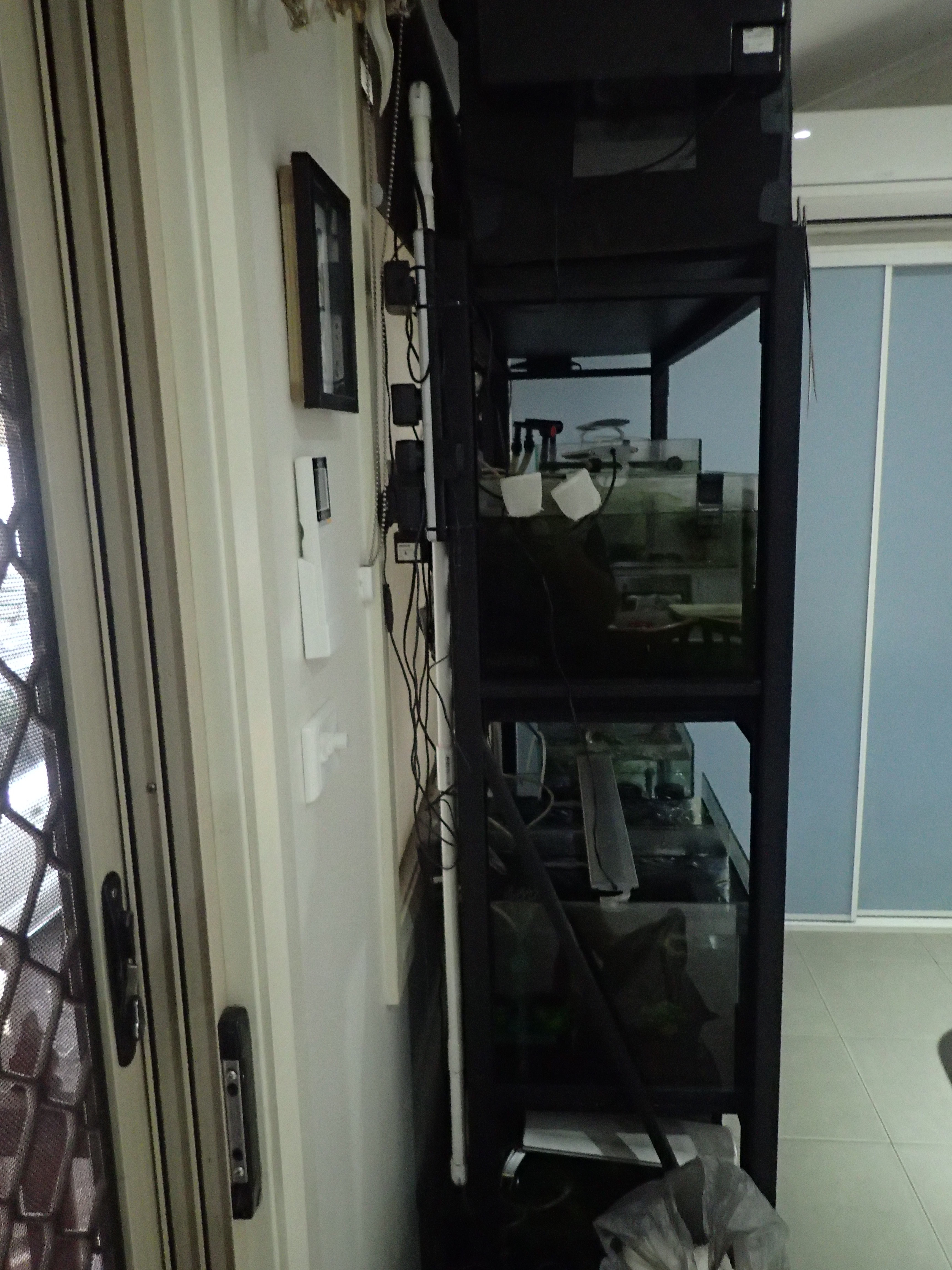
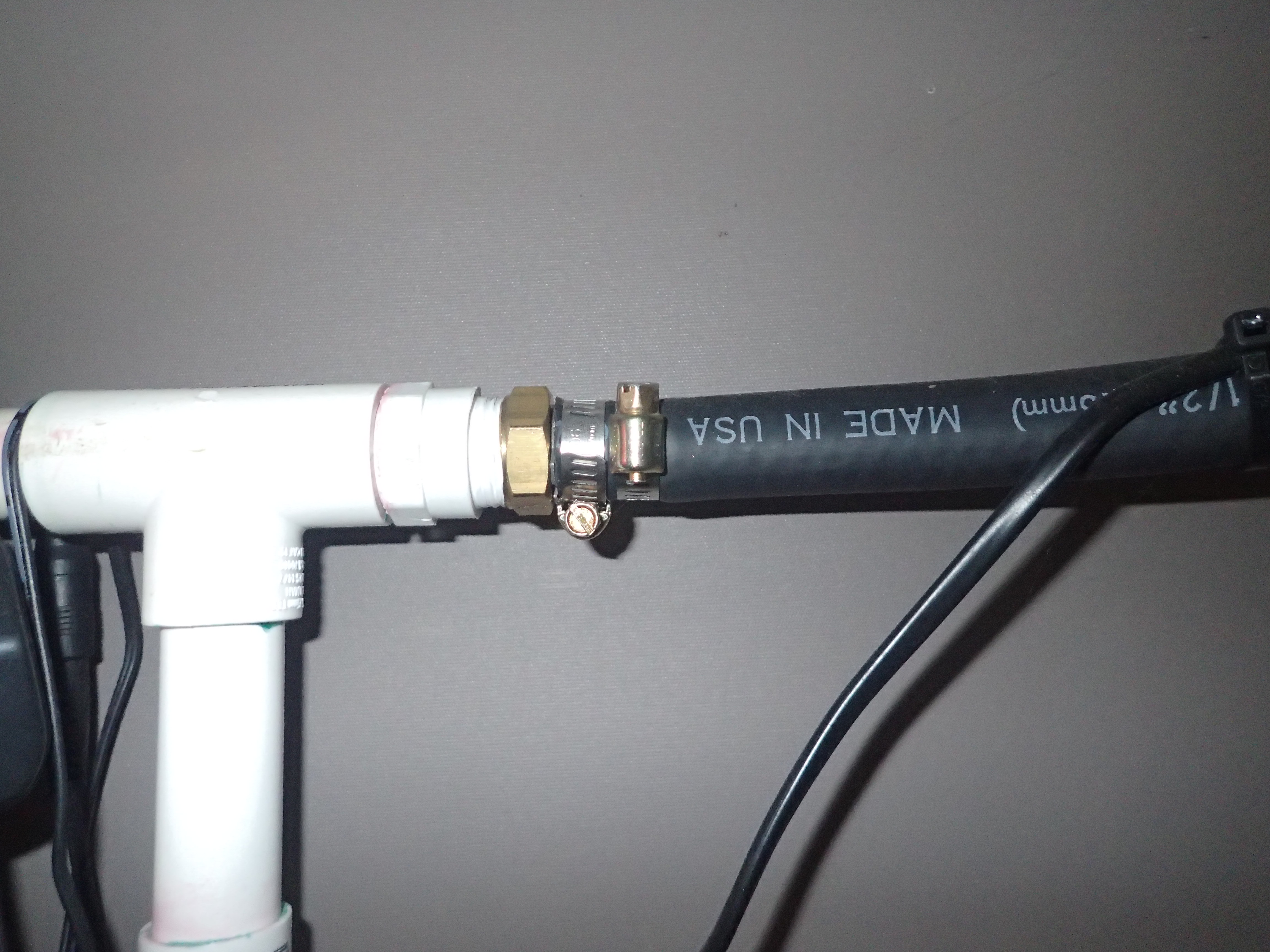
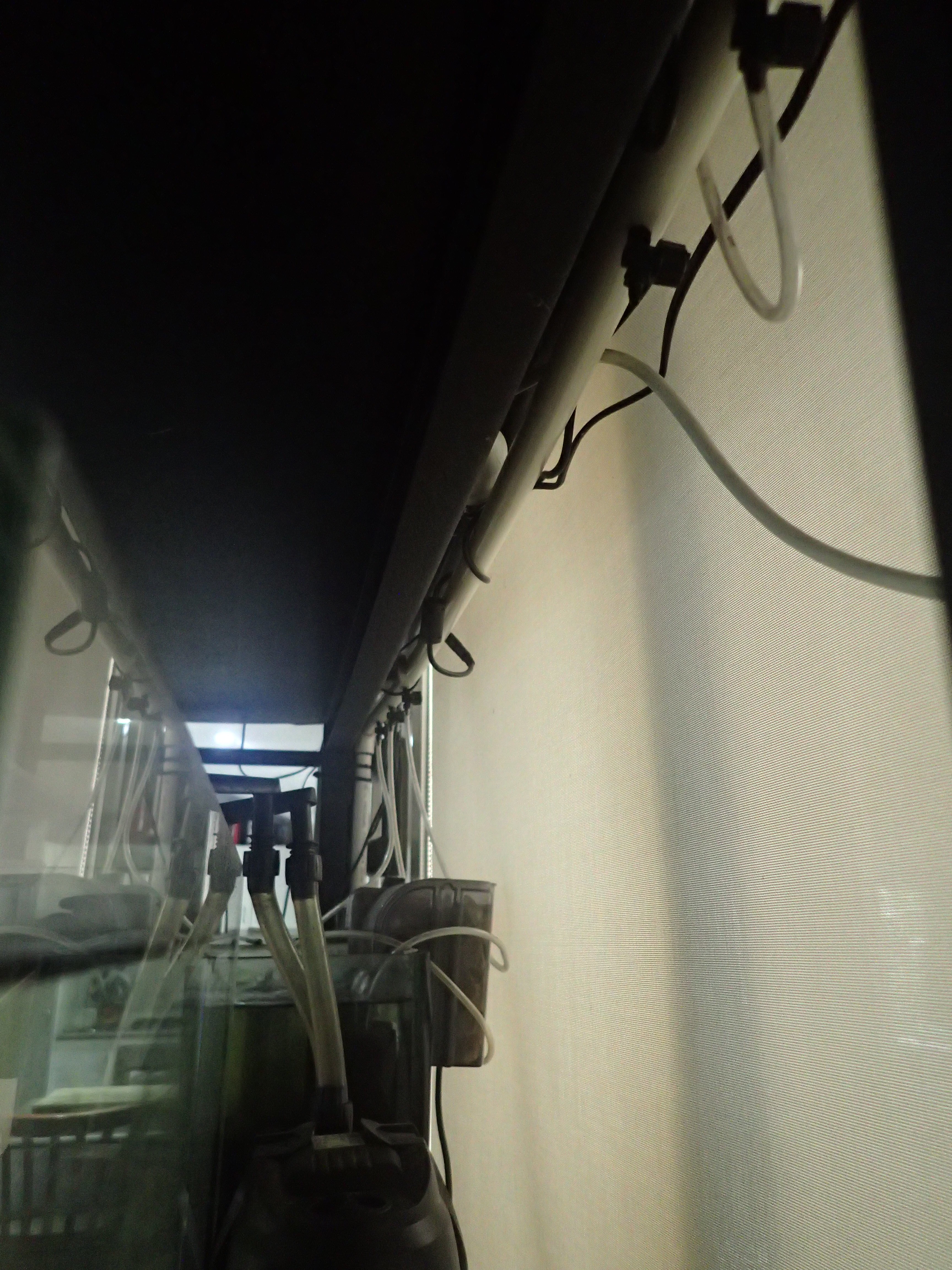
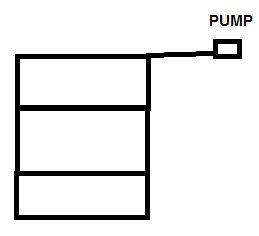
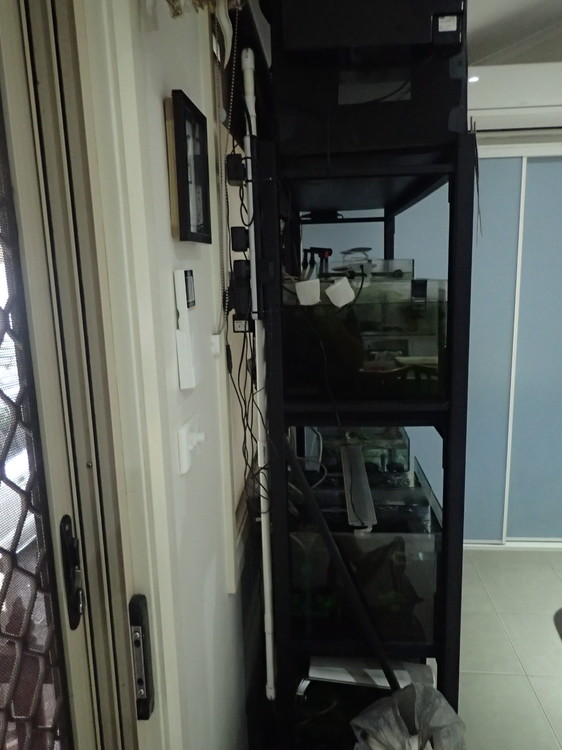
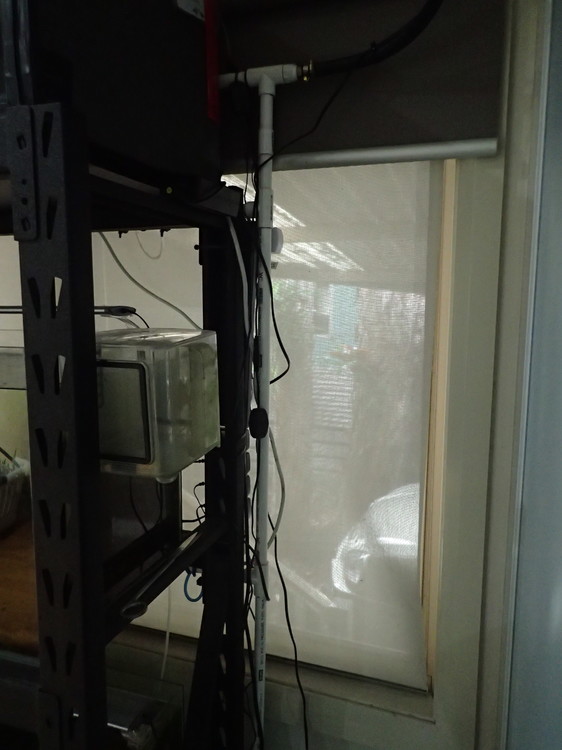
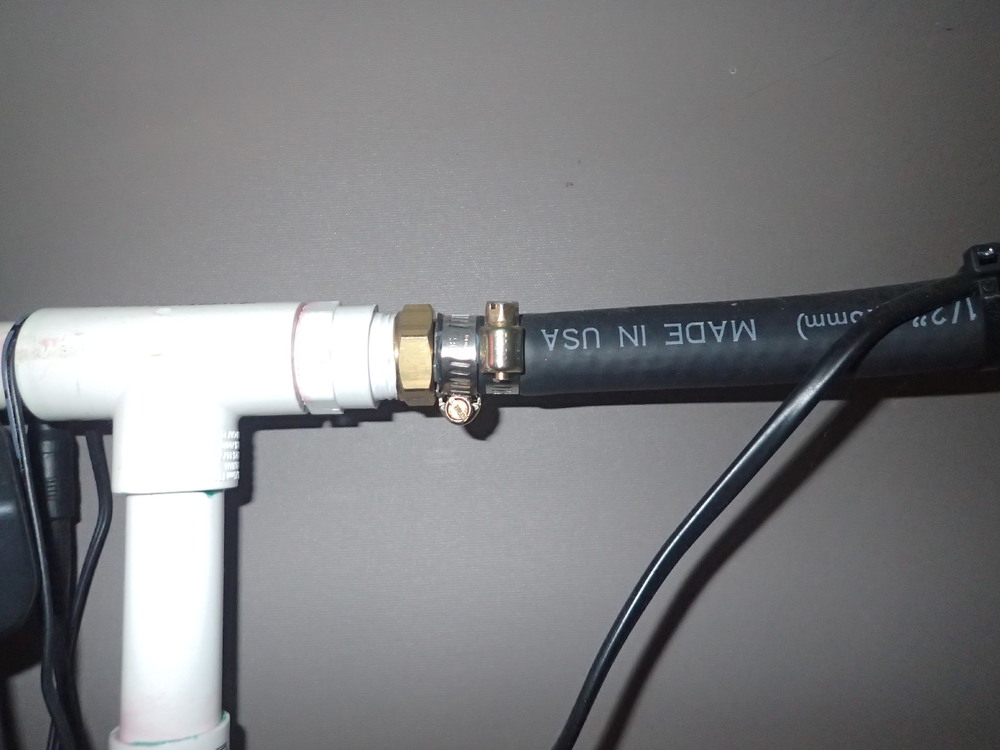
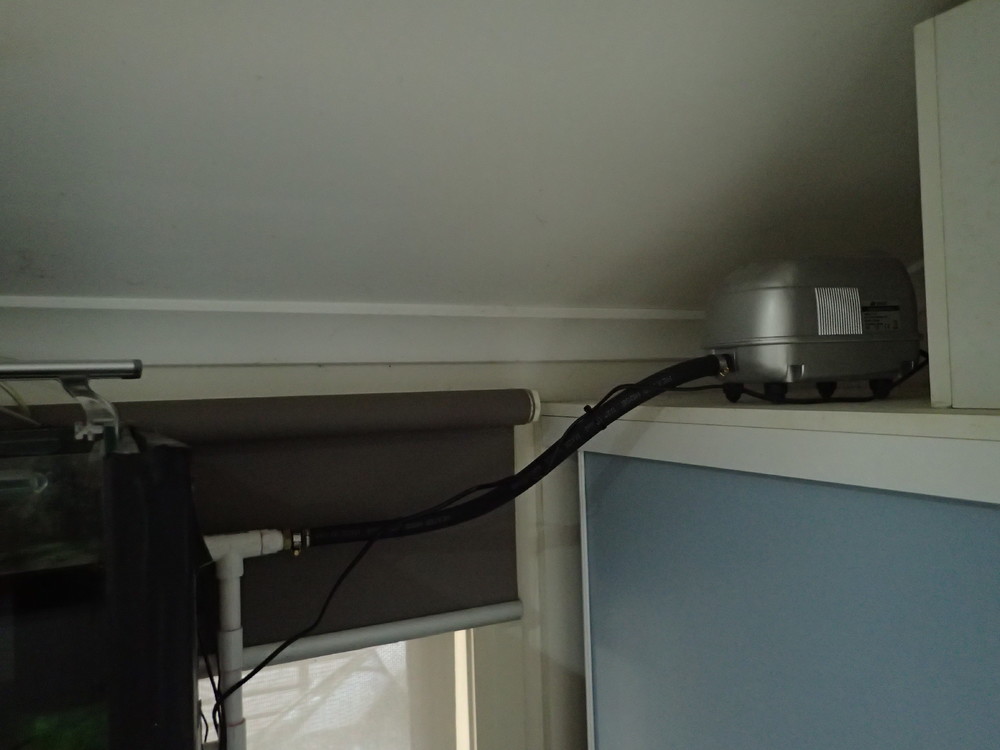
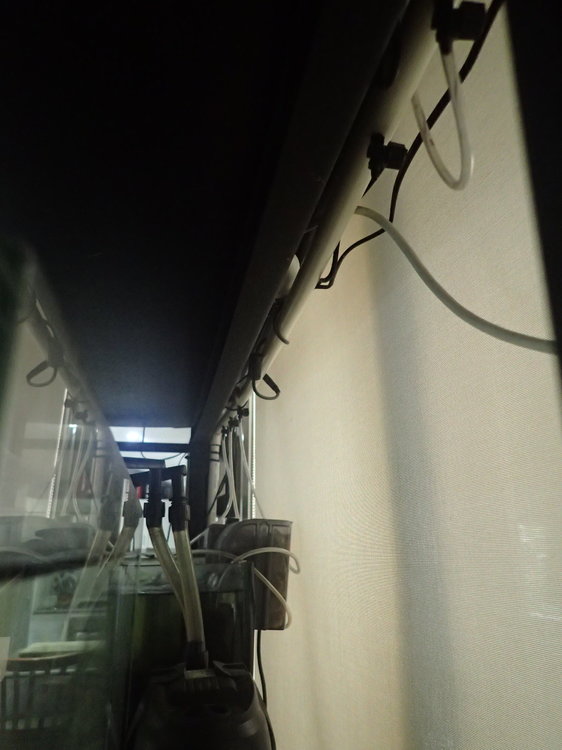
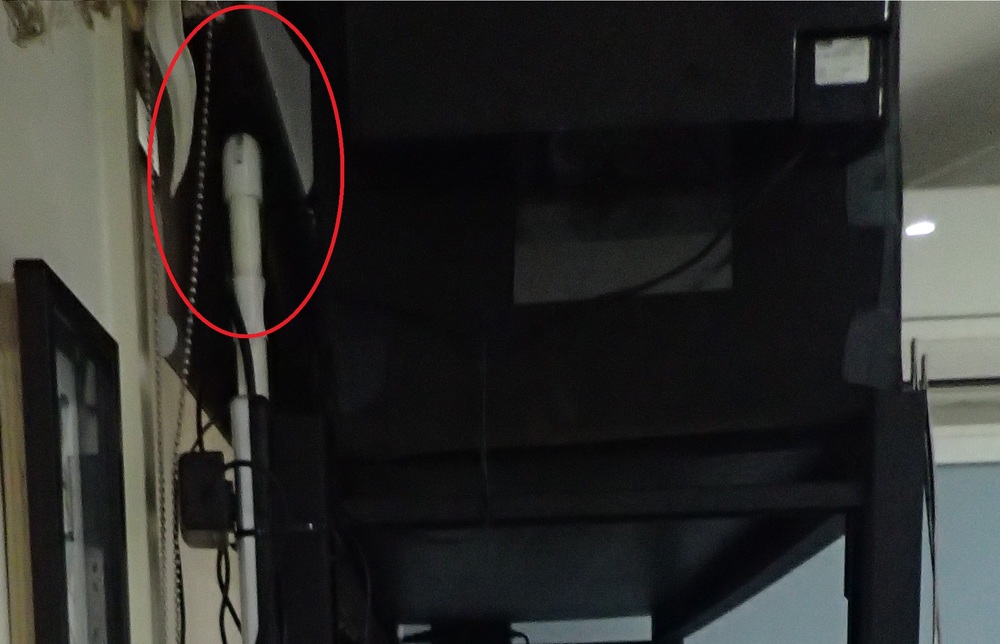
At the request of a member, here are a few shots from my current set-up showing my PVC looped air supply. Its based on my old set-up (see link below), but rejigged for a rack. For those of you who are unaware, this is my rack: Circumstances were such that I could not build the air supply onto the back of the rack until the rack was in place with tanks running. It would have been much nicer if I could have set it up first, so I encourage you to do this if you want to make something similar. I will show you the main problem later on. A (really) simple schematic for the loop is: The PVC loop is cable-tied onto the back of my rack system so is able to be dismantled if I need to move the rack. The top line is joined to a Resun LP20 air pump using a rubber hose with a special joiner that can slide (in and out) and twist (i.e. rotate) - this minimizes vibration and therefore noise from the pump. I can't remember what this joiner is called, but I found it at Bunnings. Hose clamps are used to hold the rubber hose in place (for peace of mind). Luckily I have a high shelf nearby that I can use to sit the air pump on. Remember it is very important to position the air pump above the position of the tanks so that if the power goes off, the water from the tanks will not back siphon into the air pump and ruin it. Alternatively you can use a one-way valve in front of the air pump, but having seen so many of them fail, I do not trust one-way valves at all. Each 'rung' on the loop has a series of 4mm outlets which I use to attach air line to the sponge filters in the tanks. Details for the taps are in my 'air supply' thread (linked above). The taps can be found at specialist irrigation shops or online. Bunnings does not carry them. There is one regret I have with this system. The top 'rung' does not reach the top of the tanks on the top level of the racks (see below). This means there is some risk that the water from these tanks could back siphon into the air supply if the power goes off. So far that hasn't happened, but the potential is there. Unfortunately it was a consequence of the rack and tanks being set up first - the rack was too close to the wall to fit the air supply around the blind that sits behind the tank. If I need to move this rack I will cut the PVC pipe and add inserts so the top 'rung' sits at the same height as the tanks.
 1 point
 -
 I keep OEBT in TB tank and they do fine. Very aggressive eaters and breeders1 point
 -
1 pointIf this product works like NO PLANARIA, a small dosage is enough to get rid of hydras, no need to follow the dosage to kill the planarias. I use less than a quarter of the recommended dosage and all the hydras are gone in 24 hours and never come back.1 point
-
1 pointYeah, dry dosing CaCO3 is ok, only because it doesn't dissolve well in water. But be careful not too add too much at one go since you won't see the effect immediately. Cold water - from your refrigerator. But really, you should be looking at using Calcium sulphate rather than Calcium carbonates, specifically because CaCO3 is so hard to dissolve in water. Get carbonates from potassium carbonate instead, or even shell grit or crushed corals. Just add a small handful in a bag in the filter, and it will regulate KH by itself.1 point
-
Yep, and a lot of trials, measurements and water parameter testing. I've also researched Potassium. I'm putting it out there that along with Calcium and Magnesium, the 3rd essential mineral is Potassium. Potassium is not only a macro nutrient for plants, but is also essential for shrimps in low quantities. Please note that you can get Potassium as Potassium Nitrate. But using KNO3 (Potassium Nitrate) will introduce too much nitrates into the tank, and that might harm the shrimp. Steer clear of KNO3 for shrimps. Potassium is also found in the form of Potassium Phosphate (KH2PO4). Adding too much phosphate could lead to other issues like algae. I'm doing more research on Potassium. I'll post an article in Water Parameters to go along with the threads on Ca and Mg soon. Also found evidence that Potassium (K) inhibits cyanobacteria growth. http://ag.arizona.edu/azaqua/ista/ISTA8/FinalPapers/pond%20managment%20PDF/10%20MOSTAFA%20ABDEL%20M.pdf1 point