
Leaderboard
-

KeenShrimp
Members3Points270Posts -

Zebra
Members2Points294Posts -

jayc
Moderators1Points6248Posts -

Kitz
Members1Points215Posts
Popular Content
Showing content with the highest reputation on 01/05/17 in Posts
-
For those of you that are unsure of the differences, I thought the below might help shed some light on these products. Most Asian manufacturers do not disclose the composition of their products unlike the German manufacturers, so there is a lot of uncertainty out there as to exactly what one puts in ones tank once the packet is opened. Firstly a bit about aquatic bacteria: most aquatic bacteria are slow- growing. This means that biofilm is produced slowly. Biofilm is a gel-like mucoid substance secreted by bacteria that they live in. Biofilm in aquaria are almost always gel-like. Because aquatic bacteria is often slow growing, the shrimp outstrips the biofilm faster than it can regrow. There are biofilm promoter products and direct biofilm products and combinations thereof. Genchem Biozyme is a biofilm promoter: if you look at the ingredients, it does not contain bacteria at all. It is partially digested starch and cellulose and enzymes which are utilised by bacteria to form biofilm. Shrimp eat the Biozyme directly as well. It is basically a food source for your aquarium bacteria and is also fine enough for baby shrimp to eat directly. Mosura BT-9 appears to be a mixture of bacteria found in aquariums to supplement your contained ecosystem to prevent sludge, increase ammonia-Nitrite-Nitrogen conversion cycle and to outcompete pathogenic bacteria for food by established colonies that are present rather than growth speed. Because none of the ingredients are disclosed it is impossible to say what is in BT-9, but based on my experiments, it is the slower growing aquatic bacteria, but it does form a nice biofilm over time if you do not have large shrimp populations that strip it bare. I cannot comment on other ingredients in the product as it is not disclosed. Overdosing fouls the water. Queue the new generation products: someone asked the question wether it is possible to add an ‘artificial’ bacteria that grows fast enough not to be outstripped of biofilm faster than the shrimp can eat it? Pediococcus Acidilactici is a lactic acid bacteria that is temperature stable, grows well in pH 1 -6.2 ( grows a bit slower in high pH but still grows faster than natural aquarium bacteria) and is an ideal food source for shrimplets and the cell division rate of this bacteria is fast. It does not naturally occur in aquaria. Bacillus Subtilis is a bacteria found in nature from your intestines to plant leaves and outcompetes pathogenic fungus and bacteria for resources. It is very heavily used in agriculture like mango farming. It is not a direct food source for shrimp, but undoubtedly keeps your aquarium healthier based on controlled trials. Glasgarten Bacter AE contains both the Pediococcus Acidilactici and Bacillus Subtilis as well as amino acids, enzymes and vitamins to activate the bacteria. When used as directed, it grows lactic acid bacteria biofilm fast and greatly increases shrimplet survival as result as there is constantly biofilm available as a food source. Overdosing fouls the water. A similar product available is ShrimpyDaddy Revive Vita that definitely contains a lactobacillus. Genchem Polytase does not contain Lactobacillus, but does contain Bacillus Subtilis, so does Dr Tim's probiotic. Why is there a possible shrimp death warning on the Bacter AE container?: if you do not use an Oxydator in your aquarium and you add a large amount of Bacter AE to your tank, the bacteria will grow extremely fast and use up most of the oxygen in a poorly oxygenated tank, possibly leading to shrimp death. This will not happen if you follow instructions and aerate your aquarium well. This is only a risk if you add a very large amount of Bacter AE.3 points
-
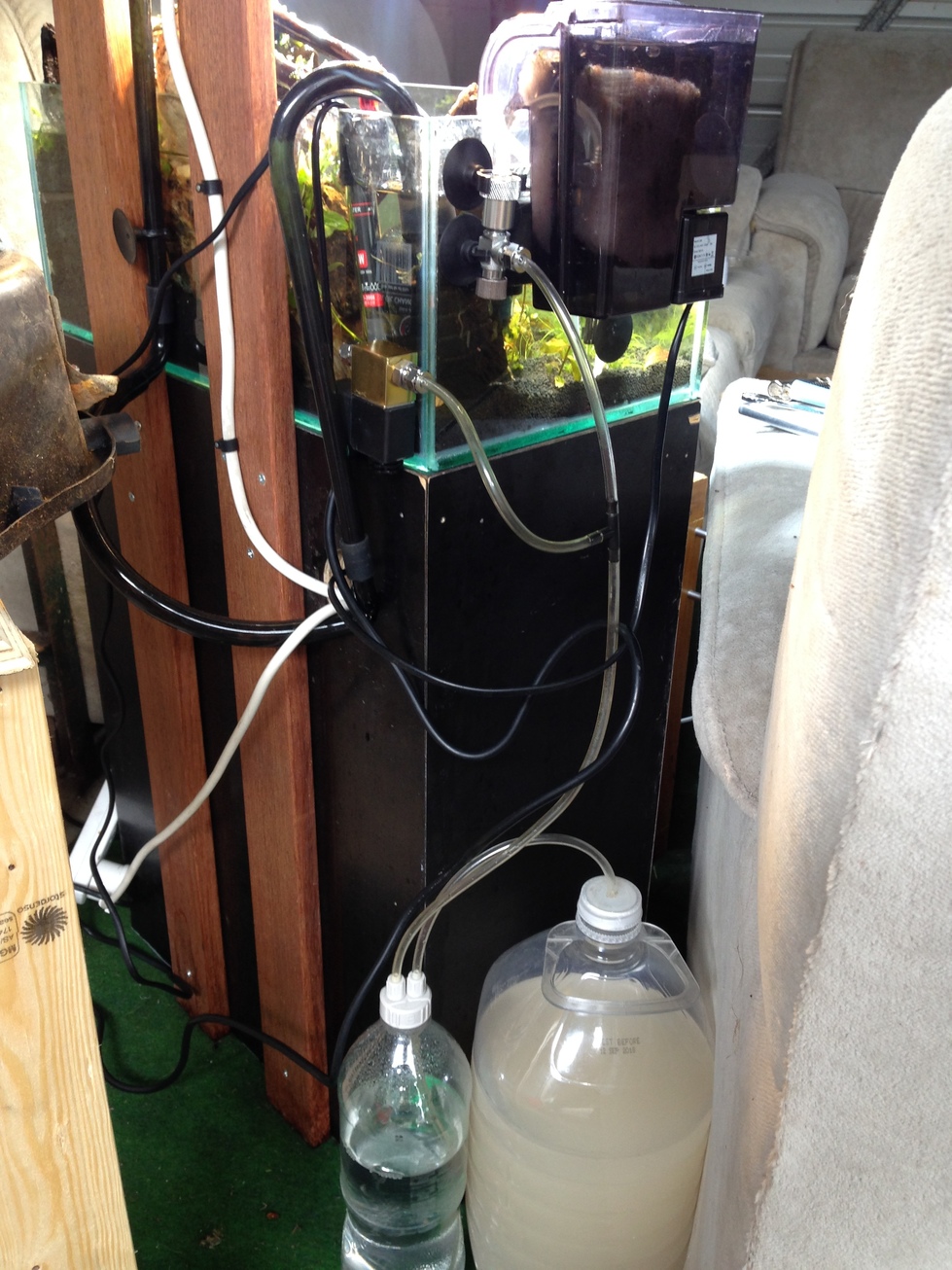
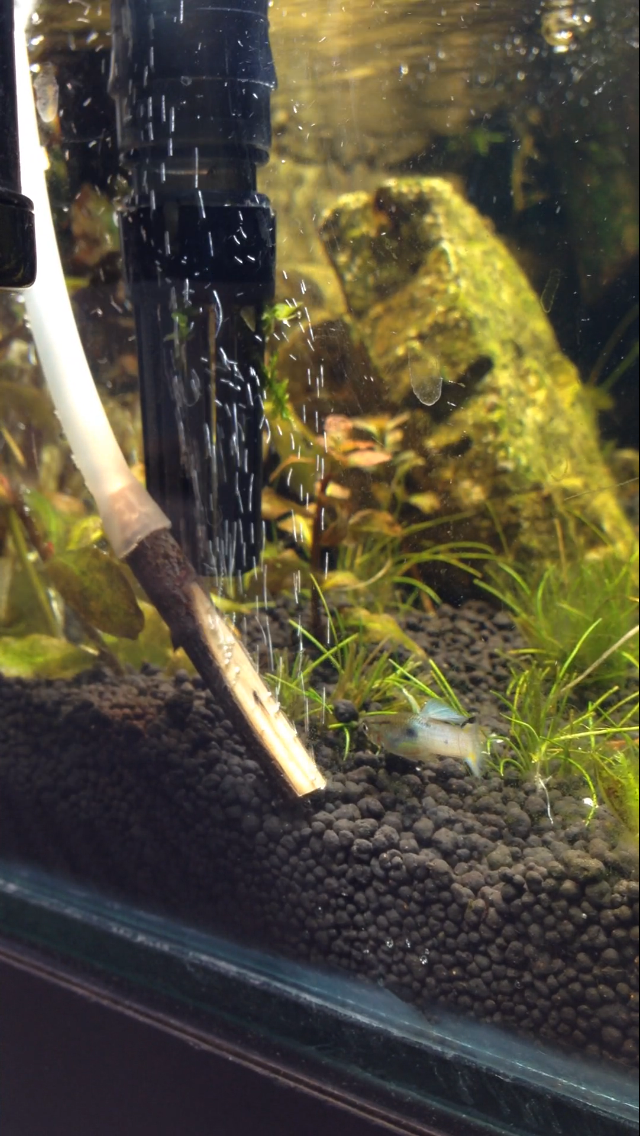
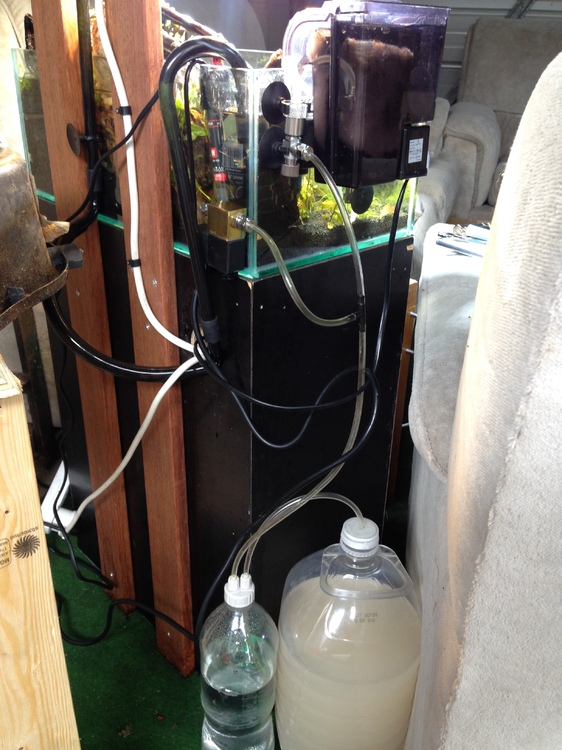
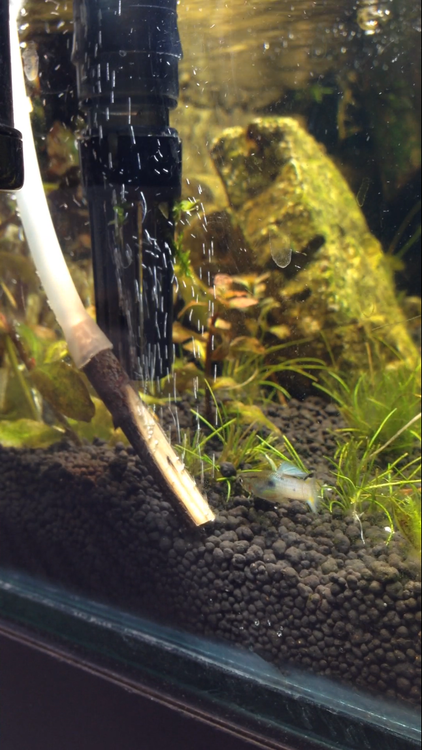
1 pointHello, So I made this little tank and stand a few weeks back to go in my shed. It gets way to hot in here to have a normal co2 cylinder and I don't have a spare one floating around anyway, but I have lots of bits and pieces, So I made this: The reactor, Filter, night time shut off and proper needle valve to ensure the co2 level is constant and never rises. A diy wooden diffuser I made producing very fine pollen style bubbles. The only thing I would add if I could is a pressure relief valve, you can buy cheap kits off eBay that have one of these and a gauge, but this system doesn't seem to need it. Im also using a recipe I adapted from mycology research utilising sugars with more complex carbohydrates to give a more stable long term reaction, I started this recipe on the 28th of dec and it's still going strong. I had to remove the built in check valve from the other side of my needle valve (cause it's made for high pressure) it prevented co2 running to the diffuser at start up, and caused pressure to build up. I just used a standard air line check valve that requires less pressure to open and it's all working fine again. Atleast now I know standard airline push fittings hold up under the pressure, literally. I have used proper co2 tubing throughout, it's probably not needed considering this is a "constant" system but I had it laying around. The the solenoid valve which runs my "night time shut off" operates a bit different to a standard pressurised co2 system. I designed my solenoid on a T to the main line, It opens at night just venting co2 into the air instead of running into the tank, this is so pressure doesn't build up and wreck the whole system. My fav part is the diffuser TBH, I'm so fascinated by wooden diffusers. enjoy.
 1 point
 -
 1 pointSKF Aquatics (Shrimp Keepers Forum) welcomes hoffy008. Please feel free to browse around and get to know others. If you have any questions please don't hesitate to ask. View Member regards, skfadmin Thanks newby here Sent from my iPhone using Tapatalk1 point
 -
 1 pointThank you for warm welcome. Have a grate day today. Wysłane z mojego Lenovo TAB S8-50L przy użyciu Tapatalka1 point
 -
1 point
-
 1 point
 -
This is probably a difficult question to answer since the substrate manufacturing ingredients and process is a trade secret that I'm sure ADA or any of the other companies would not want to disclose. So clearly I'm not going to be in the know about how it works exactly, but I think this is a very close approximation. But from a simplistic view, I understand that these planted substrates are actually soil. The soil is shaped into these roundish pellets and fired in some kiln to form the hard granules that we know of. But prior to turning it into granules, they probably add a mix of nutrients, like calcium, magnesium, potassium, etc. Some companies might add clay, sand or other mixes of soil to bulk up the mass, and therefore changes it's colour and texture. Being made up of predominantly soil, the substrate contains natural organic acids and tannins. It is this humic acid that counters the carbonates, which we measure as KH, and lowers the KH. Acids break down the bonds that form a carbonate ion CO3−2 . Carbonates exists in the water as bicarbonate ions (HCO3-), and the bicarbonate ions further break down into H+ and CO3-2 ions. More H+ ions makes the water more acidic. It doesn't magically remove KH and throws it out of your tank. It just changes it's molecular form into something else. There are no magical disappearing acts in nature. Note: the natural process of nitrification by bacteria also lowers acidity of the water by consuming the waste leaving H ions as a byproduct. Being pelleted into a hard granule means that the nutrients and organic acids and whatnot is locked in and released in a controlled manner. It also increases durability, so that it doesn't break apart and revert to mud. Dump a whole lot of soil from your garden compost into a tank and you'll see a release of nutrients in one big bang into the water column - not where the plants need it at the roots. Resulting in an unsightly tank, but also feeding algae in the longer term. Loose soil will be pushed all around by the water currents as well, not what you want. So the manufacturers have come up with these soil granules that lock in all the goodness, and releases it in a more controlled manner. Obviously, some companies do it differently and their products vary from colour to nutrient levels to durability.1 point
-
 1 pointIf you decide to write up a product review please follow these guidelines. All reviews must be factual. you must give clear reason/example of how it has succeeded or failed. No bagging products or brands at all. simply state the proven facts that you have experienced and not what a friend did or said as such.1 point
 -
 1 point