
Leaderboard
-

Forevermango
Members5Points79Posts -
Disciple
Platinum Members4Points2092Posts -

sanmasterp
Members3Points4Posts -

KeenShrimp
Members2Points270Posts
Popular Content
Showing content with the highest reputation on 02/25/16 in Posts
-
3 pointsNon-aquatic plants to avoid! When you purchase aquarium plants, it's important that you understand that not all plants available for sale are truly aquatic. Vendors have no qualms offering this plants for sale, because they are very easy to obtain, and it is rare that you will see the designation "non-aquatic." While these plants can often survive as long as a year submerged, more often than not, they begin to decompose in as little as a couple of weeks or months, causing an ammonia spike, which can lead to algae, or worse, prove toxic to fish. These plants are not meant to be grown in an aquarium long-term and it is best that you avoid purchasing them for your benefit and the benefit of the non-aquatic plant. They are terrestrial plants and are meant for either indoor or outdoor gardening. They are at their best when they planted and cared for the right way. Japanese Rush (Acorus gramineus) Often sold in pots with rockwool, this plant will survive in the aquarium upto a year, but prefer cooler temperatures. In warm tropical tanks, this plant will turn to mush very quick. Aquatic alternatives such as Lilaeopsis species, Echinodorus tenellus, Sagittaria subulata, Vallisneria species can be used. Caladium (Caladium bicolor) This plant will only survive in the aquarium for upto 6 weeks (best kept with its leaves out of the water). These are usually sold in pots with rock wool. Aquatic alternatives such as Tiger lotuses and Barclaya longifolia can be used. English Parlor Palm (Chamaedorea elegans) This plant can survive long periods in the aquarium, these are usually sold as seedlings about 20cm tall either in pots or in bunches. In terrestrial environments, these can grow upto 2m tall. Aquatic alternative such as Hygrophilia difformis can be used. Aluminum Plant (Pilea cadierei) This plant may last in the aquarium for a few weeks, but will eventually melt away. Aquatic alternatives is the Blue Stricta. Spider Plant (Chlorophytum comosum) Another plant found in the trade as a potted plant. While it may grow very well in terrestrial form, once submerged it will root very quickly. Alternatively you can use larger Sagittaria species. Lucky Bamboo (Dracaena sanderiana) The lucky bamboo is very common these days among aquarists. If the leaves are kept out of the water, it can survive for a very long time. Once completely submerged, the lifespan is roughly 8 weeks. It is usually sold as rooted stalkes. Fittonia verschaffeltii This compact little plant is usually sold in pots, but unfortunately it will only last a couple of weeks in the aquarium before it begins to decay. Alternatively you can used Staurogyne sp. Purple Waffle Plant (Hemigraphis colorata) One of the most commonly seen non-aquatic plant in the trade. It is often sold in cuttings secured with rubberbands or lead weights. It may survive upto a year in the aquarium but would require high lighting and high iron levels. This plant will slowly deteriorate. Alternatively you can use Lobelia cardinalis. Iresine lindenii A beautiful plant, but completely unsuitable for the aquarium. It is often sold as a potted plant in the aquarium trade. Alternatively you can use Alternantera reineckii. Selaginella moss (Selaginella martensii) Unfortunately, this plant only has a 2-week lifespan in the aquarium and is often sold in pots. However, it makes an excellent paludarium plant. Very similar to Selaginella martensii is Selaginella willdenowii (umbrella fern, peacock fern). Aquatic Alternatives - Aquatic mosses, including Frontinalis antipyretica, Taxiphyllum barbieri and other Taxiphyllum species, and Vesicularia dubyana and it's related species. Peace Lily (Spathiphyllum wallisii) There is a lot of debate regarding the Peace Lily, and it is often seen in the trade as a potted aquarium plant. In Peter Hiscock's book, it is listed as a suitable plant for the aquarium, since it is extremely hardy and can remain healthy in the home aquarium for many months or even years. It is slow growing and can grow with minimal effort and in lower light levels. It is not, however, a true aquatic plant. Arrowhead Plant (Syngonium podophyllum) Though suitable for paludariums, the "arrowhead plant" quickly dies if left submerged. It can, however, be kept in situations where its roots are submerged. It is often sold as a potted aquarium plant. Aquatic alternatives - Hygrophila corymbosa, Echinodorus "Ozelot green", Anubia species Mondo grass (Ophiopogon japonica) Mondo Grass is not a true aquatic plant. It will survive for awhile underwater but will not prosper. Best if taken out after a couple of months. Alternatively you can use Hairgrass or Blyxa japonica If you know any other plants I have missed, please post them below :) View full article3 points
-
3 points
-
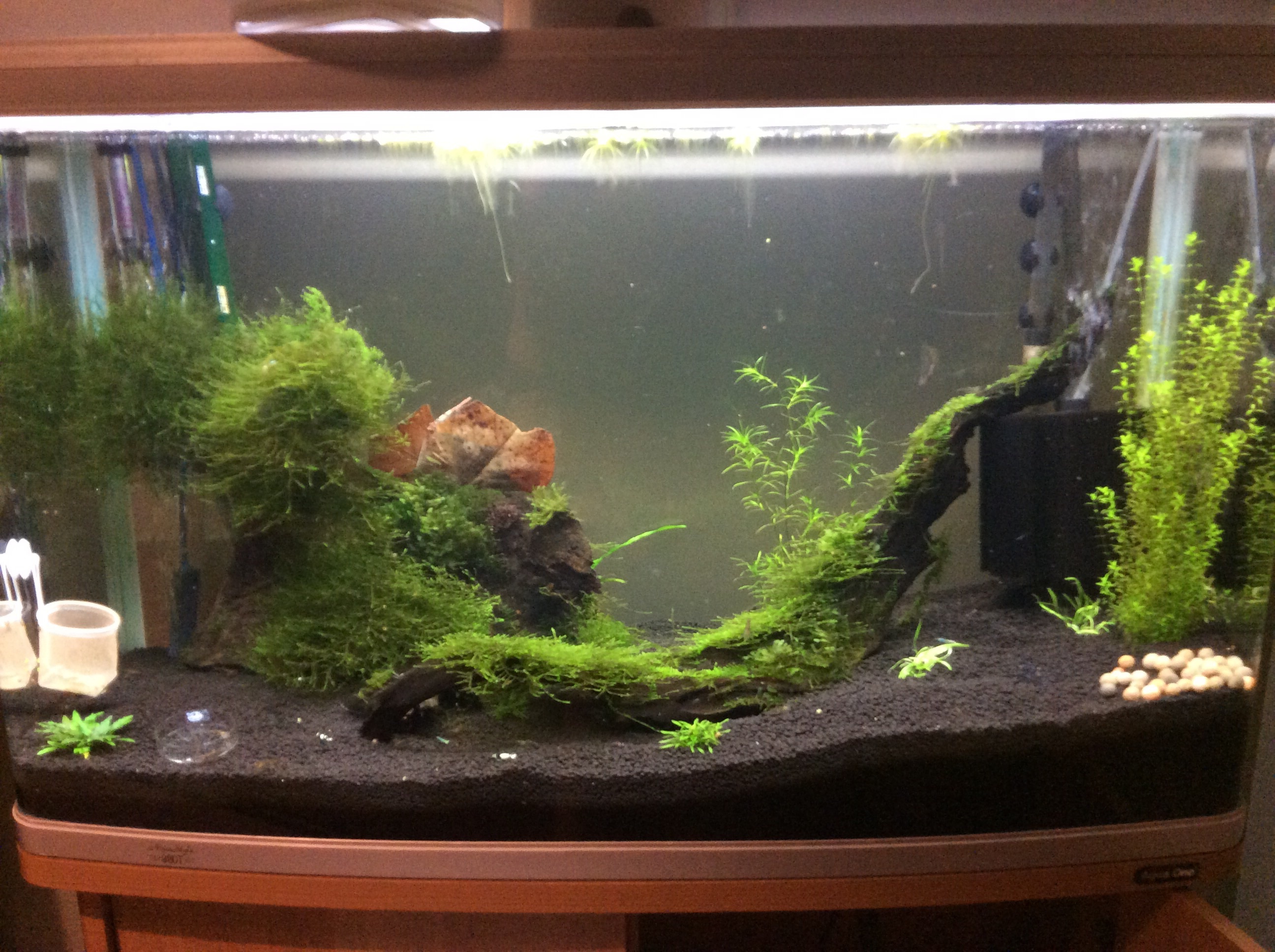
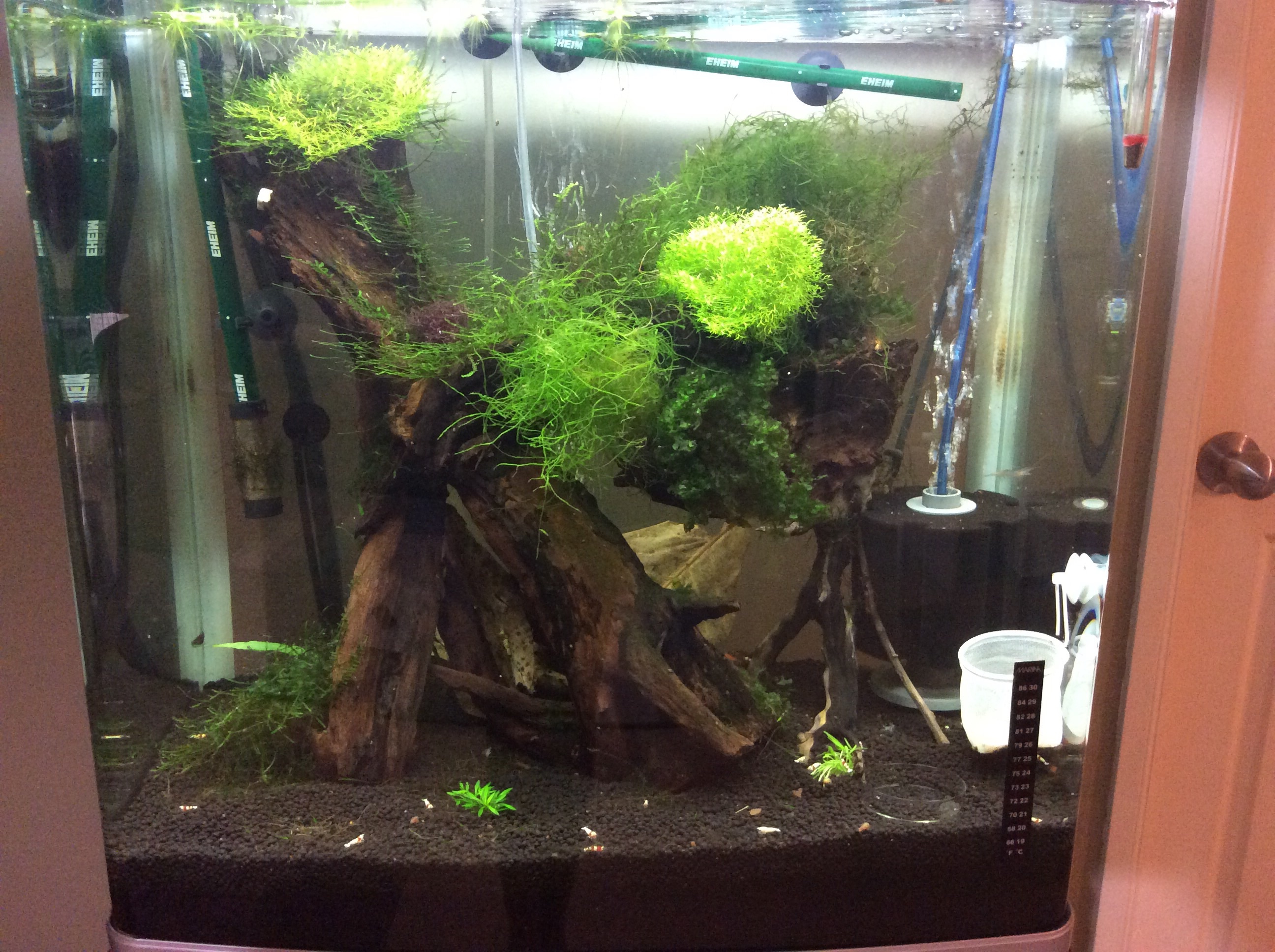
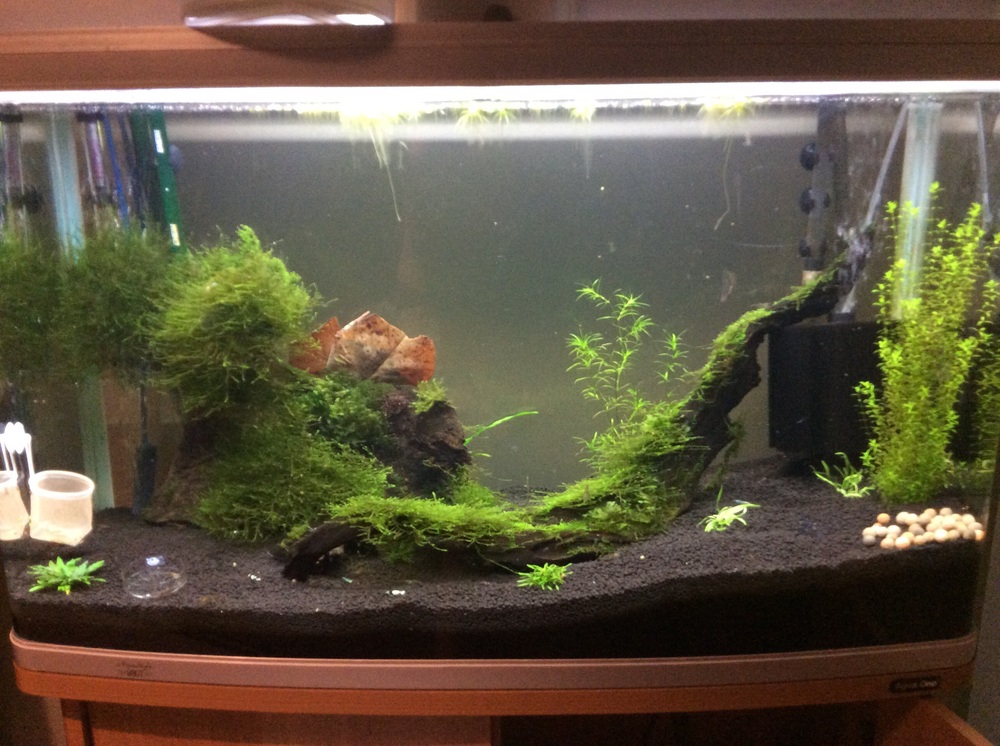
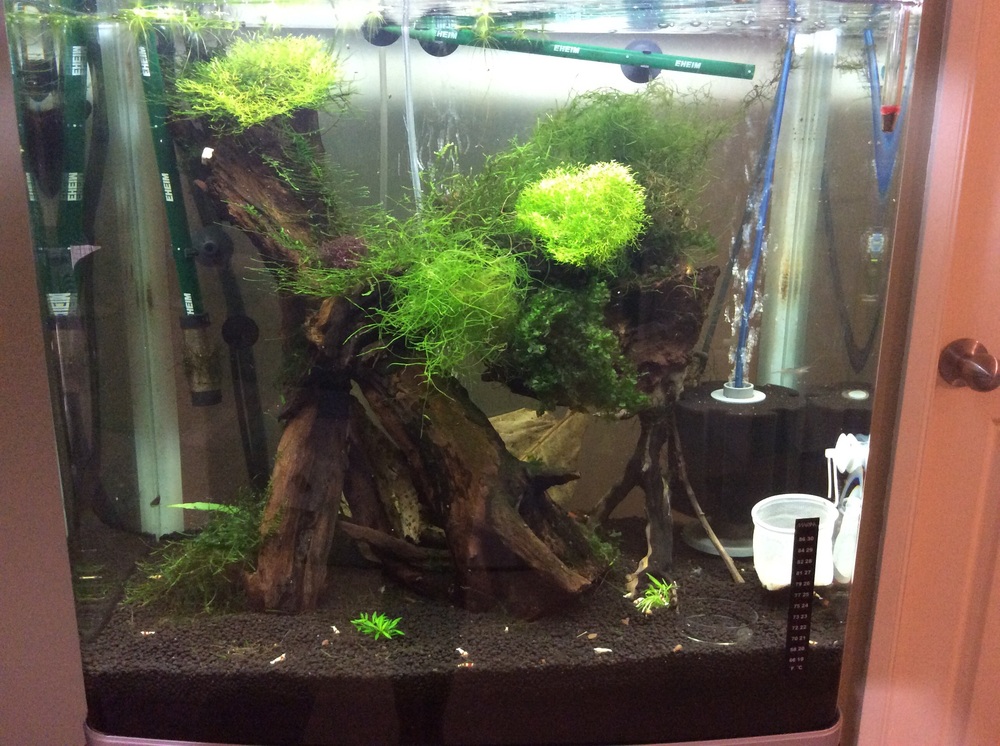
2 pointsMy 2 main 2 tanks (240litre and 130litre)- moss needs trimming. Sorry for the algae...I promise there are shrimp in there :)
 2 points
 -
1 pointWith lots of variety of mosses and ferns out there, here is a compile of Photos from the great Tomasz Wastowski of his current collection. Bolbitis sp. "Gau Angin" Microsorum "Small Leaf" Microsorum "Thunder Leaf" Microsorum "Short Narrow Leaf" Loxogramma sp. Wave Moss Mosses... Bolbitis sp. "Gua Angin", Bolbitis heteroclita "Cuspidata" & Buce. Brownie Jade Loxogramme sp. Amblystegiaceae Manaus "Queen Moss" Homalia sp "Rosa" Hymenophyllaceae sp. "Wayanad" Pteridophyta sp. "Xkiat" Microsorum sp "Trident" Plagiochcila sp. Cameroon Microsorum sp. Mini Windelov Fissidens Grandifrons var. Planiccaulis Microsorum sp. Fork Leaf Bolbitius Heteroclita Difformis Fissidens Adianthoides Fissidens Dubius & Fissidens from Poland Fissidens Dubius Fissidens from Poland Fissidens Geminiflorus "Nagasaki" Fissidens sp. "Himehouogoke" F. Nobilis, F. Zippelianus, F. Adianth, F. Dubius, F. Dubius 2, F. Poland Fissidens Nobilis View full article1 point
-
1 pointCrinum natans Continent: West Africa Region: West Africa Height: 50-150cm Width: 30cm Light Requirements: High Temperature: 18-25 °C Hardness Tolerance: Medium (6dKH) pH tolerance: 6.5 - 7.5 Growth: Slow Demands: High co2 requirements: Yes Crinum natans is an aquatic plant from West Africa that is still very rare in Australia. This Crinum is regarded as the largest and most rarest Crinum out of the three species that can be kept in aquariums. The natans had a unique leaf structure. It is long, 1-2cm wide, wrinkled and dark green which can grow upto 1.5m long. When planting this unique plant, the bulb must not be below the soil surface, and roots must be widely spread throughout the substrate. Being such a large and unique plant, with aquascaping, the natans should be a feature plant. Being a large grower, the Crinum natans' growing spot should be carefully considers. They require high lighting, even levels of co2 and ferts. With regards to substrate, it is highly recommended to use high nutrients substrate/soil such as ADA Aqua Soil. The Crinum natans take up a lot of nutrients via the massive roots systems, so planting rich fert tablets ever few months will definitely benefit with the growth of this magnificent plant. Propagation of the Crinum natans is quite difficult in the aquarium compared to its cousin the Crinum calamistratum. Propagation of the Crinum natans in Australia has not be formally documented. Propagation might be the same as the calamistratum via baby bulbs and by seed germination. Being such a rare plant in Australia. Prices has been extremely high and availability has been rare. The average price for a small plant of a few leaves average $150-$250. While adult plants has been seen to go over $400. So if you have the opportunity to get your hands on any size of Crinum natans, consider yourself very lucky. View full article1 point
-
 1 pointmy shrimp are quite fussy eaters and refuse most commercial foods except for snow. Today I bought some dried seaweed sheets like they use in sushi rolls. I put it straight into the tank just cutting it to size and weighed it down with bulldog clips. Most of the tanks went straight for it which is an unusual event with my shrimp and they are continuing to graze on it. I believe seaweed is very nutritious so here is another natural food for our shrimp. Should be available in most supermarkets1 point
 -
 1 point
 -
 1 pointI see. Thanks. I knew some shrimp go through the larvae stage. But it was the first time I've heard of that term.1 point
 -
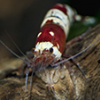
 1 pointBy direct developing larvae - larvae that hatch out close to being ready to settle on the bottom. For example, cherry and CRS have direct developing larvae as opposed to the planktonic larvae of typus or gracilirostris (for example) that must develop through a series of larvae stages before they are ready to settle onto the bottom.1 point
 -
1 point
-
 1 point
 -
 1 point
 -
 1 point
 -
 1 point