

Leaderboard
-
fishmosy
Members2Points4594Posts -

ineke
HOF Member2Points9026Posts -
NoGi
HOF Member2Points5858Posts -

OzShrimp
Members1Points4102Posts
Popular Content
Showing content with the highest reputation on 05/29/15 in Posts
-
2 points2 points
 1 pointThanks for the useful links Will and Fishmosy. I've read through the articles yesterday and realised that at 18 days they are well ready to hatch, being a couple of days off the charts at 24.5°C. I looked all over the tank with a flashlight several times through the night but could not find a trace of the shrimplets but a very lively and peckish mother to the aforementioned shrimplets. This morning when I woke up, true to your words of them having hatched, there were several shrimplets hanging out in the hairgrass and later in the evening, grazing on the algae I had left unbothered at the back panel. All is good again in my tank! As for Will and all viewers of my thread, some eye candy! Sorry about the blurry photo, they are tiny and quite far away from the camera Here's the one grazing on the back panel Here are the ones in the hairgrass that I managed to find, wonder how many more are there? On a side note my new shelter that I've spent days planning and glueing together and my modified NAG oxydator broke apart so I'll be redoing them again and will be getting some aquarium safe silicone tomorrow to make sure they stay attached. Cheers, Howard1 point
 Hey guys. I've done some reading and brought some info about shrimp survival. I've translated a report of a research about fulvic acid into English. What is FULVIC in shrimp breeding? All organic matters are broken down by bacteria after some time. Dried leaves, tree branches or dead bodies of animals. These organic matters are broken down by bateria and lose their shape, however there's something that still remain after that, that is humic aci, ulmic acid and fulvic acid. Amongst three, fulvic acid is part of humic acid which consist only 10% of humic acid. Bee shrimps naturally tend to reside in a brook where there's a lot of trees around it. Where the trees are, so are the fallen leaves. These leaves decay in the water by bacteria and thus that habitat is full of humic acid. Fulvic acid, a substance contained in humic acid has chelate in its structure and this chelate aids absorption of minerals into living body. This indicate that these bee shrimps has far less ability to absorb minerals of their own because they tend to absorb mineral with the help of fulvic acid in the nature. That is the reason why it is recommended to use aqua soil which is made of natural organic substance that contains humic acid when breeding bee shrimps in aquarium environment. It was rather known that main function of aquasoil is stabilising pH and GH however recent research by shrimp hobbyst shows that it is not only pH and GH that aids shrimps in breeding but nutritive substances in aquasoil is almost essential in shrimp breeding. So now we recognised that fulvic acid helps living bodies to absorb minerals and bee shrimps especially require this help. Established shrimp breeding methods only concentrated on minerals, however it is now known that absorption of mineral is more important in keeping shrimps alive. Adult shrimps does not rely much on the existance of fulvic acid but shrimp juvies, newly born shrimps do not show high rates of survival in an environment with less fulvic acid because they cannot absorb minerals as adult shrimps do by their own. Reference: http://blog.naver.com/dragoon86/140182305227 Summary. With help of my friend I have started a shrimp breeding project using fulvic acid early this year, and so far it seems like it's working fully well. I'm still getting 100% survival rates of shrimplets after 10 months since the set up I just wanted to make sure I get the result before introducing new information to you So I've started with 8 CBS(F0) in the beginning, in Feb 2013. A female started breeding in May- June and gave birth to 20-30 shrimplets(F1) in June-July, 2nd batch of F1 in August. I sold about 15 of them when they were 1.5cm when I attended Fishy Park Sale held in September and another 10 more in October. In October my F1 females started to breed and almost 7 females got eggs. However my mum wanted to get rid of those ugly hair algae, grabbed a net, swung it in the aquarium, and females just dropped their eggs Fortunately I got suspicious of females dropping their eggs and caught my mom in early stage. So now, December I've got first batch of F2 shrimplets grown about 1.0-1.3cm size, with second batch of F2 shrimplets are crawling in the tank. I still have 7 females barried with 3rd batch So I ended up having almost 100 shrimps + 7 barried females coming up when I started with 8 shrimps 10 months ago. However I have not yet tested how it will work with r/o water. I'll be resetting my tank very soon and this time, I'll be using r/o water. If I can set my water parameter to ideal level while getting 100% shrimplet survival rate, what else can be better? So fingers crossed for me guys :encouragement:1 point
1 pointThey may survive but you should try to dislodge them from the molt and either use an egg tumbler or try putting them in a very fine net near the bubbles from a filter so they have moving water around them- this will help keep fungus off them. Many people successfully hatch the eggs this way1 point
1 pointAre you dosing with glutaraldehyde ( like Dino spit or Flourish)? This can cause some moss to brown (die). Alternatively has the moss been grown emersed? Sometimes mosses will brown and die back after being submersed before they begin shooting their submerse leaves. Also check on temperature. High temps can cause the moss to die.1 point
1 pointNice pics mate, do your shrimp ever get confused all being named Tony ? :P1 point
1 pointHere is a useful link to info on temperature and hatching time. 18 days is certainly long enough to get a hatch.1 point
Hey guys. I've done some reading and brought some info about shrimp survival. I've translated a report of a research about fulvic acid into English. What is FULVIC in shrimp breeding? All organic matters are broken down by bacteria after some time. Dried leaves, tree branches or dead bodies of animals. These organic matters are broken down by bateria and lose their shape, however there's something that still remain after that, that is humic aci, ulmic acid and fulvic acid. Amongst three, fulvic acid is part of humic acid which consist only 10% of humic acid. Bee shrimps naturally tend to reside in a brook where there's a lot of trees around it. Where the trees are, so are the fallen leaves. These leaves decay in the water by bacteria and thus that habitat is full of humic acid. Fulvic acid, a substance contained in humic acid has chelate in its structure and this chelate aids absorption of minerals into living body. This indicate that these bee shrimps has far less ability to absorb minerals of their own because they tend to absorb mineral with the help of fulvic acid in the nature. That is the reason why it is recommended to use aqua soil which is made of natural organic substance that contains humic acid when breeding bee shrimps in aquarium environment. It was rather known that main function of aquasoil is stabilising pH and GH however recent research by shrimp hobbyst shows that it is not only pH and GH that aids shrimps in breeding but nutritive substances in aquasoil is almost essential in shrimp breeding. So now we recognised that fulvic acid helps living bodies to absorb minerals and bee shrimps especially require this help. Established shrimp breeding methods only concentrated on minerals, however it is now known that absorption of mineral is more important in keeping shrimps alive. Adult shrimps does not rely much on the existance of fulvic acid but shrimp juvies, newly born shrimps do not show high rates of survival in an environment with less fulvic acid because they cannot absorb minerals as adult shrimps do by their own. Reference: http://blog.naver.com/dragoon86/140182305227 Summary. With help of my friend I have started a shrimp breeding project using fulvic acid early this year, and so far it seems like it's working fully well. I'm still getting 100% survival rates of shrimplets after 10 months since the set up I just wanted to make sure I get the result before introducing new information to you So I've started with 8 CBS(F0) in the beginning, in Feb 2013. A female started breeding in May- June and gave birth to 20-30 shrimplets(F1) in June-July, 2nd batch of F1 in August. I sold about 15 of them when they were 1.5cm when I attended Fishy Park Sale held in September and another 10 more in October. In October my F1 females started to breed and almost 7 females got eggs. However my mum wanted to get rid of those ugly hair algae, grabbed a net, swung it in the aquarium, and females just dropped their eggs Fortunately I got suspicious of females dropping their eggs and caught my mom in early stage. So now, December I've got first batch of F2 shrimplets grown about 1.0-1.3cm size, with second batch of F2 shrimplets are crawling in the tank. I still have 7 females barried with 3rd batch So I ended up having almost 100 shrimps + 7 barried females coming up when I started with 8 shrimps 10 months ago. However I have not yet tested how it will work with r/o water. I'll be resetting my tank very soon and this time, I'll be using r/o water. If I can set my water parameter to ideal level while getting 100% shrimplet survival rate, what else can be better? So fingers crossed for me guys :encouragement:1 point
1 pointThey may survive but you should try to dislodge them from the molt and either use an egg tumbler or try putting them in a very fine net near the bubbles from a filter so they have moving water around them- this will help keep fungus off them. Many people successfully hatch the eggs this way1 point
1 pointAre you dosing with glutaraldehyde ( like Dino spit or Flourish)? This can cause some moss to brown (die). Alternatively has the moss been grown emersed? Sometimes mosses will brown and die back after being submersed before they begin shooting their submerse leaves. Also check on temperature. High temps can cause the moss to die.1 point
1 pointNice pics mate, do your shrimp ever get confused all being named Tony ? :P1 point
1 pointHere is a useful link to info on temperature and hatching time. 18 days is certainly long enough to get a hatch.1 point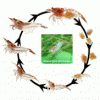 1 pointThe mean duration of the incubation period increased significantly (P < 0.005) with decreasing water temperature, from 12 days at 32°C to almost the double (21 days) at 24°C, the above is taken from here - http://journals.plos.org/plosone/article?id=10.1371/journal.pone.0119468 based on the above trial my uneducated guess is that if it is 18 days since you first noticed her being berried and she has lost her eggs then you would be unlucky. chances are they have hatched Have a close look when you get a chance and I hope to hear some good news from you next time !! No doubt someone will correct me if I'm wrong in any case time will tell so fingers crossed! love n peace will1 point
Just a little update I am seeing far more molts in my big tank since adding the Blackwater Extract - I haven't been seeing a lot prior to this although plenty of Cherries were breeding but not so much the Crystals so will be interesting to see if my Crystal population expands any quicker.1 point
1 pointThe mean duration of the incubation period increased significantly (P < 0.005) with decreasing water temperature, from 12 days at 32°C to almost the double (21 days) at 24°C, the above is taken from here - http://journals.plos.org/plosone/article?id=10.1371/journal.pone.0119468 based on the above trial my uneducated guess is that if it is 18 days since you first noticed her being berried and she has lost her eggs then you would be unlucky. chances are they have hatched Have a close look when you get a chance and I hope to hear some good news from you next time !! No doubt someone will correct me if I'm wrong in any case time will tell so fingers crossed! love n peace will1 point
Just a little update I am seeing far more molts in my big tank since adding the Blackwater Extract - I haven't been seeing a lot prior to this although plenty of Cherries were breeding but not so much the Crystals so will be interesting to see if my Crystal population expands any quicker.1 point