
Leaderboard
-

Shrimpmaster
Diamond Members4Points268Posts -

jayc
Moderators3Points6248Posts -
lodo
Members2Points188Posts -

GotCrabs
Members2Points1430Posts
Popular Content
Showing content with the highest reputation on 03/09/15 in Posts
-
2 pointsProblem with cichlids is every man and his dog breed them. bettas take a lot more work, conditioning, and knowledge of behaviour I feel to be successful. What I may do is make a thread for what wilds are available and from where. Some amazing species currently through aquarium industries, but they list them with common names which makes it hard for hobbyists to request their store get a certain species2 points
-
2 pointsSea shells are made of calcium carbonate. The side effect is that it will leach calcium and increase TDS. You will need constant monitoring to ensure it doesn't cause your water parameters to move outside of the shrimp's ideal requirements. And it will eventually mean constant water changes to rectify the imbalance in TDS. The smaller your tank, the more impact it will have. It might not be an issue if you have a large tank and only add a few shells. Also not an issue if you have very soft water, and want to raise it a bit.2 points
-
WEEK 8 Due to me having a massive day on the Jack Daniels cans yesterday I was unable to take a photo of the tank, haha, so here it is, again all going well, shrimp seem to be happy and active.2 points
-
 1 point
In this topic I will post the quality characteristics of Pure Red Line shrimp, how I believe they should be. Most of them are commonly accepted and some of them are personal preferences. I will show you examples of colored legs, white and red density, body, tail, antenna's and more. We'll kick of with the obvious: pure white. The white of a PRL should be pure white. Very bright, but also soft like silk. This has less to do with the thickness. It should not have any yellow or pink tint. For example: Yellow tint: Pink tint: And finally the pure white as I like it: I admit that lightning is a little to bright on this picture, but believe me this is one piece with nice clear white in real life. And another picture of this piece: Next time I will show you examples of leg coloration! Any questions or requests for the next post, feel free to ask.1 point
1 point
1 pointIn this topic I will post the quality characteristics of Pure Red Line shrimp, how I believe they should be. Most of them are commonly accepted and some of them are personal preferences. I will show you examples of colored legs, white and red density, body, tail, antenna's and more. We'll kick of with the obvious: pure white. The white of a PRL should be pure white. Very bright, but also soft like silk. This has less to do with the thickness. It should not have any yellow or pink tint. For example: Yellow tint: Pink tint: And finally the pure white as I like it: I admit that lightning is a little to bright on this picture, but believe me this is one piece with nice clear white in real life. And another picture of this piece: Next time I will show you examples of leg coloration! Any questions or requests for the next post, feel free to ask.1 point Hi SKFers! I"ve been a member for a few months and and I'm thinking I'm finally comfortable enough to make a journal that will be documenting my journey with breeding Japanese Black/Red Bees. A little info about me - I've been a shrimper for 5 years now and been into aquaria for 7-8 years. It all started with the GF getting me some goldfish to fit her theme of asking me to Prom (i'm older by 2 years and it was her prom and I didn't go to the same school) and since then have been involved with aquaria related stuff. What started off as an attempt to keep the goldfish (those $1 for 10 goldfish) quickly turned into a betta hobby which lead to breeding with lead to live plants which lead to aquascaping which lead to where we are now... Shrimping.... Currently, I'm keeping only Caridina species but did start off with Neocaridinas but have recently decided to drop keeping neos to clear up space and narrow my focus. My shrimpy passion is a little "excess" to say the least. It has driven me to travel all over Asia to visit aquascaping and fishkeeping as it is bigger there but the food was also a good incentive to visit. Of the Caridinas that I keep includes: Crystal Red Shrimp in the form of PRL and Japanese Red Bees, Japanese Black Bees, Red Wine - Ruby Red Taiwan Bees, Panda Taiwan Bees, Blue Bolts, Pintos, and Orange Eyes Blue Tigers (OEBTs). It wasn't until my most recent trip to Japan and getting to know a close friend that I discovered Japanese Red/Black Bees. These are (to me) a higher and purer form of Pure Red/Black Lines that we see available today. Originating from Japan, these bees were the predecessors of what we see today as Pure Red Line. I'm very happy to have been able to travel to Japan and bring back these precious guys. Although it did cost an arm and a leg, I'm very happy that I got the chance to experience the culture, the food, and the people. A little insight on my plans regarding the breeding project. I'm planning to do rack style setups where as I can have 2 main rimless 25G cubes whereas I can breed the main colony of Japanese Black Bees (JBB) and Japanese Red Bees (JRB) and have subsequent 10g tanks underneath whereas I can cull and selectively breed for specific traits. Apart of being a shrimper I'm a growing macro photographer (thanks part to said friend and his patience with me) and so as my shrimping abilities grow, I also hope that my photography skills also developes in the same positive manner. Nuff said, please enjoy photos I've taken so far. Japanese BlackBees: Japanese RedBees: The colony of RedBees and BlackBees started off very small but is growing quite rapidly. I'm very happy that I've been thus far successful. I hope to grow out my population within a few months and be able to start my selectively breeding process very soon! Thank you for reading!1 point
 1 pointYeah should be interesting lol. I am looking forward to being able to separate and work on improving my rili''s & CRS and being able to try out TB's.1 point
1 pointNice topic this is, even with all the side discussions, I like it. Informative for me too. Sorry I can't keep up the posts every week, very busy period at the moment This time I was going to show something that ShrimpDaddy point me to. It's about colored swimminglegs or pleopods as they are called. A good characteristic in my opinion is that as much as possible parts are colored. As showed before, this is much more intense that on 'normal' crystal red. Like the legs and the antenna's. But even some of them has colored pleopods. I've been camping in front of my tanks, but so fare I only have one picture from Shrimp Daddy to prove this colored pleopods: Very nice example! So you have to be patient for more pictures about this, and if I will not succeed, next post (in the new year!!) will be about abdomen, abdominal somietes.The panser of the body and the thickness and form of it.1 point
1 pointIt's Tuesday again (at least on this side of the world) and time for a new post. I'm glad you're not bored so far, so lets continue! . This time as promised: antenna coloration. For me, a PRL shrimp is only complete with white colored antenna's. Without it, it looks like a normal shrimp. I cull out all shrimp with no or bad antenna coloration. So far just one exception of one piece with very very beautiful red and white, I keep that one and hope the offspring will have full white colored antenna's instead. When talking about the antenna's we are talking about a lot of parts. I'm not an biologist, but I've looked it up: The antenna starts with a thicker part and then the actual small antenna. A total of 6. But most people talking about antenna coloration are talking about the thick part. I've never seen the thin part also colored like Sulawesi shrimp have. This is very very rare among Cardina shrimp. Still I hope to breed it one day if possible. 1. This are a 4 small antenna attached to the upper tick antenna part. 2. This are the two long antenna's attached to the thick part below. 3. This is a part in the middle. I believe you should not call it an antenna, but with the naked eye it just seems to be a part of it. Sometimes the shrimp moves this parts sideways (to clean them?) and you can see them. Sulawesi shrimp, full colored white antenna's up till the end: Back to the PRL antenna. When you look close, almost without exception there is some red in it. Especially on the middle antenna part (nr. 3 in the illustration). When the antenna is red, it looks like it has no color with the naked eye. Because of the contrast I guess, so I always aim for a least full white of the upper tick part (nr. 1 in the illustration). This has the most effect when you see them in real life. Red colored antenna's: Looks nice hu? But only on a macro image, in real life this looks not very nice at all. This is an example of a piece with white colored upper part (nr. 1) but red or no color at the other parts: Or this one, with more red in it: Most of the time this will be enough to give the shrimp a good look. But when the other parts are also white it shines even more. Like this one that has almost completely white only, just a small touch of red. Again, with the naked eye, you can't see this small red spots: This is the same shrimp as used before in this topic: I'm sorry if the pictures a not top quality. I've had little time and to show the antenna's I have to use a lot of 'digital zoom' (crop) an this makes it even worse. But beside that I think this is a good example of antenna coloration. Next time I hope to show something about.... surprise . I will first contact some people with PRL/JRB to see if they got some images of the subject I have in mind.1 point
1 pointGood to hear! I will try to keep up and post on a weekly basis As promised this time: leg coloration This is for me one of the most important quality characteristics to aim for. Because without colored legs it's not complete for me. I can divide it in three groups: - Full red legs - Top part white legs - Top part white, bottom part red I've seen a lot of full red legs, but I've never see full white legs. And I've never seen top part red and bottom part white. If you got a picture of these, feel free to post or drop me a link. The leg coloration develops when the shrimp gets older. The white is visible form very young age. Just a few weeks old, you already can see the white on the legs. The red is different. It takes about 6 month to develop full thickness. According to my experience it keeps getting better when the shrimp grows older. Examples: Just a little leg coloration Red leg coloration (not the best example, but will do for now) update: ShrimpyDaddy came to help and send me a nice picture of a piece with full colored red legs, great example: White leg coloration The most desired coloration of the legs for me is without a doubt the Top part white and the bottom part nice and deep red. This one of my shrimp match the most according to this description: But still I feel I have a long way to go before I'm satisfied about the leg coloration. I'll keep selection and searching for ways to improve this part. Leg coloration also has something to do with the body pattern. I've noticed that Smiley pattern shrimp has white legs, but hardly no red in it. While shrimp with a Hinnomaru pattern have much more red in their legs than other shrimp. It will take more time to come up with a final conclusion about this observation. Next time I want to show you something about: antenna coloration. Seems to be a small part, but it has huge impact on the overall appearance of the PRL shrimp!1 point
1 pointYeah should be interesting lol. I am looking forward to being able to separate and work on improving my rili''s & CRS and being able to try out TB's.1 point
1 pointNice topic this is, even with all the side discussions, I like it. Informative for me too. Sorry I can't keep up the posts every week, very busy period at the moment This time I was going to show something that ShrimpDaddy point me to. It's about colored swimminglegs or pleopods as they are called. A good characteristic in my opinion is that as much as possible parts are colored. As showed before, this is much more intense that on 'normal' crystal red. Like the legs and the antenna's. But even some of them has colored pleopods. I've been camping in front of my tanks, but so fare I only have one picture from Shrimp Daddy to prove this colored pleopods: Very nice example! So you have to be patient for more pictures about this, and if I will not succeed, next post (in the new year!!) will be about abdomen, abdominal somietes.The panser of the body and the thickness and form of it.1 point
1 pointIt's Tuesday again (at least on this side of the world) and time for a new post. I'm glad you're not bored so far, so lets continue! . This time as promised: antenna coloration. For me, a PRL shrimp is only complete with white colored antenna's. Without it, it looks like a normal shrimp. I cull out all shrimp with no or bad antenna coloration. So far just one exception of one piece with very very beautiful red and white, I keep that one and hope the offspring will have full white colored antenna's instead. When talking about the antenna's we are talking about a lot of parts. I'm not an biologist, but I've looked it up: The antenna starts with a thicker part and then the actual small antenna. A total of 6. But most people talking about antenna coloration are talking about the thick part. I've never seen the thin part also colored like Sulawesi shrimp have. This is very very rare among Cardina shrimp. Still I hope to breed it one day if possible. 1. This are a 4 small antenna attached to the upper tick antenna part. 2. This are the two long antenna's attached to the thick part below. 3. This is a part in the middle. I believe you should not call it an antenna, but with the naked eye it just seems to be a part of it. Sometimes the shrimp moves this parts sideways (to clean them?) and you can see them. Sulawesi shrimp, full colored white antenna's up till the end: Back to the PRL antenna. When you look close, almost without exception there is some red in it. Especially on the middle antenna part (nr. 3 in the illustration). When the antenna is red, it looks like it has no color with the naked eye. Because of the contrast I guess, so I always aim for a least full white of the upper tick part (nr. 1 in the illustration). This has the most effect when you see them in real life. Red colored antenna's: Looks nice hu? But only on a macro image, in real life this looks not very nice at all. This is an example of a piece with white colored upper part (nr. 1) but red or no color at the other parts: Or this one, with more red in it: Most of the time this will be enough to give the shrimp a good look. But when the other parts are also white it shines even more. Like this one that has almost completely white only, just a small touch of red. Again, with the naked eye, you can't see this small red spots: This is the same shrimp as used before in this topic: I'm sorry if the pictures a not top quality. I've had little time and to show the antenna's I have to use a lot of 'digital zoom' (crop) an this makes it even worse. But beside that I think this is a good example of antenna coloration. Next time I hope to show something about.... surprise . I will first contact some people with PRL/JRB to see if they got some images of the subject I have in mind.1 point
1 pointGood to hear! I will try to keep up and post on a weekly basis As promised this time: leg coloration This is for me one of the most important quality characteristics to aim for. Because without colored legs it's not complete for me. I can divide it in three groups: - Full red legs - Top part white legs - Top part white, bottom part red I've seen a lot of full red legs, but I've never see full white legs. And I've never seen top part red and bottom part white. If you got a picture of these, feel free to post or drop me a link. The leg coloration develops when the shrimp gets older. The white is visible form very young age. Just a few weeks old, you already can see the white on the legs. The red is different. It takes about 6 month to develop full thickness. According to my experience it keeps getting better when the shrimp grows older. Examples: Just a little leg coloration Red leg coloration (not the best example, but will do for now) update: ShrimpyDaddy came to help and send me a nice picture of a piece with full colored red legs, great example: White leg coloration The most desired coloration of the legs for me is without a doubt the Top part white and the bottom part nice and deep red. This one of my shrimp match the most according to this description: But still I feel I have a long way to go before I'm satisfied about the leg coloration. I'll keep selection and searching for ways to improve this part. Leg coloration also has something to do with the body pattern. I've noticed that Smiley pattern shrimp has white legs, but hardly no red in it. While shrimp with a Hinnomaru pattern have much more red in their legs than other shrimp. It will take more time to come up with a final conclusion about this observation. Next time I want to show you something about: antenna coloration. Seems to be a small part, but it has huge impact on the overall appearance of the PRL shrimp!1 point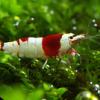 1 pointAs I saw them first by a german breeder I was totally surprised. Never seen somthing like this before. He has one of the best breedinglines in Germany. Now I am lucky that 12 of these shrimp are moved about two months ago in my tank. I'm waiting for offspring. But this will take time. They are still too young. Greetings Lars Finally, a few impressions:1 point