
Leaderboard
-

Squiggle
Members5Points10433Posts -
Disciple
Platinum Members3Points2092Posts -

OzShrimp
Members3Points4102Posts -

wot_fan
Members2Points194Posts
Popular Content
Showing content with the highest reputation on 01/30/15 in Posts
-
2 pointsCardboard packaging is always better than what's inside, can make a fort with boxes & guns & swords with tubes!2 points
-
1 pointEveryone knows the best material is aluminium foil cause it stops the government from listening to your thoughts whilst your playing!1 point
-
 1 pointSorry it's taken so long but I've finally got some time to do an update on how my RCS with the nasty bacterial infection are going. I found an article on treating diseased freshwater prawns with Levimisole HCL and noticed the bacteria they were using in the study were from the same family/genius? as in this thread, when I was searching the net for any info that might help combat the infection quicker than just water changes. Here's the link http://www.sciencepub.net/researcher/research0303/13_4867research0303_82_85.pdffor any one interested. I have Levimiasole HCL at home from when I had guppys infected with Camalanus Worm so I decided to give it a go. It's not pure form HCL as that's very expensive, but a product called Big L's pig and poultry wormer. Levimiasole HCL is the active ingredient in it and it can be brought on line or from some livestock produce supply stores. The starter dose is 1ml per 7 litres of aquarium waster. Within 48 hours of the first dose all clinical signs of the bacterial infection had disappeared and shrimp deaths from it stopped. You can dose with Levimiasole HCL every 48 hours and can triple the dose in stubborn cases as well. I was lucky and it only infected the one tank with RCS &Chameleons. I don't know how CRS, Mishlings, TB's or other shrimp might be affected by the use of Levimiasole HCL. Hope others might find this helpful, but a UV filter would most likely stop it from ever happening1 point
 -
 1 point1 point
1 pointdont hate the playa hate the game! its ok mate I can post you the cardboard cylinder and i'll even leave the boss aquaria sticker on it. SKF love!1 point
1 point1 point
1 pointdont hate the playa hate the game! its ok mate I can post you the cardboard cylinder and i'll even leave the boss aquaria sticker on it. SKF love!1 point 1 pointI just received a cardboard tube from Boss as well. Thanks Jay! About to start making a sword with it; have boxes stockpiled for the fort.1 point
1 pointI didn't use all the pieces I purchased from her. I will try some in another tank. Thanks.1 point
1 point
1 point
1 pointI just received a cardboard tube from Boss as well. Thanks Jay! About to start making a sword with it; have boxes stockpiled for the fort.1 point
1 pointI didn't use all the pieces I purchased from her. I will try some in another tank. Thanks.1 point
1 point
1 point 1 pointHi all, Recently, I did some testing on buce for about 2 month to find out what will be the best method to accelerate the grow. Hence, I would like to share some of my findings (initially I wanted to post on my blog but my blog is under-maintenance). Lighting - Buce prefers much higher lighting than anubias. However, if you keep them at very low light, it will survive and colour up but not growing much. The colouring up includes turning the emerged-grown leaves into submerge colour. But when you turn up the lighting to medium intensity (similar to the intensity for growing Staurogyne Repens) and does not inject CO2, the growth and colouring up stop. Once you inject CO2 the, the growth and colouring accelerated much faster. But it will concentrate on growing new submerge leaves instead of colouring up the old emerged-grown leaves. As such, I conclude the best lighting will be medium-low. If you planning to use stronger intensity, Otocinclus is must. Or else, the buce will be covered by diatom. Another interesting part of lighting is that when the plant receive sufficient lighting, they will grow leaves at the bottom instead of the top. Hence if you plant them into substrate at bright area and when you see them never grow any new leaves, use the twister and lift them up a little. You will see tons of leaves growing below. You may need to do this once in awhile. Before you do this, make sure there are some roots that attached to the substrate. CO2 - Tested from 5ppm to 40ppm and there is no significant differences. The key factor is as long as you inject CO2. Just a tiny bit at 5ppm will be good enough. NO3 - Tested from 5ppm to 25ppm and there is not really significant differences (I increase CO2 and lighting intensity when I increase NO3). However if the NO3 is below 5 and below and when lighting is strong, the leaves will turn yellow and diatom will form. As such, I will recommend maintain the NO3 at 10ppm (provided your pH is above 5.8). PO4 - All my tanks are consistently with 0.75 to 1ppm of PO4. Hence, I can't tell from my experiment whether they will affect buce or not. Trace Fertiliser - They love trace fert. The more you dose, the better the colour and the thicker and rubber the leaves. This makes me suspect the logic for them not growing new leaves fast. I think they have priority on using energy and nutrients to improve existing leaves, instead of growing new leaves like most plants. Best Way to Propagate - Trim them as often as possible. Once they grow to a decent height, they will grow very dense leaves. Once this happens, it is almost impossible to cut at their rhizome. For a new plant you bought, if the rhizome is long, cut them to small multiple leaves. A 2 to 4 leaves new plant grows best initially. If the rhizome has cut and the leaves are little, they will grow many leaves at one time. I did an experiment by taking a long rhizome with 2 leaves and use pen knife and do multiple cuts. End up, I get like 8 leaves growing at the same time (even in non-CO2 injected tank). Planting Area - The roots and rhizome loves substrate. Hence, they grow even much faster if you plant them into rich substrate (this is align with my finding on they love trace nutrients). The rhizome will not rot like Anubias. As such, Buce could be plant almost every where you like, except area that is high up and next to the lighting. Temperature - Tested 26C and 30C and they are doing just fine. Many claims that they melt at high temperature. I think this got to do with nutrients level, which is the same as lighting intensity. Higher temperature will have higher metabolic rate that may have the same effect as high light intensity. If sufficient nutrients (including CO2) are provided and lighting intensity is not too strong, don't worry about the leaves melting. They will grow back later on. Personally, I prefer them to melt away all the emerge-grown leaves and grow out the smaller, rubbery, thick and colour leaves. But there is one annoying thing you need to take note (not much people observed). Buce's young leaves are tender and tasty. Shrimp and Otocinclus love to much them. If you are keeping buce with them, make sure they are well fed. Or else, you will find your buce leaves start to have bit and pieces being bitten off. Hope these information help. ;)1 point
 No it wasn't missed. I noticed it too. Adding it to the sticky thread will be a big boost to the database. Don't forget to also tell us where to buy Levamisole HCL.1 point
Sorry I missed this thread, I have done extensive comparisons between my mineral powder & the Benibachi Mironecton & there is very little difference. As jayc mentioned, there is a slight TDS rise but very little & not enough to affect the TDS level in a negative way.1 point
No it wasn't missed. I noticed it too. Adding it to the sticky thread will be a big boost to the database. Don't forget to also tell us where to buy Levamisole HCL.1 point
Sorry I missed this thread, I have done extensive comparisons between my mineral powder & the Benibachi Mironecton & there is very little difference. As jayc mentioned, there is a slight TDS rise but very little & not enough to affect the TDS level in a negative way.1 point 1 pointId also boil Afew almond leaves and make a concentrate almond leave tea and add it in little bits to ur whole system I'd also add alittle bit of internal parasite clear just Incase it helps the shrimp1 point
1 point
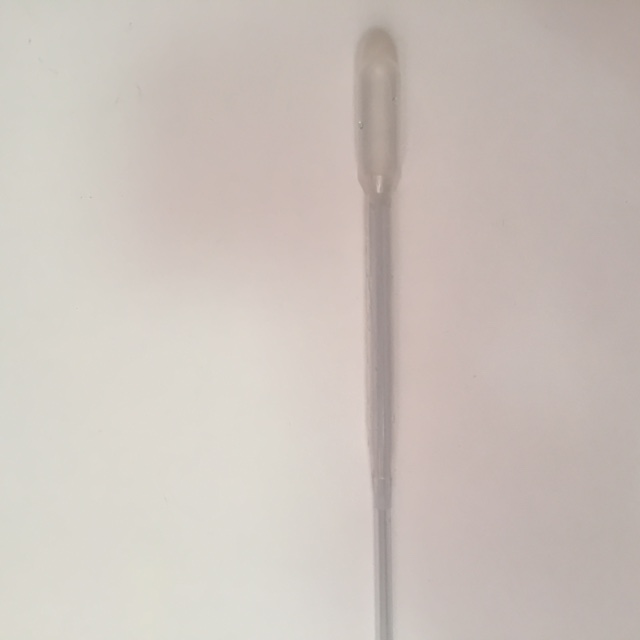
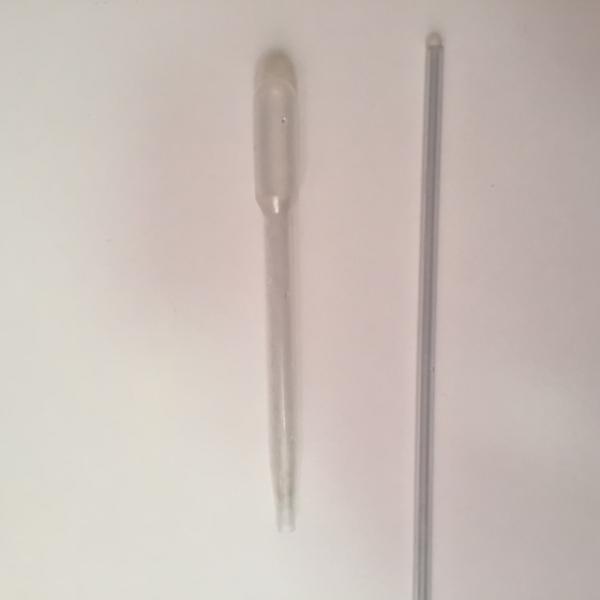
1 pointHi buck & jenbenwren, That feeding tool is made of a snipped disposable pipette and a PP tube. The disposable pipette is acting a a bulb pump. Below are the picture of that tool:
1 pointId also boil Afew almond leaves and make a concentrate almond leave tea and add it in little bits to ur whole system I'd also add alittle bit of internal parasite clear just Incase it helps the shrimp1 point
1 point
1 pointHi buck & jenbenwren, That feeding tool is made of a snipped disposable pipette and a PP tube. The disposable pipette is acting a a bulb pump. Below are the picture of that tool: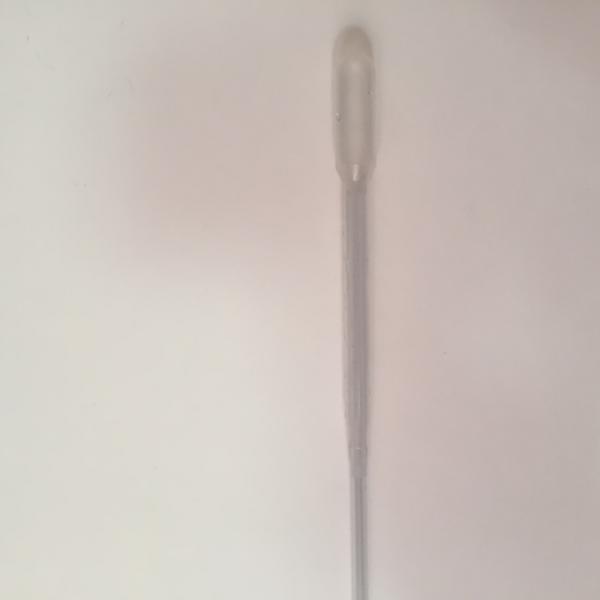
 1 point
@Jenbenwren Thanks. I am anxious to get shrimp but I will be happy if my tank is fully cycled at the 6 week mark. I have read several posts on different forums by people whose cycles aren't finished at the 2 and even 3 month mark. Day 6 1/3 The gentleman I bought the moss from sent a lot more than I was expecting. I put the extra on tiles. Depending on how it grows in this tank, it may be temporary. I also added sponge filters on the intakes of the HOBs. I noticed that there is something white and fluffy on the spider wood. Based on what I have read, this is not uncommon. It is a fungus that will die off on its own as it is outcompeted by bacteria. You can see it in the second picture below. Am I correct that this is nothing to worry about? Other than that, not much has changed. I did another 50% water change. Water parameter before WC TDS: 140ppm Temp: 78.1°F GH: 8 KH: 0-1 PH: 6.4 Ammonia: 0.5ppm Nitrite: 0ppm1 point
Have you got one of those big square fish nets? When i moved house i used one of those to scoop up the substrate, quiet easy to do :) and quick1 point
Feel free to create a topic Matuva nad post your WC's and we will be sure to help you out with diagnosing problems:)1 point
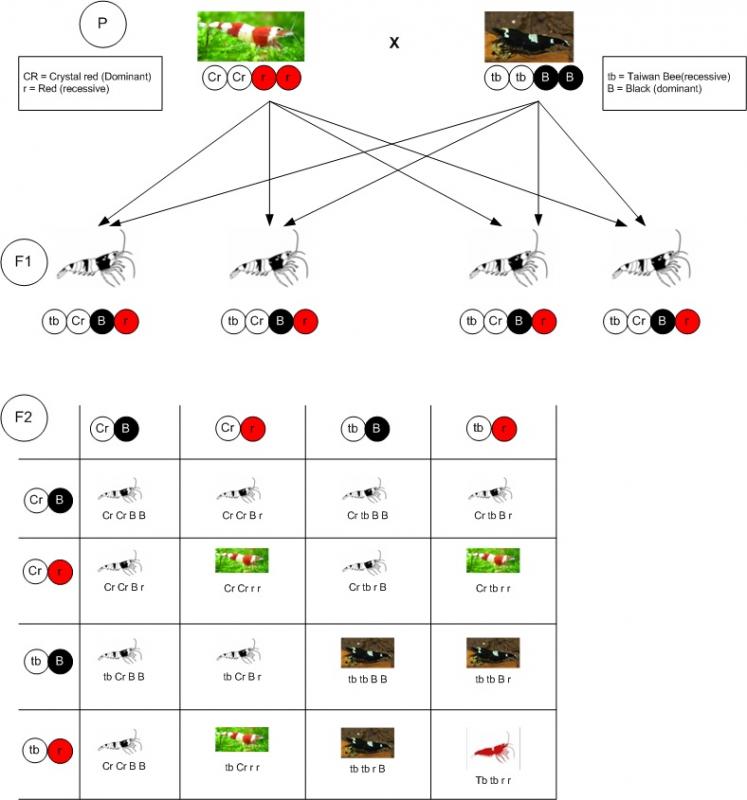
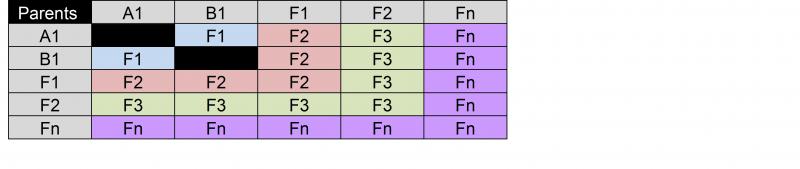
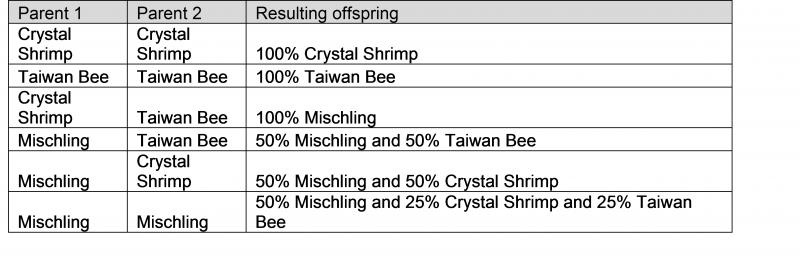
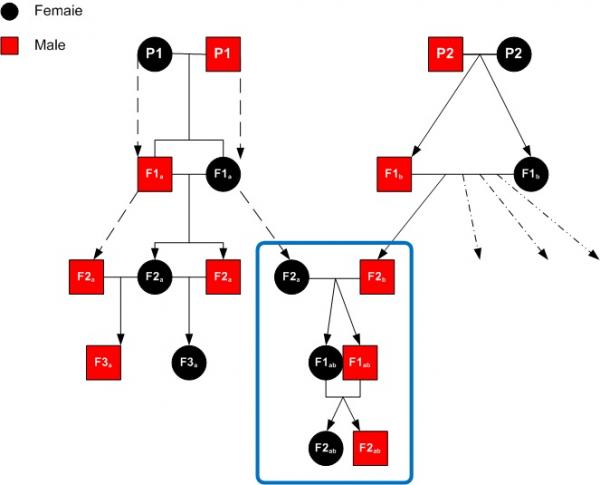
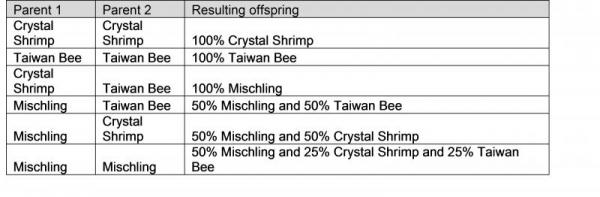
Genetic Linkage from Mendel's Laws To begin defining the F1, F2, F3, etc terminology, we need to cover some basics in genetics and inheritance. Using Gregor Mendel's Law of inheritance, let's observe how genetic traits are handed down from parents to offspring. We will concentrate on the simplified traits of shrimp variants and colour traits (or phenotype) only, which will be easier for everyone to understand. A simplified view of what you would get crossing a Taiwan Bee and Crystal Shrimp. Over simplified Mendel's Law applied to Bee shrimps (click to expand). Of course it is never that simple and it doesn't mean you are guaranteed a % of either offspring. A more detailed result of Mendelian inheritance including the Law of Dominance applied to a Taiwan Bee and Crystal Shrimp is as per this picture I drew up below. (Click to expand) Notice in the F1 generation, the Black trait is dominant, all the resulting offspring look black, but they still carry the recessive red gene. Let's see what happens in the F2 generation. When the F1 generation mate with each other, we see the results in the F2 table above. Notice we get many more Black Crystal shrimp, than Red Crystals. We also have a smaller possibility of getting Black Taiwan Bees. And an even smaller chance of getting a Red Taiwan Bee. So in this example, we have 1 in 16 chance per egg of getting a Red Taiwan Bee. 3 in 16 chance per egg of getting a Black Taiwan Bee. 3 in 16 chance per egg of getting a Crystal Red. 9 in 16 chance per egg of getting a Crystal Black. The F3 generation will dilute the possibilities again of getting a recessive trait. Let's assume you are aiming for that Red Taiwan Bee in the example above. The chances are 1 in 16 or a 6.25% that the right allele (or colour trait) is passed on. Notice I said "per egg". If the shrimp is carrying 16 eggs, it doesn't mean you will get at least 1 Red TB !! This is where the practice of culling is used to keep the variation in dominant and recessive traits to a minimum to achieve a certain result. There are no guarantees with nature. Even when you think you have the Blue genes breeding true in your colony of shrimps, a Red gene could pop up by chance even after 4 generations of Blues. The Blue gene might be dominant, but when two shrimps with the red recessive gene get together by chance ... nature has spun you a curve ball. What is Filial F1, F2, F3, etc ? F1 stands for Filial 1 (or first filial). Filial is a word used to describe sons and daughters, and it means the first generation from a genetic cross between parents. For example, it can be used to describe fish that are first generation from wild parents (ie. the fry have come from wild caught fish), so it's seen as an indication of genetic quality. Definition: the offspring of a genetically specified mating: first filial generation (symbol F1), the offspring of parents of contrasting genotypes; second filial generation (F2), the offspring of two F1 individuals; third filial generation (F3), fourth filial generation (F4), etc., the offspring in succeeding generations of continued inbreeding of F1 descendents. So an F2 would be the 2nd generation from the original parents you are counting from. This could be from the F1 mating with the Original parents or between two F1 siblings. As long as it involves the F1 generation. An F3 would be the 3rd generation. This could be from the F2 mating with the Original parents or between two F2 siblings. As long as it involves the F2 generation. And so forth for F4, F5, etc (Click to expand) A1 Original Male B1 Original Female Fn Offspring Filial number The moment you introduce an individual from a different Parent (and thus genealogy), you can't continue counting the Filial number. So while an F4 Tibee with Parents (A) X another F4 Tibee of a different Parents (B) still produces a Tibee, it is no longer an F4 Tibee. The offspring of two different F4 individuals has different genetics (A & B) now and has to be an F1 again. IF you get two related brother and sister F4 Tibees who share the same P (initial parents), then yes ... it's offspring will be an F5 Tibee. (Click to expand) From a practical point of view, another thing Filial numbers are used for is to determine how stable the genes are in a certain specimen. For example, if you are looking for CRS, then an F8 CRS is going to be more desirable than an F1 CRS. The F8 CRS has more stable genes, than an F1 CRS which might have been an offspring from a mischling or taiwan bee shrimp. And would be closer to being a candidate for a Pure Red Line programme. Thus the F1 CRS is not as "pure" bred as an F8. But on the other hand, it could also be an indication of how far it is from the desirable genetics. Like in the case of fish, an F1 Apistogramma or Discus might be more desirable than an F9 fish. Since the F1 offspring are direct descendants of wild caught fish. And if the breeding stock is small, and offsprings keep breeding with each other, then the F5 generation will have a very small gene pool diversity from it's original parents. <-- not good. Since it will be an increased risk of genetic defects/disorders.
1 point
1 point@Jenbenwren Thanks. I am anxious to get shrimp but I will be happy if my tank is fully cycled at the 6 week mark. I have read several posts on different forums by people whose cycles aren't finished at the 2 and even 3 month mark. Day 6 1/3 The gentleman I bought the moss from sent a lot more than I was expecting. I put the extra on tiles. Depending on how it grows in this tank, it may be temporary. I also added sponge filters on the intakes of the HOBs. I noticed that there is something white and fluffy on the spider wood. Based on what I have read, this is not uncommon. It is a fungus that will die off on its own as it is outcompeted by bacteria. You can see it in the second picture below. Am I correct that this is nothing to worry about? Other than that, not much has changed. I did another 50% water change. Water parameter before WC TDS: 140ppm Temp: 78.1°F GH: 8 KH: 0-1 PH: 6.4 Ammonia: 0.5ppm Nitrite: 0ppm1 point
Have you got one of those big square fish nets? When i moved house i used one of those to scoop up the substrate, quiet easy to do :) and quick1 point
Feel free to create a topic Matuva nad post your WC's and we will be sure to help you out with diagnosing problems:)1 point
Genetic Linkage from Mendel's Laws To begin defining the F1, F2, F3, etc terminology, we need to cover some basics in genetics and inheritance. Using Gregor Mendel's Law of inheritance, let's observe how genetic traits are handed down from parents to offspring. We will concentrate on the simplified traits of shrimp variants and colour traits (or phenotype) only, which will be easier for everyone to understand. A simplified view of what you would get crossing a Taiwan Bee and Crystal Shrimp. Over simplified Mendel's Law applied to Bee shrimps (click to expand). Of course it is never that simple and it doesn't mean you are guaranteed a % of either offspring. A more detailed result of Mendelian inheritance including the Law of Dominance applied to a Taiwan Bee and Crystal Shrimp is as per this picture I drew up below. (Click to expand) Notice in the F1 generation, the Black trait is dominant, all the resulting offspring look black, but they still carry the recessive red gene. Let's see what happens in the F2 generation. When the F1 generation mate with each other, we see the results in the F2 table above. Notice we get many more Black Crystal shrimp, than Red Crystals. We also have a smaller possibility of getting Black Taiwan Bees. And an even smaller chance of getting a Red Taiwan Bee. So in this example, we have 1 in 16 chance per egg of getting a Red Taiwan Bee. 3 in 16 chance per egg of getting a Black Taiwan Bee. 3 in 16 chance per egg of getting a Crystal Red. 9 in 16 chance per egg of getting a Crystal Black. The F3 generation will dilute the possibilities again of getting a recessive trait. Let's assume you are aiming for that Red Taiwan Bee in the example above. The chances are 1 in 16 or a 6.25% that the right allele (or colour trait) is passed on. Notice I said "per egg". If the shrimp is carrying 16 eggs, it doesn't mean you will get at least 1 Red TB !! This is where the practice of culling is used to keep the variation in dominant and recessive traits to a minimum to achieve a certain result. There are no guarantees with nature. Even when you think you have the Blue genes breeding true in your colony of shrimps, a Red gene could pop up by chance even after 4 generations of Blues. The Blue gene might be dominant, but when two shrimps with the red recessive gene get together by chance ... nature has spun you a curve ball. What is Filial F1, F2, F3, etc ? F1 stands for Filial 1 (or first filial). Filial is a word used to describe sons and daughters, and it means the first generation from a genetic cross between parents. For example, it can be used to describe fish that are first generation from wild parents (ie. the fry have come from wild caught fish), so it's seen as an indication of genetic quality. Definition: the offspring of a genetically specified mating: first filial generation (symbol F1), the offspring of parents of contrasting genotypes; second filial generation (F2), the offspring of two F1 individuals; third filial generation (F3), fourth filial generation (F4), etc., the offspring in succeeding generations of continued inbreeding of F1 descendents. So an F2 would be the 2nd generation from the original parents you are counting from. This could be from the F1 mating with the Original parents or between two F1 siblings. As long as it involves the F1 generation. An F3 would be the 3rd generation. This could be from the F2 mating with the Original parents or between two F2 siblings. As long as it involves the F2 generation. And so forth for F4, F5, etc (Click to expand) A1 Original Male B1 Original Female Fn Offspring Filial number The moment you introduce an individual from a different Parent (and thus genealogy), you can't continue counting the Filial number. So while an F4 Tibee with Parents (A) X another F4 Tibee of a different Parents (B) still produces a Tibee, it is no longer an F4 Tibee. The offspring of two different F4 individuals has different genetics (A & B) now and has to be an F1 again. IF you get two related brother and sister F4 Tibees who share the same P (initial parents), then yes ... it's offspring will be an F5 Tibee. (Click to expand) From a practical point of view, another thing Filial numbers are used for is to determine how stable the genes are in a certain specimen. For example, if you are looking for CRS, then an F8 CRS is going to be more desirable than an F1 CRS. The F8 CRS has more stable genes, than an F1 CRS which might have been an offspring from a mischling or taiwan bee shrimp. And would be closer to being a candidate for a Pure Red Line programme. Thus the F1 CRS is not as "pure" bred as an F8. But on the other hand, it could also be an indication of how far it is from the desirable genetics. Like in the case of fish, an F1 Apistogramma or Discus might be more desirable than an F9 fish. Since the F1 offspring are direct descendants of wild caught fish. And if the breeding stock is small, and offsprings keep breeding with each other, then the F5 generation will have a very small gene pool diversity from it's original parents. <-- not good. Since it will be an increased risk of genetic defects/disorders.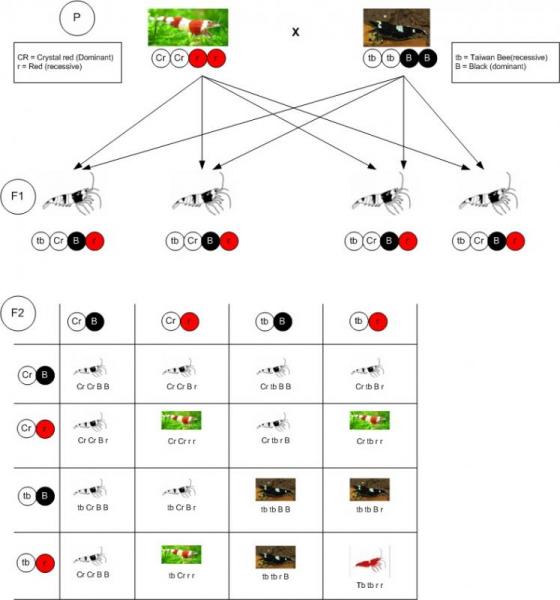

 1 point
 1 pointIm thinking your mischlings have some tiger blood in them or it crossed with a tiger/tibee, making that what looks like a lil TiBee1 point