
Leaderboard
-
Shrimpy Daddy
Premium Members7Points388Posts -

newbreed
Members5Points3152Posts -
fishmosy
Members2Points4594Posts -

Shrimpeee
Members2Points19Posts
Popular Content
Showing content with the highest reputation on 12/15/14 in Posts
-
3 pointsI think everyone should do due diligent to check the source, and get shrimp and/ or plants from respectable sources. ;)3 points
-
Hi all, I wrapped up my work early today. Hence, I setup my camera and managed to take some nice picture of my Japanese Red Bee shrimps. As such, I will like to share with everyone to cheer up your weekend. ^^ Cheers. Shrimpy Daddy1 point
-
Not sure posting external link will violate the forum rule. I will PM you instead. ^^1 point
-
 Thanks Techden, For all the prizes so far and looking forward to make a order from your store soon.1 point
 -
Thanks for giving us a reason to have the comps in the first place!!!! It's been good to see the participation is increasing as the week progresses!! Hope lots are getting photo for tomorrows comp!! http://shrimpkeepersforum.com/forum/index.php/photorating/competition/4-12-days-of-shrimpmas-challenge-4/1 point
-
1 point
-
 1 pointOh where do we start???? I actually don't envy you with the choices you have . there are so many beautiful shrimp out there that we can't get where would we even start. I will be very interested to see what you end up with. Maybe you can put up some pictures of your choices then we can help you decide! Good luck and happy shrimping. :-)1 point
 -
 1 point
 -
OK, as per the rules, there are quite a few numbers left. So anyone who wishes to select a second number for the draw, go for it. The Numbers selected so far are as follows: 5, 7, 8, 15, 18, 21, 24, 32, 40, 43, 45 Someone's gotta win it!!! Good luck everyone!!1 point
-
1 pointDo you import them or grow them yourself? If you grow them, whats do you find is the best way to grow them? Emerse or submerse? Temperature? pH? ect.1 point
-
This challenge is now Closed!! The correct locations of the Christmas Shrimp images are as follows: http://shrimpkeepers...feeding/kale-r4 http://shrimpkeepers...-substrates-r15 http://shrimpkeepers...on-planaria-r33 http://shrimpkeepers...aridina-cant-r2 http://shrimpkeepers...6#commentsStart http://shrimpkeepers...9#commentsStart http://shrimpkeepers...5#commentsStart http://shrimpkeepers...ffle-shrimp-r21 It is worth checking them out, in case we have a similar comp and you want to know how craftily they can be hidden!! :) And while you're there, its worth having a look through the library occasionally, as we have some wonderful useful information stored here. Thanks to all participants.1 point
-
 1 point
 -
Just in case anyone would like to know about how these photos were taken, below are the list of my gears, setup and configuration. Equipment List Camera: Fujifilm X-T1 Lens: Carl Zeiss Touit 2.8/50M Tripod/ Ballhead: Gitzo Traveler Series 1 6x Carbon tripod and Really Right Stuff BH-40 ballhead Remote Shutter Release: None. Using camera built-in shutter release. Flash Light: 2 x Fujifilm EF-42 Flashlight Remote Flash Release: 2 x wireless flash release receiver and 1 x wireless flash transmitter Flash Clamp: 2 x Manfrotto clamp + Joby Flash clamp combo Equipment Configuration Camera/ Lens: ISO: 200 Shutter Speed: 1/125s Aperture: F3.6 to 5.0 Flash: Power: 1/32 Diffuser: Double diffuser (built in diffuser and small bounce diffuser). This will minimise hotspot and light piercing through the shell of shrimp. Equipment Setup Camera Placement: 50 to 70cm from camera sensor to subject (to achieve DoF that could cover half to whole shrimp) Flash Placement: Have a nice weekend. ^^ Shrimpy Daddy1 point
-
Whatever I am going to tell you, you may not believe it. LOL!!! In Japan, we don't really go for pattern. We just go for colour. The Saber Tooth pattern shrimp usually will have the best and purest gene. This is due to much lesser cross-breeding and/or in-breeding. In recent years, all the gold medalists in shrimp competition are Saber Tooth pattern. The PRL currently in the market are originate from JRB. The Taiwanese use the JRB to cross-breed with their shrimps to create those PRL we see today. After that they sold it to the mass market in EU and US. Hence, it is no surprise your Saber Tooth pattern shrimp still carry JRB's colouration. For my that Saber Tooth patter shrimp, another affecting pattern is that she is about to breed. This is why her colour is more intensified. Ah... I remember something that I wanted to let you know but always forgotten to. When you are culling/breeding PRL, do note that those with ivory colour (not yellow but more like very pale cream colour) carries more of the original gene. The whiter it is, the more Taiwan Bee gene it has. If you keep breeding all the ivory colour shrimp together, you will get more red legs than white legs shrimp.1 point
-
 1 pointGood to hear! I will try to keep up and post on a weekly basis As promised this time: leg coloration This is for me one of the most important quality characteristics to aim for. Because without colored legs it's not complete for me. I can divide it in three groups: - Full red legs - Top part white legs - Top part white, bottom part red I've seen a lot of full red legs, but I've never see full white legs. And I've never seen top part red and bottom part white. If you got a picture of these, feel free to post or drop me a link. The leg coloration develops when the shrimp gets older. The white is visible form very young age. Just a few weeks old, you already can see the white on the legs. The red is different. It takes about 6 month to develop full thickness. According to my experience it keeps getting better when the shrimp grows older. Examples: Just a little leg coloration Red leg coloration (not the best example, but will do for now) update: ShrimpyDaddy came to help and send me a nice picture of a piece with full colored red legs, great example: White leg coloration The most desired coloration of the legs for me is without a doubt the Top part white and the bottom part nice and deep red. This one of my shrimp match the most according to this description: But still I feel I have a long way to go before I'm satisfied about the leg coloration. I'll keep selection and searching for ways to improve this part. Leg coloration also has something to do with the body pattern. I've noticed that Smiley pattern shrimp has white legs, but hardly no red in it. While shrimp with a Hinnomaru pattern have much more red in their legs than other shrimp. It will take more time to come up with a final conclusion about this observation. Next time I want to show you something about: antenna coloration. Seems to be a small part, but it has huge impact on the overall appearance of the PRL shrimp!1 point
 -
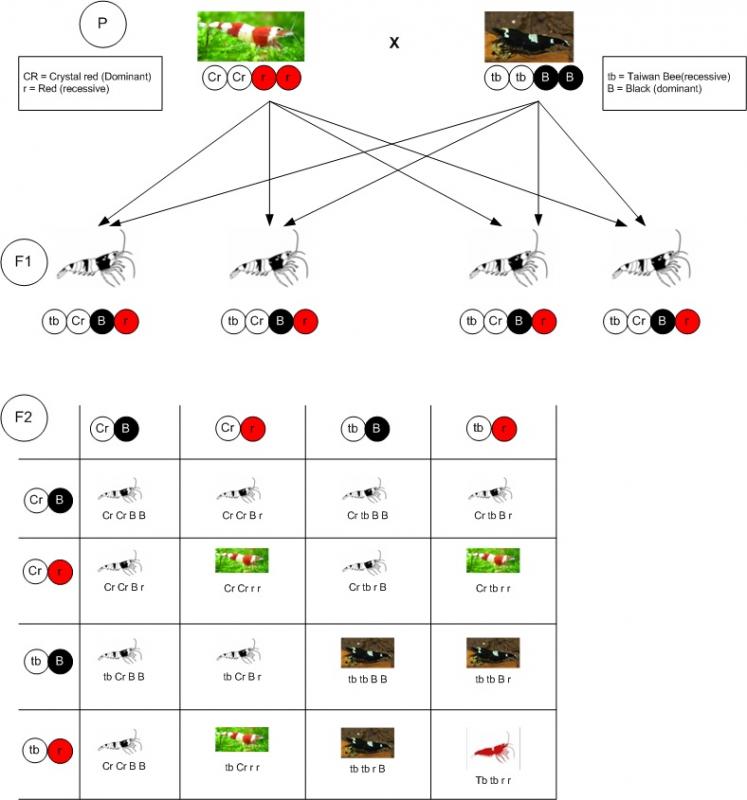
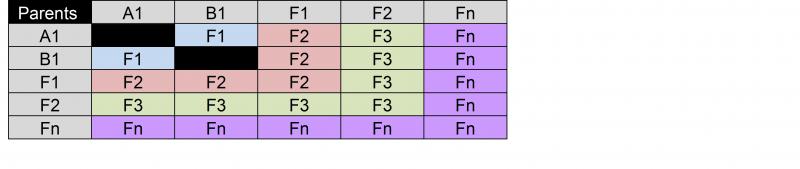
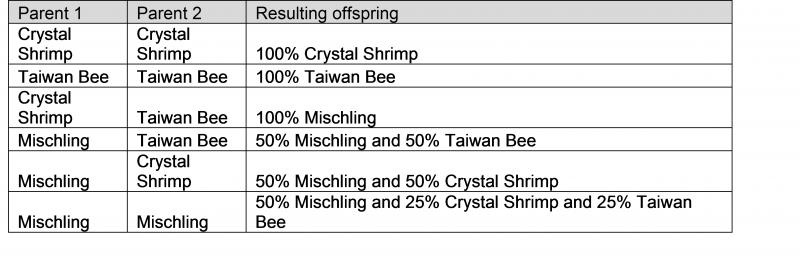
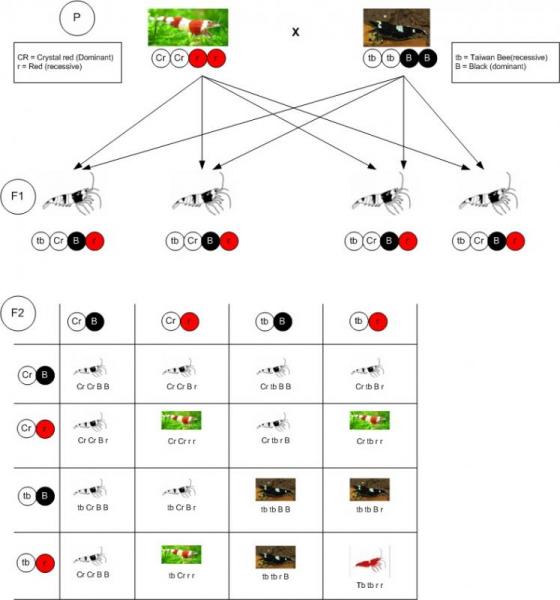
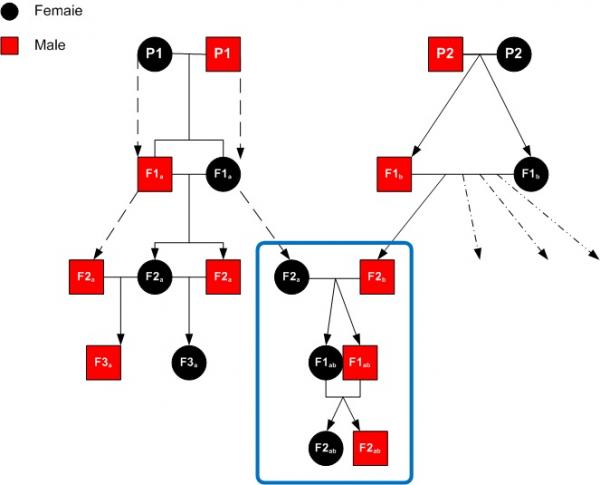
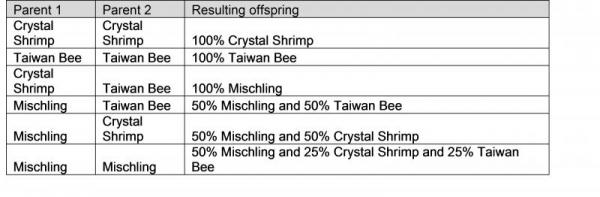
Genetic Linkage from Mendel's Laws To begin defining the F1, F2, F3, etc terminology, we need to cover some basics in genetics and inheritance. Using Gregor Mendel's Law of inheritance, let's observe how genetic traits are handed down from parents to offspring. We will concentrate on the simplified traits of shrimp variants and colour traits (or phenotype) only, which will be easier for everyone to understand. A simplified view of what you would get crossing a Taiwan Bee and Crystal Shrimp. Over simplified Mendel's Law applied to Bee shrimps (click to expand). Of course it is never that simple and it doesn't mean you are guaranteed a % of either offspring. A more detailed result of Mendelian inheritance including the Law of Dominance applied to a Taiwan Bee and Crystal Shrimp is as per this picture I drew up below. (Click to expand) Notice in the F1 generation, the Black trait is dominant, all the resulting offspring look black, but they still carry the recessive red gene. Let's see what happens in the F2 generation. When the F1 generation mate with each other, we see the results in the F2 table above. Notice we get many more Black Crystal shrimp, than Red Crystals. We also have a smaller possibility of getting Black Taiwan Bees. And an even smaller chance of getting a Red Taiwan Bee. So in this example, we have 1 in 16 chance per egg of getting a Red Taiwan Bee. 3 in 16 chance per egg of getting a Black Taiwan Bee. 3 in 16 chance per egg of getting a Crystal Red. 9 in 16 chance per egg of getting a Crystal Black. The F3 generation will dilute the possibilities again of getting a recessive trait. Let's assume you are aiming for that Red Taiwan Bee in the example above. The chances are 1 in 16 or a 6.25% that the right allele (or colour trait) is passed on. Notice I said "per egg". If the shrimp is carrying 16 eggs, it doesn't mean you will get at least 1 Red TB !! This is where the practice of culling is used to keep the variation in dominant and recessive traits to a minimum to achieve a certain result. There are no guarantees with nature. Even when you think you have the Blue genes breeding true in your colony of shrimps, a Red gene could pop up by chance even after 4 generations of Blues. The Blue gene might be dominant, but when two shrimps with the red recessive gene get together by chance ... nature has spun you a curve ball. What is Filial F1, F2, F3, etc ? F1 stands for Filial 1 (or first filial). Filial is a word used to describe sons and daughters, and it means the first generation from a genetic cross between parents. For example, it can be used to describe fish that are first generation from wild parents (ie. the fry have come from wild caught fish), so it's seen as an indication of genetic quality. Definition: the offspring of a genetically specified mating: first filial generation (symbol F1), the offspring of parents of contrasting genotypes; second filial generation (F2), the offspring of two F1 individuals; third filial generation (F3), fourth filial generation (F4), etc., the offspring in succeeding generations of continued inbreeding of F1 descendents. So an F2 would be the 2nd generation from the original parents you are counting from. This could be from the F1 mating with the Original parents or between two F1 siblings. As long as it involves the F1 generation. An F3 would be the 3rd generation. This could be from the F2 mating with the Original parents or between two F2 siblings. As long as it involves the F2 generation. And so forth for F4, F5, etc (Click to expand) A1 Original Male B1 Original Female Fn Offspring Filial number The moment you introduce an individual from a different Parent (and thus genealogy), you can't continue counting the Filial number. So while an F4 Tibee with Parents (A) X another F4 Tibee of a different Parents (B) still produces a Tibee, it is no longer an F4 Tibee. The offspring of two different F4 individuals has different genetics (A & B) now and has to be an F1 again. IF you get two related brother and sister F4 Tibees who share the same P (initial parents), then yes ... it's offspring will be an F5 Tibee. (Click to expand) From a practical point of view, another thing Filial numbers are used for is to determine how stable the genes are in a certain specimen. For example, if you are looking for CRS, then an F8 CRS is going to be more desirable than an F1 CRS. The F8 CRS has more stable genes, than an F1 CRS which might have been an offspring from a mischling or taiwan bee shrimp. And would be closer to being a candidate for a Pure Red Line programme. Thus the F1 CRS is not as "pure" bred as an F8. But on the other hand, it could also be an indication of how far it is from the desirable genetics. Like in the case of fish, an F1 Apistogramma or Discus might be more desirable than an F9 fish. Since the F1 offspring are direct descendants of wild caught fish. And if the breeding stock is small, and offsprings keep breeding with each other, then the F5 generation will have a very small gene pool diversity from it's original parents. <-- not good. Since it will be an increased risk of genetic defects/disorders.

 1 point