
Leaderboard
-

jayc
Moderators6Points6248Posts -
NoGi
HOF Member5Points5858Posts -

szentgyo
Members1Points5Posts -

petfish
Members1Points315Posts
Popular Content
Showing content with the highest reputation on 10/03/14 in Posts
-
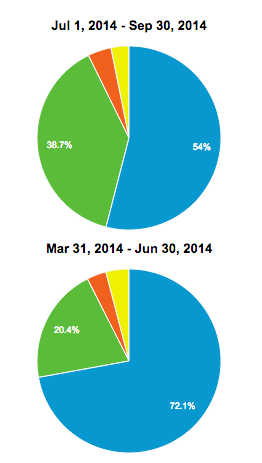
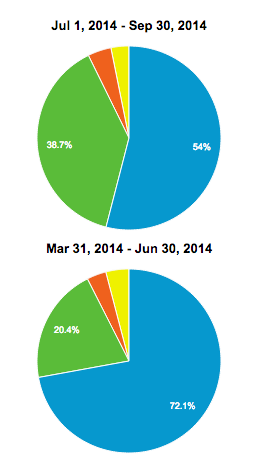
5 pointsWith around 12 weekends to go until Christmas, it's probably a good time for the next SKF quarterly update. Forum Upgrade A fair bit of work is happening in the background by the forum software developers on the next version of forum software. A lot of enhancements are being included and the new version has been rebuilt from the ground up to be a lot more responsive for all platforms. In layman's terms, this means a much better experience for those of you that also use your iPhones/iPads or Android tablets to access the site. To better inform our community, I've created a forum dedicated to the next upgrade. In that forum I've already posted some videos and details around a test\demo site. The following threads might be of interest to you: Video Examples of Next Upgrade Demo SKF Site SKF Marketplace This has been a regular topic of discussion from the change to Classifieds and then to the new Marketplace. I've listened to all the feedback and have reverted the Marketplace back to the original format where you can post directly to the forums instead of needing to use the Marketplace app. I'll be decommissioning the app shortly. Image Restrictions Upload restrictions have been at 2MB for sometime now. With newer phones and cameras supporting higher resolutions, a lot of photo's being taken are over this limit causing members to have issues in uploading. I've temporally increased this limit to trial larger image uploads with a view to eventually allow this for SKF subscribers only. Larger uploads equates to requiring more space in the backend to support their storage hence limiting to subscribers only. For the moment, everyone can enjoy the additional quota. Opening up the Site Visitor traffic to the site via organic search (e.g. Google) continues to grow. This quarter saw an increase to 38.7%, up from 20.4% from the previous period. This has translated to an increase in overseas members joining the ranks which is great to see. Traffic from social media remains low at under 5% and will be an ongoing area of focus. Referral Program A referral program is now in place to facilitate word-of-mouth registrations. For more information, have a read through this thread. SKF Library The library hasn't had much attention in this last quarter and I'll try to spend some time on it in the upcoming period. In the meantime, I've put a call out for anyone interested in helping out. Supporting the Site If you are interested in supporting the site consider becoming a subscription member. We currently have 3 levels of subscription: Premium - Access to classifieds via the SKF Marketplace, chatroom and up to 500 PMs Platinum - Premium benefits + up to 1,000 Pms and 5MB uploads Individual Sponsor - Platinum benefits + dedicated gallery album and own forum (if required) to promote personal non-commercial blogs, youtube channels etc... As I bring more and more features to the site, they will generally start with the subscription members first. There is also SKF Merchandise available for sale at the SKF Store.
 5 points
 -
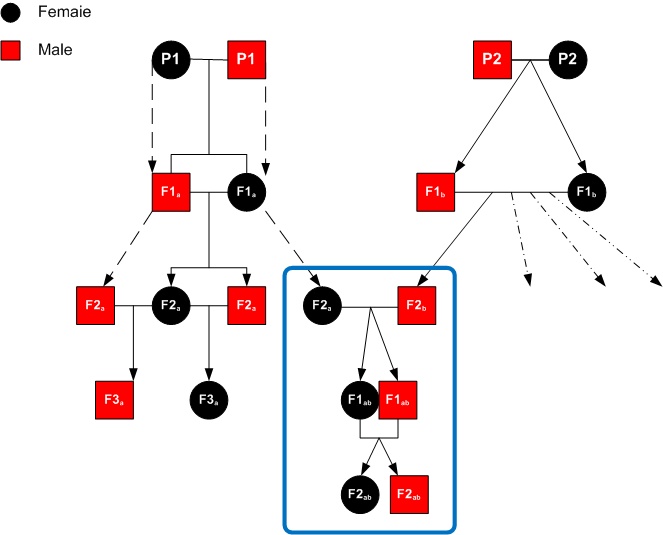
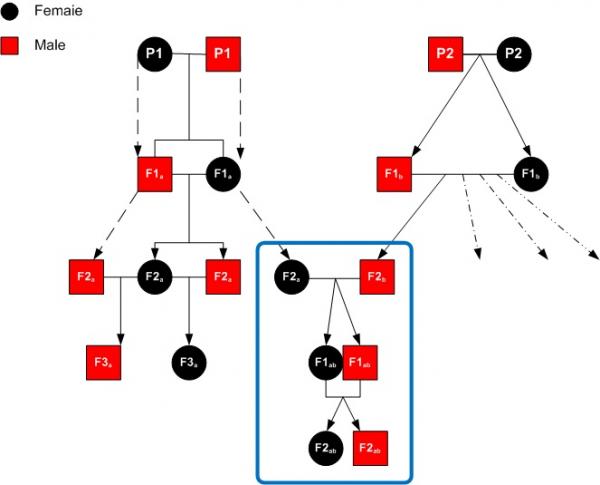
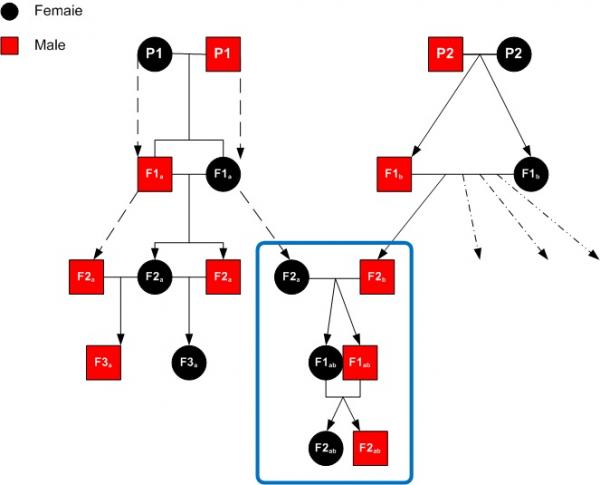
2 pointsWe need to resolve this misunderstanding of filial generation numbering. This is one definition of Filial generation: Definitions: 1. the offspring of a genetically specified mating: first filial generation (symbol F1), the offspring of parents of contrasting genotypes; second filial generation (F2), the offspring of two F1 individuals; third filial generation (F3), fourth filial generation (F4), etc., the offspring in succeeding generations of continued inbreeding of F1 descendents. Notice the word inbreeding? Here is another definition of 2nd Filial generation: Definition of F2 GENERATION : the generation produced by interbreeding individuals of an F1 generation and consisting of individuals that exhibit the result of recombination and segregation of genes controlling traits for which stocks of the P1 generation differ—called also second filial generation Again notice the word interbreeding? And another definition: Offspring generation. F1 is the first offspring or filial generation; F2 is the second; and so on. Successive generations of progeny in a controlled series of crosses, starting with two specific parents (the P generation) and selfing or intercrossing the progeny of each new (F1; F2; . . . ) generation. Again selfing or Intercrossing. You can look it up yourselves to see that - Which ever definition, which ever source, you will always get the same or similar definition. Filial generations are only counted down the line from parents (P) to offspring, and the interbreeding amongst the Parents and the brother & sister offsprings. The moment you introduce an individual from a different Parent (and thus genealogy), you can't continue counting the Filial number. So while an F4 Tibee X another F4 Tibee of a different parent produces a Tibee 100%, it is no longer an F4 Tibee. The offspring of two different F4 has different genetics now and has to be an F1 again. IF you get two related brother and sister F4 Tibees who share the same P (initial parents), then yes ... it's offspring will be an F5 Tibee. In this example above, F2 from parents a (F2a) crossed with F2 from parents b (F2b) will result in offspring F1 with common parents ab. Yes, it's the 3rd generation, and it's still the same type of shrimp as the parents P1 or P2. But it's no longer an F2 or an F3. Filial generation is not the same as a Family tree or Generational tree.
 2 points
 -
1 point
-
 1 point
 -
1 point
-
Thanks! I am not yet very familiar with this forum but i will figure out where to upload pics, for now i insert some photos here, if you do not mind.1 point
-
True. Realisation that just stating F7 , or F1 description isn't going to be enough is going to be an educational task for the hobby. In the case of selling, further history of its lineage is required. That is, a more descriptive text on generation tree is going to be needed. If people are using filial numbers wrongly, doesn't make it right to continue perpetuating the problem. If you are buying an F7 shrimp ask for a better description of its family line. If you are selling, give an accurate description.1 point
-
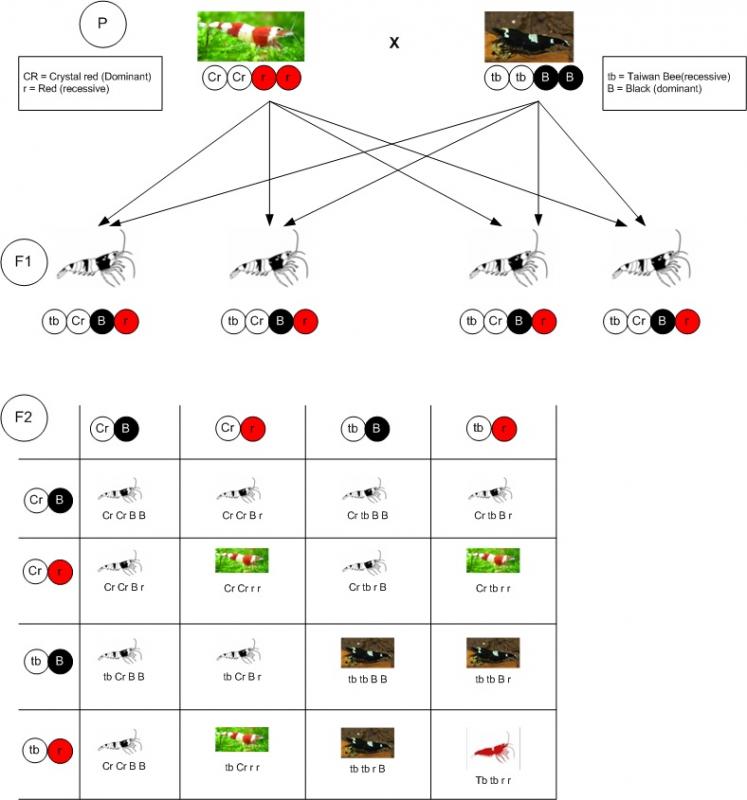
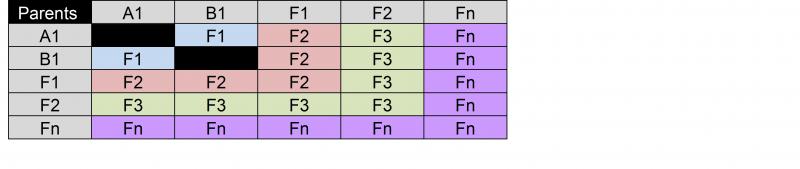
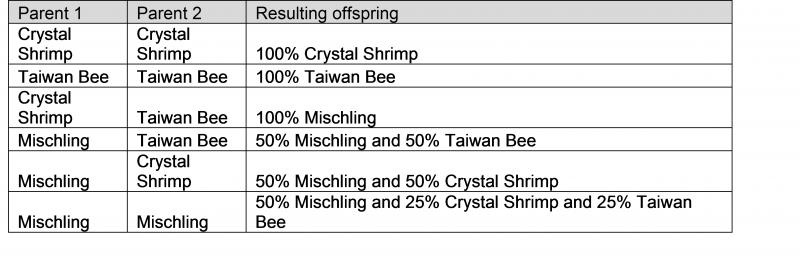
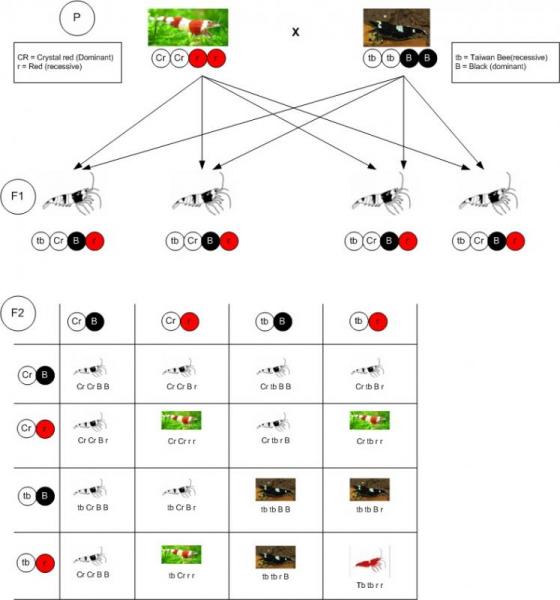
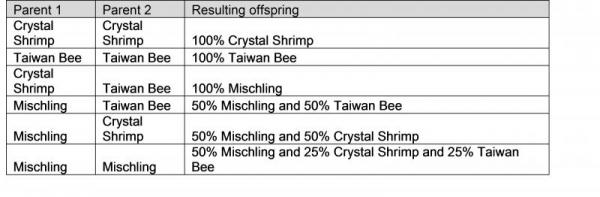
Genetic Linkage from Mendel's Laws To begin defining the F1, F2, F3, etc terminology, we need to cover some basics in genetics and inheritance. Using Gregor Mendel's Law of inheritance, let's observe how genetic traits are handed down from parents to offspring. We will concentrate on the simplified traits of shrimp variants and colour traits (or phenotype) only, which will be easier for everyone to understand. A simplified view of what you would get crossing a Taiwan Bee and Crystal Shrimp. Over simplified Mendel's Law applied to Bee shrimps (click to expand). Of course it is never that simple and it doesn't mean you are guaranteed a % of either offspring. A more detailed result of Mendelian inheritance including the Law of Dominance applied to a Taiwan Bee and Crystal Shrimp is as per this picture I drew up below. (Click to expand) Notice in the F1 generation, the Black trait is dominant, all the resulting offspring look black, but they still carry the recessive red gene. Let's see what happens in the F2 generation. When the F1 generation mate with each other, we see the results in the F2 table above. Notice we get many more Black Crystal shrimp, than Red Crystals. We also have a smaller possibility of getting Black Taiwan Bees. And an even smaller chance of getting a Red Taiwan Bee. So in this example, we have 1 in 16 chance per egg of getting a Red Taiwan Bee. 3 in 16 chance per egg of getting a Black Taiwan Bee. 3 in 16 chance per egg of getting a Crystal Red. 9 in 16 chance per egg of getting a Crystal Black. The F3 generation will dilute the possibilities again of getting a recessive trait. Let's assume you are aiming for that Red Taiwan Bee in the example above. The chances are 1 in 16 or a 6.25% that the right allele (or colour trait) is passed on. Notice I said "per egg". If the shrimp is carrying 16 eggs, it doesn't mean you will get at least 1 Red TB !! This is where the practice of culling is used to keep the variation in dominant and recessive traits to a minimum to achieve a certain result. There are no guarantees with nature. Even when you think you have the Blue genes breeding true in your colony of shrimps, a Red gene could pop up by chance even after 4 generations of Blues. The Blue gene might be dominant, but when two shrimps with the red recessive gene get together by chance ... nature has spun you a curve ball. What is Filial F1, F2, F3, etc ? F1 stands for Filial 1 (or first filial). Filial is a word used to describe sons and daughters, and it means the first generation from a genetic cross between parents. For example, it can be used to describe fish that are first generation from wild parents (ie. the fry have come from wild caught fish), so it's seen as an indication of genetic quality. Definition: the offspring of a genetically specified mating: first filial generation (symbol F1), the offspring of parents of contrasting genotypes; second filial generation (F2), the offspring of two F1 individuals; third filial generation (F3), fourth filial generation (F4), etc., the offspring in succeeding generations of continued inbreeding of F1 descendents. So an F2 would be the 2nd generation from the original parents you are counting from. This could be from the F1 mating with the Original parents or between two F1 siblings. As long as it involves the F1 generation. An F3 would be the 3rd generation. This could be from the F2 mating with the Original parents or between two F2 siblings. As long as it involves the F2 generation. And so forth for F4, F5, etc (Click to expand) A1 Original Male B1 Original Female Fn Offspring Filial number The moment you introduce an individual from a different Parent (and thus genealogy), you can't continue counting the Filial number. So while an F4 Tibee with Parents (A) X another F4 Tibee of a different Parents (B) still produces a Tibee, it is no longer an F4 Tibee. The offspring of two different F4 individuals has different genetics (A & B) now and has to be an F1 again. IF you get two related brother and sister F4 Tibees who share the same P (initial parents), then yes ... it's offspring will be an F5 Tibee. (Click to expand) From a practical point of view, another thing Filial numbers are used for is to determine how stable the genes are in a certain specimen. For example, if you are looking for CRS, then an F8 CRS is going to be more desirable than an F1 CRS. The F8 CRS has more stable genes, than an F1 CRS which might have been an offspring from a mischling or taiwan bee shrimp. And would be closer to being a candidate for a Pure Red Line programme. Thus the F1 CRS is not as "pure" bred as an F8. But on the other hand, it could also be an indication of how far it is from the desirable genetics. Like in the case of fish, an F1 Apistogramma or Discus might be more desirable than an F9 fish. Since the F1 offspring are direct descendants of wild caught fish. And if the breeding stock is small, and offsprings keep breeding with each other, then the F5 generation will have a very small gene pool diversity from it's original parents. <-- not good. Since it will be an increased risk of genetic defects/disorders.

 1 point
 -
1 point
-
 1 pointan update to my PRL project, it's been almost 4 years now of line breeding and to date. not one golden bee has been produced in a year . the culling continues but for now, i can't help but feel proud of how far these guys have come through. ENJOY!1 point